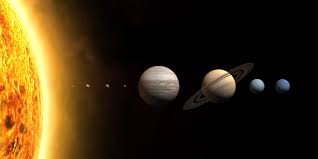
Planetary system (solar system) – it is a collection of celestial bodies – planets, their moons, dwarf planets, asteroids and comets – that orbit one or more central stars. They are gravitationally bound to each other. The Solar System, with the Earth and the Sun, is an example of such a system.
Key facts about planetary systems:
Composition: They consist of a star (or stars), planets and smaller objects (planets, dust).
Center: A star is the center around which everything orbits.
Solar System: This is our local planetary system, consisting of the Sun, 8 planets, 5 dwarf planets and billions of smaller bodies.
Exoplanets: Thousands of other planetary systems have already been discovered in our galaxy, in which planets orbit other stars.
Formation: Planetary systems are formed from gravitationally collapsing molecular clouds.
Most of the stars we see may have their own planetary systems, and their architecture is often very diverse, different from the orderly Solar System.
Four classes of planetary system architectures are distinguished as: similar, ordered, anti-ordered and mixed.
A similar planetary system (or “similar to the Solar System”) is an exoplanetary system that resembles our Solar System in terms of structure and composition. It is usually characterized by a central star similar to the Sun, the presence of rocky planets on the inner orbits and gas giants on the outer orbits, which favors the search for life.
Key features of systems similar to the Solar System:
Central star: A star similar to the Sun (spectral type G), providing stable conditions.
Structure: Rocky planets with smaller masses are located closer to the star, and massive gas giants are further away (so-called “ordered architecture”).
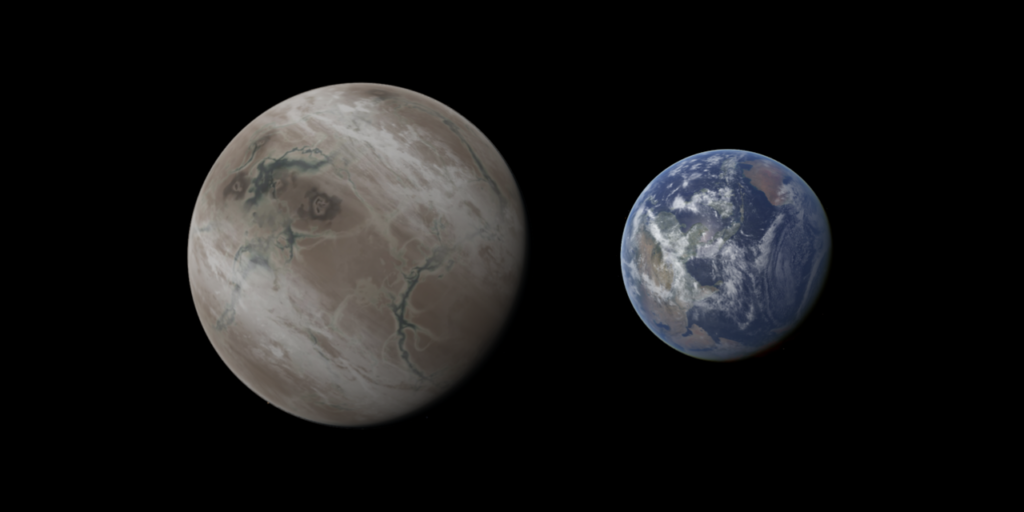
Ecosphere: The occurrence of rocky planets in a zone that allows the existence of liquid water, such as Kepler-452b.
Ordered planetary system – is a type of star system architecture in which planets are arranged according to a clear rule, usually based on mass and distance from the central star. The most important features of an ordered planetary system:
The mass of the planets increases with distance. Smaller, rocky planets (Earth-like) are located closer to the star, while large gas or ice giants are located further away. This is a rarity in space. According to research, ordered systems are rarer than chaotic or mixed systems, where giant planets orbit very close to the star.
Anti-ordered planetary system – is a type of planetary system architecture in which the masses of the planets decrease with distance from the parent star. This means that the largest, most massive planets (gas giants) are located closest to the star, and smaller, rocky planets orbit further away. It is the opposite of our Solar System, which is considered an “ordered” system (small planets close, gas giants further). The recently discovered system around the red dwarf LHS 1903 is an example of such a structure, where gas giants are closer to the star than one of the outer, rocky worlds.
Such systems are thought to form from massive protoplanetary disks rich in heavy elements.
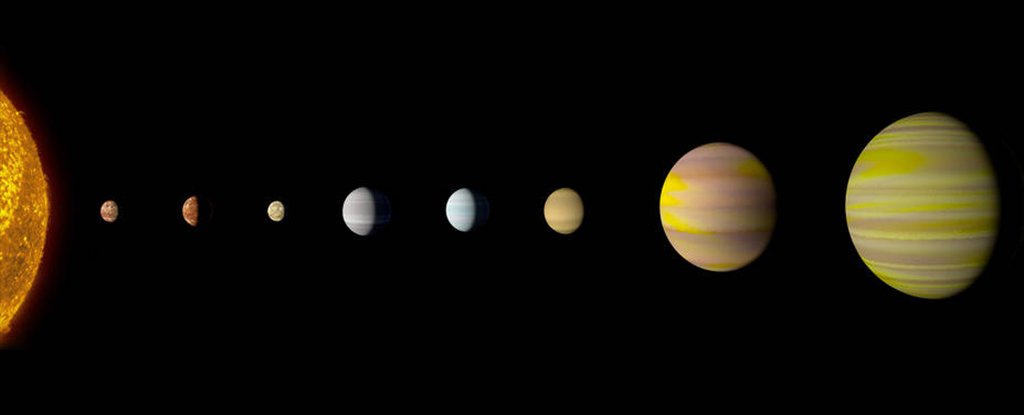
Mixed planetary system in contrast to ordered systems (such as our Solar System), in mixed systems the masses of adjacent planets differ significantly. In such a system, small, rocky planets can be found in the immediate vicinity of large gas giants. These systems do not show a clear order (small inside, large outside), but a chaotic distribution of masses. Their structure is often the result of violent dynamic interactions between planets, such as collisions or ejections of planets from the system. An example of a system with a mixed architecture is Kepler-89.
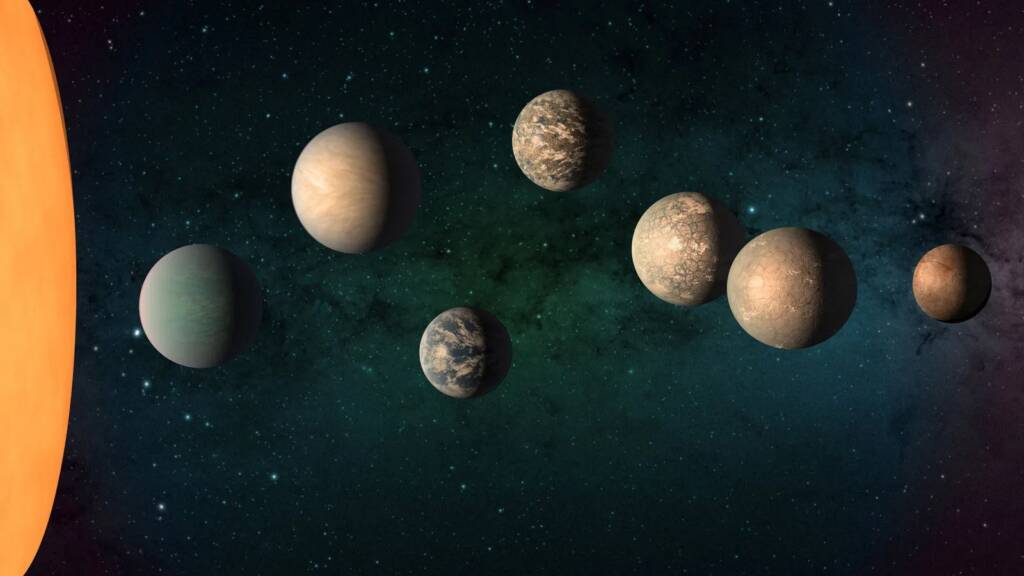
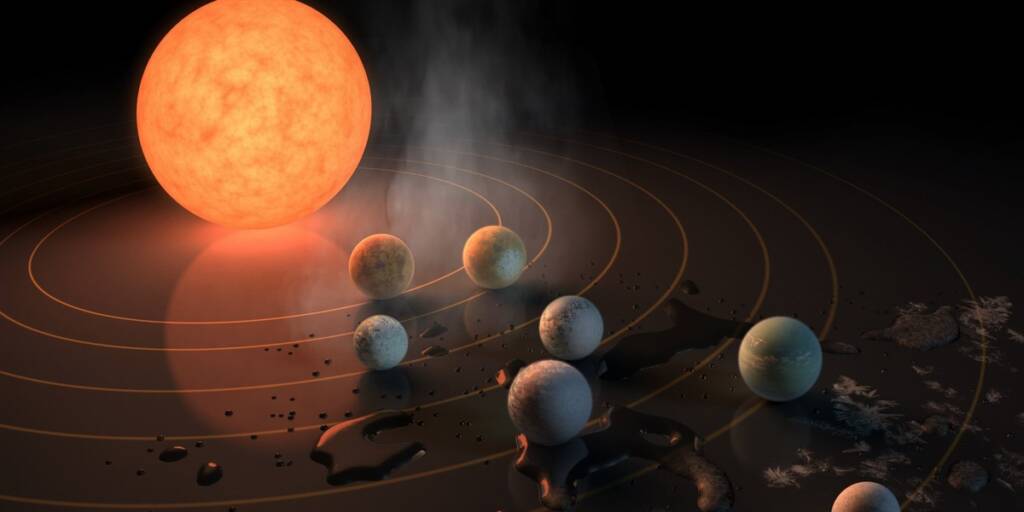
The TRAPPIST-1 planetary system – is a unique, miniature planetary system consisting of at least seven rocky planets (with sizes close to Earth), which orbit a very cool red dwarf of spectral type M8V.
Here are the key features of this system:
Central star: TRAPPIST-1 is an ultra-cool dwarf, much smaller and dimmer than the Sun (it has about 9% of the Sun’s mass and a slightly larger radius than Jupiter).
Planet characteristics: All seven known planets (marked with letters b to h) have a density suggesting a rocky composition, similar to Earth or Venus.
System scale: The system is very tight. All seven planets are located much closer to their star than Mercury is to the Sun.
Habitable zone: Several of the planets (specifically e, f, g) are in the so-called ecosphere (habitable zone), where temperatures theoretically allow the existence of liquid water.
Orbital resonance: The planets are locked in a complex, orderly chain of orbital resonance, suggesting a calm history of system formation.
Due to the fact that the star is very cold, these planets (although located close) are not scorched, and this system is one of the most important targets in the search for exoplanets with a potential atmosphere and life beyond the Solar System.