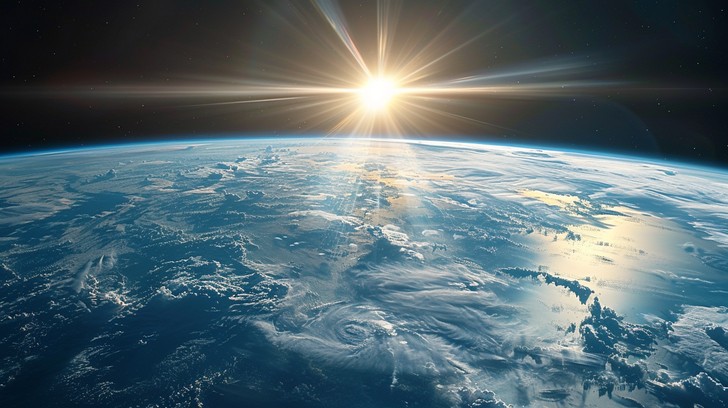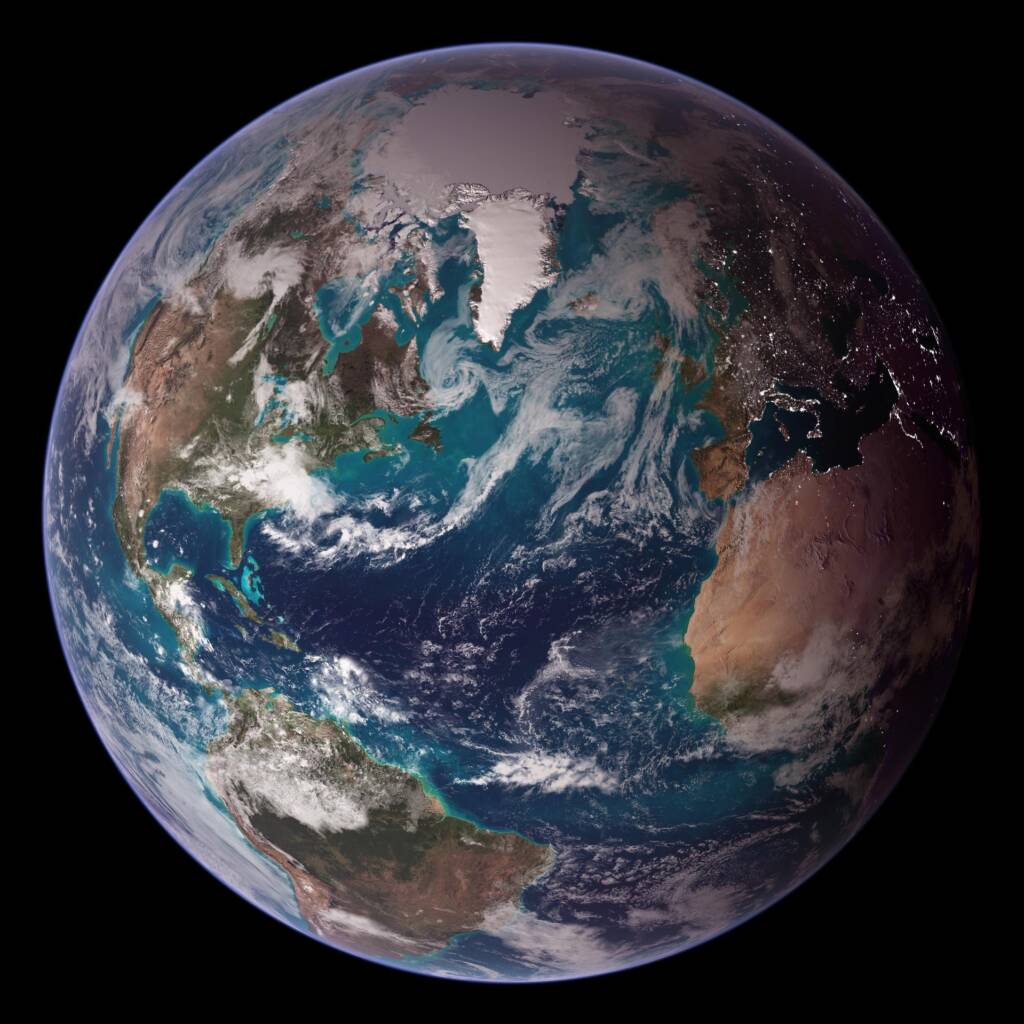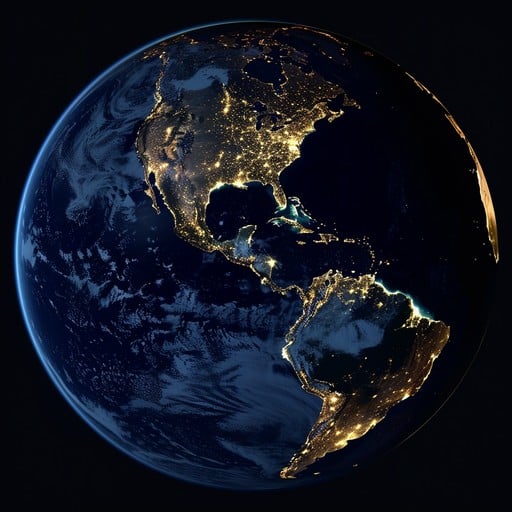
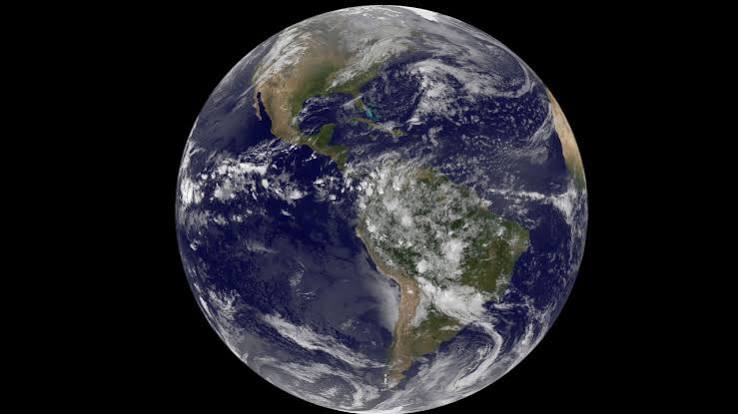
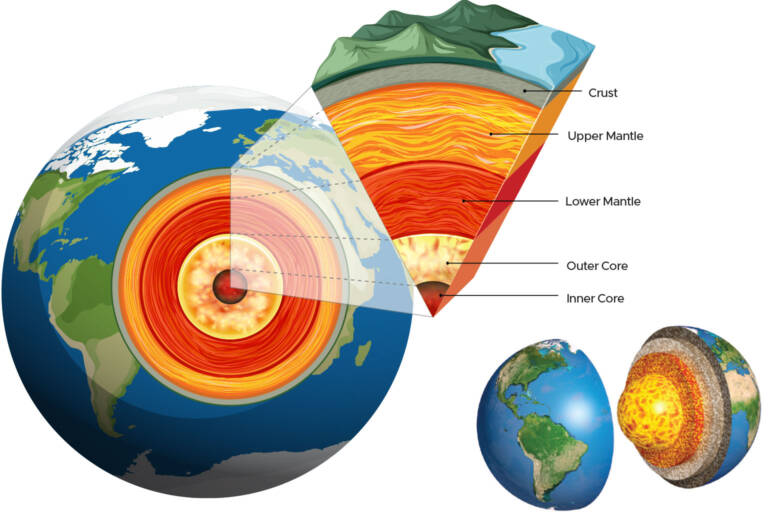
Earth is the third planet from the Sun and the only astronomical object known to harbor and support life. About 29.2% of Earth’s surface is land consisting of continents and islands. The remaining 70.8% is covered with water, mostly by oceans, seas, and gulfs, but also by lakes, rivers, and other freshwater, which together constitute the hydrosphere. Earth’s polar regions are mostly covered in ice. Earth’s outer layer is divided into several rigid tectonic plates that migrate across the surface over periods of millions of years, while its active interior remains dynamic, featuring a solid iron inner core, a liquid outer core that generates the planet’s protective magnetosphere, and a convective mantle that drives plate tectonics.
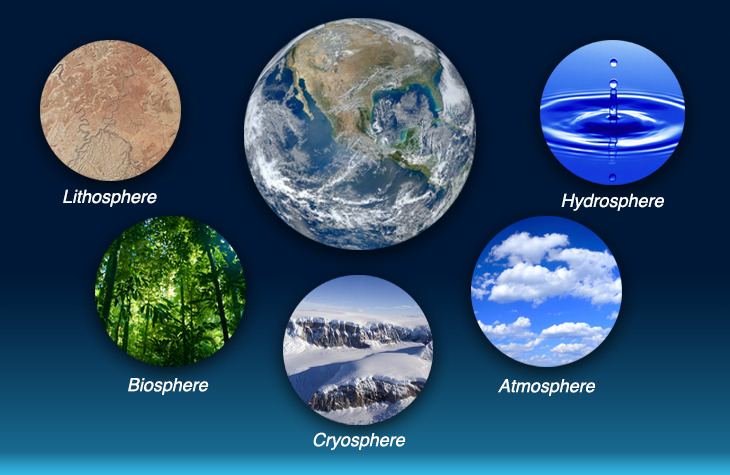
Earth’s atmosphere is unique in the Solar System. Rich in nitrogen and oxygen, it not only sustains life but also shields the surface from harmful cosmic radiation and regulates the global climate via a natural greenhouse effect. The planet’s history spans over 4.5 billion years, during which biological evolution has deeply co-evolved with Earth’s chemical and geological systems. This complex interplay of spheres—the lithosphere, atmosphere, hydrosphere, and biosphere—creates a dynamic, self-regulating planetary engine that remains the cornerstone of modern astrobiological and geophysical research.
I. COSMIC ADDRESS AND SYSTEM GEOMETRY
To truly understand Earth, one must first examine its physical placement within the cosmos and the precise geometric dance it performs within the Solar System. The spatial coordinates, orbital mechanics, and gravitational relationships of Earth define the fundamental physical boundaries that allow life to persist.
- Earth’s Position in the Solar System and the Milky Way (The Solar Ecosphere)
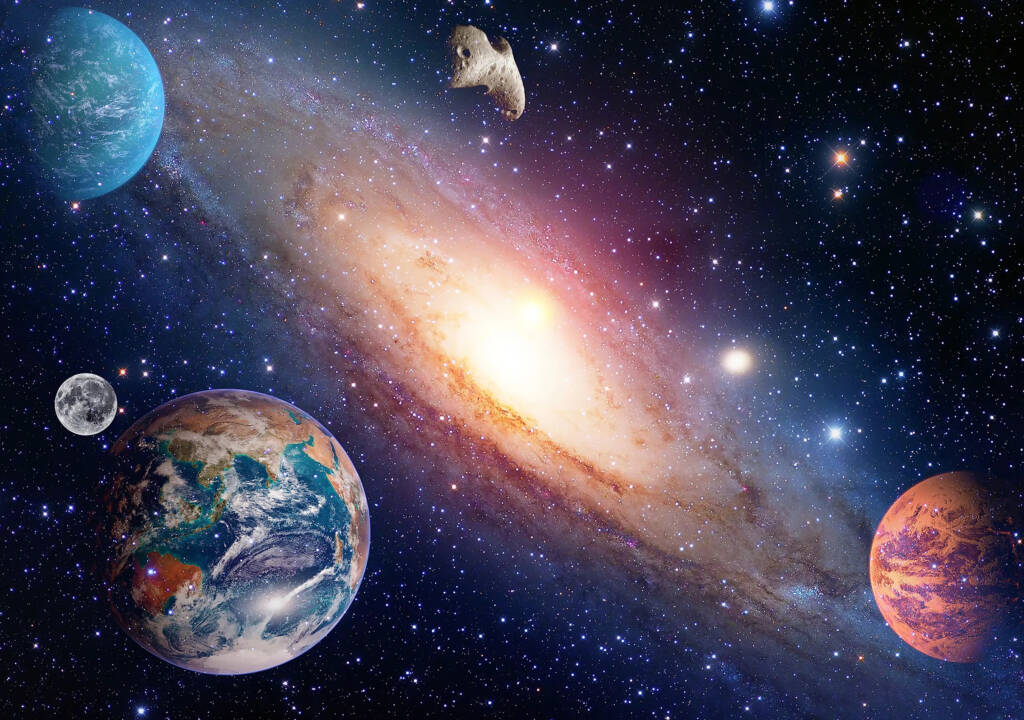
Earth resides in a highly specific cosmic neighborhood. On a galactic scale, our planet is located within the Milky Way, a barred spiral galaxy spanning approximately 100,000 light-years in diameter. The Solar System is situated in the Orion Cygnus Arm (also known as the Local Arm), roughly 26,000 light-years from the Galactic Center. This location is cyclically stable, positioned well outside the chaotic, radiation-heavy core of the galaxy, yet rich enough in heavy elements (metallicity) to allow the formation of rocky planets.
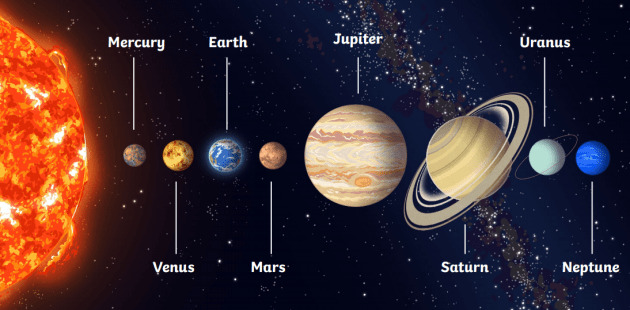
Within the Solar System, Earth occupies the third orbit from the Sun, situated perfectly within the Circumstellar Habitable Zone (CHZ)—often referred to as the Solar Ecosphere or the “Goldilocks Zone.” This is the narrow orbital band around a star where the planetary surface temperature can sustain liquid water under sufficient atmospheric pressure. If Earth were closer to the Sun (like Venus), it would suffer a runaway greenhouse effect; if it were further (like Mars), its water would freeze permanently. The Solar Ecosphere represents a delicate thermodynamic equilibrium where solar irradiance matches planetary thermal emission, allowing biochemistry to thrive.
2. Precise Cosmic Distances: Earth – Sun (The Astronomical Unit)
The distance between the Earth and the Sun is the fundamental yardstick of planetary astronomy. This distance is defined as the Astronomical Unit (AU).
Because Earth’s orbit is not a perfect circle but rather an ellipse with a low eccentricity of approximately 0.0167, the actual physical distance between the Earth and the Sun fluctuates throughout the year:
- Perihelion: The point of closest approach, occurring in early January, when Earth is approximately 147.1 million kilometers (0.983 AU) from the Sun.
- Aphelion: The point of furthest separation, occurring in early July, when Earth is approximately 152.1 million kilometers (1.017 AU) from the Sun.
To establish a constant baseline, the International Astronomical Union (IAU) has conventionally defined the Astronomical Unit as exactly 149,597,870,700 meters (approx. 92.95 million miles). At this distance, light emitted from the photosphere of the Sun takes approximately 8 minutes and 20 seconds to reach Earth, carrying the solar energy (solar constant of $\approx 1361 \text{ W/m}^2$) that drives our planetary weather systems and fuels photosynthesis.
3. Dynamics of a Binary System: Distance and Gravitational Interactions between Earth and Moon
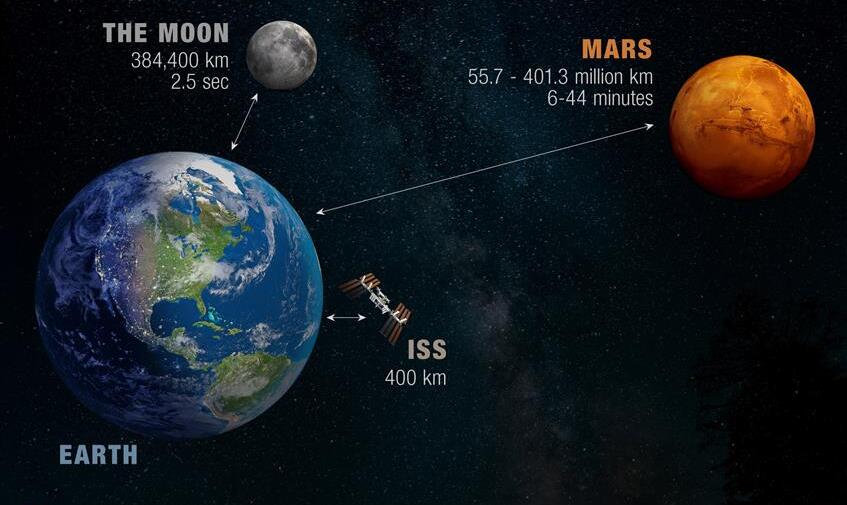
The Earth and its only natural satellite, the Moon, are so closely linked and comparable in relative scale that astronomers often describe them as a clastic binary planet system. The Moon’s mass is about 1.23% of Earth’s, and it orbits the planet at an average semi-major axis distance of 384,400 kilometers (approx. 0.00257 AU).
This proximity results in powerful, mutual gravitational interactions:
- Tidal Locking: Due to millions of years of gravitational friction (tidal dissipation), the Moon is tidally locked to Earth. This means its rotational period on its own axis matches its orbital period around Earth (approx. 27.3 days), causing the Moon to always present the same face toward our planet.
- Oceanic and Crustal Tides: The gravitational pull of the Moon (aided to a lesser extent by the Sun) creates a differential gravitational force across Earth’s diameter. This distorts Earth’s hydrosphere, creating two tidal bulges (high tides) that migrate across the globe as the planet rotates. This tidal kneading also flexes Earth’s lithosphere, generating minor internal heat.
- Orbital Decoupling and Angular Momentum: As a result of tidal friction, Earth’s rotation is gradually slowing down (days are lengthening by about 2 milliseconds per century). Concurrently, angular momentum is transferred to the Moon, causing its orbit to spiral outward, moving away from Earth at a rate of approximately 3.8 centimeters per year.
4. Orbital Parameters, Axial Tilt, and Astronomical Causes of the Seasons
Earth’s movement through space is governed by a set of precise orbital parameters that dictate the cyclic delivery of solar energy.
- Orbital Period: Earth completes one full revolution around the Sun relative to the background stars—known as a sidereal year—in 365.256 days. Relative to the vernal equinox (which dictates our calendar), the tropical year is slightly shorter, lasting 365.242 days due to the axial precession of Earth’s rotational axis.
- Axial Tilt (Obliquity): The fundamental cause of Earth’s seasons is not its variable distance from the Sun, but rather its obliquity. Earth’s rotational axis is tilted at an angle of approximately 23.44° (23.4°) relative to the plane of its orbit (the ecliptic plane). This axis points toward a fixed point in cosmic space (currently near Polaris, the North Star) as Earth orbits the Sun.
- Astronomical Mechanism of the Seasons: As Earth progresses along its orbit, the orientation of its hemispheres relative to the Sun shifts continuously:
- Solstices: During the June Solstice, the Northern Hemisphere is tilted directly toward the Sun, receiving maximum solar irradiance and experiencing summer, while the Southern Hemisphere experiences winter. This geometry reverses during the December Solstice.
- Equinoxes: At the March and September equinoxes, Earth’s axis is perpendicular to the line connecting the Earth and Sun. On these days, both hemispheres receive equal amounts of light, and day and night are of roughly equal length across the entire globe.
This tilt, stabilized over deep geological time by the gravitational presence of the Moon, prevents extreme climate fluctuations and ensures a predictable, habitable rhythm of seasons that has shaped the biosphere for eons.
II. GENESIS AND HISTORY OF THE PLANET
The history of Earth is a epic saga of cosmic violence, thermal evolution, and deep-time transformations. Over the course of approximately 4.54 billion years, our planet has transitioned from a molten, chaotic proto-planetary mass into a highly stratified, life-bearing world. This section explores the primordial origins of Earth, the cataclysm that formed our Moon, the cooling of the first crust, and the immense geological timescale that charts the planet’s evolution.
1. Accretion of Matter and the Birth of Proto-Earth in the Early Solar System
The genesis of Earth began approximately 4.567 billion years ago within the Solar Nebula—a massive, rotating cloud of interstellar gas and dust left behind by the gravitational collapse of a giant molecular cloud. As the Sun ignited at the center of this disk, the remaining material began to cool and condense.
Through the process of accretion, electrostatic forces caused microscopic dust grains to stick together, gradually forming larger particles. Over millions of years, these particles collided and merged to form planetesimals (bodies of a few kilometers in diameter). The gravitational fields of these planetesimals began to dominate, pulling in surrounding debris in a runaway growth phase to form protoplanets.
During this high-energy accretionary phase, the proto-Earth was continuously bombarded by smaller bodies. The kinetic energy of these impacts, combined with the heat generated by the decay of short-lived radioactive isotopes (such as Aluminum-26 and Iron-60) and intense gravitational compression, caused the young planet to melt completely. This molten state allowed for planetary differentiation: denser materials, primarily metallic iron and nickel, sank to the center to form the core, while lighter, silicate-rich materials floated to the surface, creating the primordial mantle and crust.
2. The Giant Impact Hypothesis (Theia) and the Cosmic Origin of the Moon
The most widely accepted scientific model for the origin of the Moon is the Giant Impact Hypothesis. Approximately 4.5 billion years ago—shortly after the proto-Earth had differentiated into its core and mantle—it collided with a Mars-sized protoplanet named Theia (the mythical mother of Selene, the goddess of the Moon).
This was not a head-on collision, but rather a colossal, glancing blow. The impact released an astronomical amount of energy, completely vaporizing Theia and a significant portion of Earth’s primordial mantle. The cores of both planets merged, while a massive ring of vaporized rock and debris was ejected into a close orbit around the Earth, situated just beyond Earth’s Roche limit.
Over a remarkably short period—potentially ranging from a few years to less than a century—this orbiting debris disk cooled and accreted under its own gravity to form the Moon. This hypothesis explains several key astronomical observations:
- Similar Isotopic Signatures: The oxygen, titanium, and tungsten isotopic ratios of Earth and Lunar rocks are nearly identical, proving they share a common origin.
- Lack of Volatiles on the Moon: The extreme heat of the collision boiled off volatile elements (like water, potassium, and sodium), leaving the Moon highly depleted of these substances.
- Small Lunar Metallic Core: Because the Moon formed primarily from the ejected, silicate-rich mantle debris of both bodies, its metallic core is exceptionally small (accounting for only about 1-2% of its total mass, compared to Earth’s 30%).
3. The Late Heavy Bombardment and the Evolution of Earth’s Primordial Crust
As the molten Earth cooled, a highly unstable outer crust of basaltic and komatiitic composition began to solidify. This primordial lithosphere was repeatedly recycled back into the mantle through a primitive form of recycling, driven by extreme mantle convection and a lack of thick, buoyant continental crust.
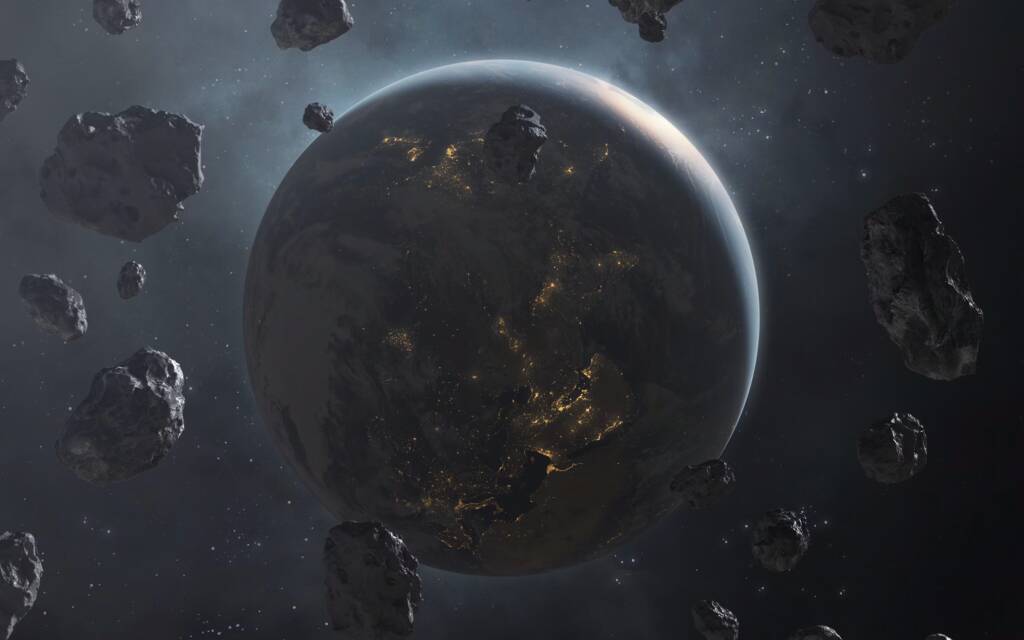
Between approximately 4.1 and 3.8 billion years ago, a phase known as the Late Heavy Bombardment (LHB) is hypothesized to have occurred. Triggered by the orbital migration of the gas giant planets (Jupiter and Saturn), which destabilized the asteroid and Kuiper belts, a relentless torrent of bolides (asteroids and comets) plunged into the inner Solar System.
The LHB profoundly reshaped Earth’s primordial crust. It repeatedly fractured the lithosphere, creating deep conduits that allowed magma to erupt onto the surface, while simultaneously vaporizing any early surface liquid water. Crucially, however, comets and water-rich asteroids from the outer Solar System colliding with Earth during this era delivered vast amounts of water and organic compounds, directly contributing to the volume of the planet’s oceans and providing the prebiotic chemical precursors necessary for the emergence of life.
4. The Stratigraphic Table and Geological Eras (From the Hadean to the Anthropocene)
Geologists divide Earth’s immense history into distinct intervals of time based on major geological, biological, and climatic shifts. This framework is organized into Eons, Eras, Periods, and Epochs, culminating in the modern day.
III. INTERNAL ARCHITECTURE AND CHEMICAL COMPOSITION
Beneath its blue surface, Earth is a highly stratified machine. The planet’s physical properties, magnetic field, and geologic activity are directly driven by its internal chemical composition and the thermodynamic processes occurring thousands of kilometers beneath our feet. This section examines the elemental makeup of the planet, the structural layers of its interior, the mechanics of plate tectonics, and the distribution of its crust.
1. Bulk Mass and Chemical Composition of the Planet
Earth’s total mass is approximately $5.972 \times 10^{24} \text{ kg}$. While the surface layers are dominated by lighter elements, the bulk composition of the planet as a whole (including the mantle and core) is dominated by four key elements which make up over 90% of Earth’s entire mass:
- Iron (Fe): $\approx 32.1\%$
- Oxygen (O): $\approx 30.1\%$
- Silicon (Si): $\approx 15.1\%$
- Magnesium (Mg): $\approx 13.9\%$
The remaining mass is composed of Sulfur ($2.9\%$), Nickel ($1.8\%$), Calcium ($1.5\%$), and Aluminum ($1.4\%$), with trace amounts of other elements.
This elemental distribution is highly segregated. Because of planetary differentiation, nearly all the heavy iron and nickel sank into the deep interior during the planet’s molten youth, while the lighter silicates (compounds of silicon, oxygen, magnesium, and aluminum) remained in the outer layers.
2. Layers of the Earth’s Interior (Physicochemical Parameters)
The interior of Earth is divided into distinct layers, characterized both by their chemical composition (compositional layers) and their physical behavior (mechanical layers).
A. The Crust (Compositional)
The outermost, solid skin of the Earth. It is divided into two distinct types:
- Oceanic Crust: Thin ($5\text{ to }10\text{ km}$), dense ($\approx 3.0 \text{ g/cm}^3$), and composed primarily of dark, mafic rocks like basalt.
- Continental Crust: Thick ($30\text{ to }70\text{ km}$), buoyant ($\approx 2.7 \text{ g/cm}^3$), and composed of felsic rocks like granite.
B. The Mantle (Compositional / Mechanical)
Representing about 84% of Earth’s volume, the mantle extends to a depth of $2,890\text{ km}$. It is composed of silicate rocks rich in iron and magnesium (primarily peridotite).
- Lithosphere (Mechanical): The brittle, solid uppermost mantle combined with the crust. It is broken into tectonic plates.
- Asthenosphere (Mechanical): Located below the lithosphere, this is a hot, semi-fluid, plastic layer of the upper mantle. Although solid, it undergoes slow, ductile convection over geological timescales.
- Mesosphere (Lower Mantle): Solid and highly compressed due to extreme pressures, extending down to the core-mantle boundary (the D” layer).
C. The Core (Compositional / Mechanical)
An immense metallic sphere composed primarily of an iron-nickel alloy ($85\% \text{ Fe}$, $5\% \text{ Ni}$, and lighter elements like oxygen, sulfur, and silicon).
- Outer Core: A liquid metallic layer approximately $2,260\text{ km}$ thick. Intense convection of this molten iron, driven by planetary rotation and heat loss, generates Earth’s magnetic field via the geodynamo mechanism. Temperatures range from $4,000 \text{ °C}$ to $5,700 \text{ °C}$.
- Inner Core: A solid metallic sphere at the very center of the planet with a radius of about $1,220\text{ km}$ (roughly 70% of the Moon’s radius). Despite temperatures exceeding $5,400 \text{ °C}$ (comparable to the surface of the Sun), the immense pressure of $\approx 330\text{ to }360 \text{ GPa}$ forces the iron-nickel atoms to crystallize into a solid state.
3. Plate Tectonics, Continental Drift, and the Dynamic Balance of the Lithosphere
The surface of Earth is not a static shell, but a jigsaw puzzle of roughly 15 major and dozens of minor tectonic plates that float on the ductile asthenosphere. This system is described by the theory of Plate Tectonics, which unified Alfred Wegener’s early concept of Continental Drift with the discovery of seafloor spreading.
The motion of these plates is driven by three main forces: mantle convection currents (acting as a thermal engine transferring heat from the core to the surface), slab pull (the gravitational sinking of cold, dense oceanic plates into the mantle), and ridge push (gravitational sliding away from elevated mid-ocean ridges).
Tectonic interactions occur along three types of boundaries:
- Divergent Boundaries: Where plates pull apart. Magma rises from the mantle to fill the gap, cooling to create new crust (e.g., the Mid-Atlantic Ridge).
- Convergent Boundaries: Where plates collide.
- If an oceanic plate meets a continental plate, the denser oceanic plate is forced down into the mantle in a subduction zone, melting and fueling volcanic arcs (e.g., the Andes).
- If two continental plates collide, they buckle and uplift to form massive mountain ranges (e.g., the Himalayas).
- Transform Boundaries: Where plates slide horizontally past one another, accumulating stress that is violently released as earthquakes (e.g., the San Andreas Fault).
Through this continuous cycle of subduction (destruction of crust) and seafloor spreading (creation of crust), the Earth maintains a dynamic lithospheric balance, recycling volatile elements back into the interior and shaping the surface geography over millions of years.
4. Surface Proportions: Total Ratio of Land to Ocean Area
The modern Earth is defined by a striking asymmetry between dry land and liquid water, giving the planet its characteristic “Blue Marble” appearance.
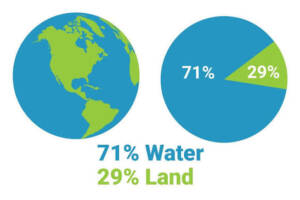
The surface area of Earth is approximately $510,072,000 \text{ km}^2$, distributed as follows:
- World Ocean (Hydrosphere): Covers approximately $70.8\%$ of the surface ($\approx 361,132,000 \text{ km}^2$). This vast body of water is divided into five major oceans (Pacific, Atlantic, Indian, Southern, and Arctic) and holds about 97% of all water on Earth.
- Landmasses (Lithosphere): Covers approximately $29.2\%$ of the surface ($\approx 148,940,000 \text{ km}^2$). This includes all seven continents and planetary islands.
This distribution is highly uneven between the hemispheres. The Northern Hemisphere contains about 68% of Earth’s total land area (often called the “Land Hemisphere”), whereas the Southern Hemisphere is overwhelmingly dominated by water, hosting only about 32% of the planet’s land. Over geological time, this ratio changes slightly as global sea levels rise and fall, and as plate tectonics rearrange the shapes and positions of the continents.
IV. ATMOSPHERE, HYDROSPHERE, AND CRYOSPHERE
Earth’s surface environment is governed by a complex, interconnected web of fluid layers: the atmosphere (gas), the hydrosphere (liquid water), and the cryosphere (frozen water). Together with the solar energy driving them, these spheres form a highly efficient planetary climate engine that regulates global temperatures, distributes nutrients, and maintains the exact physical conditions necessary to sustain life.
1. Evolution of the Earth’s Atmosphere and Its Modern Chemical Composition
The air we breathe today is the product of billions of years of geological and biological transformation. Earth’s atmosphere has evolved through three distinct stages:
- The Primary Atmosphere (Primordial): Formed during the accretion phase, this early envelope consisted mainly of hydrogen ($H_2$) and helium ($He$) swept from the solar nebula. Because of Earth’s relatively low gravity and the stripping force of the intense young solar wind, this atmosphere was quickly lost to space.
- The Secondary Atmosphere: Created by massive volcanic outgassing as the young Earth cooled. This atmosphere was rich in water vapor ($H_2O$), carbon dioxide ($CO_2$), nitrogen ($N_2$), and sulfur compounds, but contained virtually no free oxygen. As temperatures fell, the water vapor condensed to form the first oceans, scrubbing vast amounts of carbon dioxide out of the atmosphere and locking it into marine carbonates.
- The Tertiary (Modern) Atmosphere: Shaped fundamentally by life. The evolution of photosynthetic cyanobacteria around 2.7 to 2.4 billion years ago triggered the Great Oxidation Event (GOE). These organisms flooded the environment with free oxygen ($O_2$), permanently altering Earth’s geochemistry and paving the way for aerobic life.
Today, dry air at sea level has a highly stable, uniform chemical composition:
- Nitrogen ($N_2$): $\approx 78.08\%$ (Provides atmospheric pressure and dilutes oxygen to safe levels)
- Oxygen ($O_2$): $\approx 20.95\%$ (Sustains respiration and fuel combustion)
- Argon ($Ar$): $\approx 0.93\%$ (An inert noble gas from radioactive decay)
- Trace Gases & Greenhouse Gases: $\approx 0.04\%$ (Including carbon dioxide ($CO_2$), methane ($CH_4$), nitrous oxide ($N_2O$), and ozone ($O_3$)). Water vapor ($H_2O$) is highly variable, ranging from 0% in deserts to 4% in humid tropical regions.
2. Layered Structure of the Atmosphere and the Physics of Protective Barriers
Earth’s atmosphere extends hundreds of kilometers upward, divided into distinct thermal layers defined by how temperature changes with altitude. This structure serves as a series of physical and chemical shields protecting the surface.
- Troposphere (Surface to $\approx 12\text{ km}$): Containing 80% of the atmosphere’s mass and virtually all its water vapor, this is where all planetary weather occurs. Temperature decreases with altitude at an average rate of $6.5\text{ °C/km}$. It ends at the tropopause.
- Stratosphere ($\approx 12\text{ to }50\text{ km}$): Here, temperature increases with altitude because it houses the Ozone Layer ($O_3$). Ozone molecules absorb harmful ultraviolet (UV-B and UV-C) radiation from the Sun, converting it into heat and protecting terrestrial DNA from lethal mutation.
- Mesosphere ($\approx 50\text{ to }85\text{ km}$): The coldest layer of the atmosphere, with temperatures plunging to $-90\text{ °C}$. It acts as a physical shield against space debris; the friction of the thinning gas causes most incoming meteors to burn up here.
- Thermosphere ($\approx 85\text{ to }600\text{ km}$): Temperatures skyrocket to over $1,500\text{ °C}$ due to the direct absorption of high-energy X-ray and extreme UV radiation from the Sun (though the air is so thin it would feel freezing to the touch). This layer overlaps with the Ionosphere, where solar radiation strips electrons from atoms, creating a charged layer crucial for global radio communications.
- Exosphere ($\approx 600\text{ to }10,000\text{ km}$): The final, ultra-attenuated frontier of the atmosphere where the gas density is so low that atoms rarely collide. Lighter gases like hydrogen and helium slowly bleed out into space from this layer.
3. Earth’s Water Resources: Balance of Fresh, Salt, and Cryosphere-Stored Water
Earth is uniquely characterized by its massive abundance of water. The total volume of the planetary hydrosphere is estimated at roughly $1.386 \text{ billion cubic kilometers}$. However, this crucial resource is heavily stratified by salinity and physical state.
- Saline Water (Oceans and Seas): Accounts for $97.5\%$ of all water on Earth ($\approx 1.351 \text{ billion km}^3$). This water contains dissolved salts (primarily sodium chloride, $NaCl$), maintaining a uniform average salinity of about 35 parts per thousand ($35\text{‰}$).
- Freshwater: Accounts for just $2.5\%$ of the global water volume ($\approx 35 \text{ million km}^3$).
Of that tiny 2.5% sliver of total planetary freshwater, the distribution is highly restricted:
- The Cryosphere: Roughly $68.7\%$ of all freshwater is locked away as solid ice in glaciers, permanent snow cover, and the massive ice sheets of Antarctica and Greenland.
- Groundwater: Roughly $30.1\%$ is stored underground in deep aquifers and soil moisture, representing the largest accessible reservoir of liquid freshwater.
- Surface Freshwater: Only about $1.2\%$ of freshwater exists on the surface as lakes, rivers, swamps, and atmospheric vapor. Rivers, which supply the vast majority of human and terrestrial animal needs, constitute a mere 0.006% of all freshwater.
4. Global Ocean Circulation (Thermohaline) and the Planetary Heat Distribution System
Because the Sun strikes Earth’s equator more directly than its poles, the tropics accumulate a massive thermal surplus, while the polar regions suffer a thermal deficit. The planet relies on a massive, global conveyer belt known as the Thermohaline Circulation to equalize this energy gap.
Driven by differences in water density—which is determined by temperature (thermo) and salinity (haline)—this ocean current system moves heat around the globe over a cycle that takes roughly 1,000 years to complete.
The mechanism operates through a continuous planetary loop:
- The Tropical Engine: Warm surface water is heated near the equator and pushed toward the poles by prevailing atmospheric winds. A key component of this is the Gulf Stream, which carries immense thermal energy from the Gulf of Mexico up into the North Atlantic.
- The Polar Sink: As this warm water reaches the North Atlantic (near Greenland and Iceland), it releases its heat into the cold polar atmosphere, warming Western Europe. As the water cools, evaporation and the formation of sea ice leave the remaining liquid water exceptionally cold and highly saline.
- The Deep Return: This cold, salty water becomes incredibly dense and sinks to the ocean floor, forming the North Atlantic Deep Water (NADW). This deep, high-pressure current flows south all the way past Africa and Antarctica, eventually upwelling back to the surface in the Indian and Pacific Oceans as it warms, completing the global loop.
By distributing gigawatts of thermal energy across latitudes, the thermohaline circulation acts as the planet’s primary thermostat, preventing the tropics from becoming intolerably hot and the high latitudes from freezing solid.
V. GLOBAL PROTECTIVE SHIELDS AND ELECTROMAGNETIC PHENOMENA
Earth is continuously bathed in a hostile stream of cosmic radiation and high-energy particles emitted by the Sun. The survival of the biosphere relies entirely on an invisible, dynamic infrastructure of electromagnetic shields. Driven by the churning metallic heart of the planet and extending tens of thousands of kilometers into space, these protective barriers mitigate cosmic hazards and give rise to striking atmospheric phenomena.
1. Earth’s Dynamo: Origin and Dynamics of the Magnetic Field
Earth’s geomagnetic field is not an inherent, static property of the rock, but an active phenomenon generated deep within the planet’s interior via the Geodynamo mechanism.
This self-sustaining dynamo operates within the liquid iron-nickel outer core and relies on three strict physical conditions:
- A Conducting Fluid: The outer core is composed of highly conductive, molten iron-nickel alloy.
- Thermal and Compositional Convection: Heat escaping from the solid inner core toward the mantle, combined with the crystallization of iron at the inner core boundary, drives massive convection currents within the liquid metal.
- Coriolis Force (Rotation): As the planet rotates on its axis, the Coriolis force twists these rising plumes of molten metal into helical, spiral columns parallel to Earth’s rotational axis.
As the conductive fluid flows through an existing, weak magnetic field, it generates electric currents. These electric currents, in turn, reinforce and sustain a massive, global magnetic field. This field is primarily a dipole (resembling a giant bar magnet tilted at an angle of roughly $11^\circ$ relative to Earth’s rotational axis), though it contains complex non-dipolar components that cause the magnetic poles to continuously drift across the geographic polar regions over time.
2. The Magnetosphere and Van Allen Radiation Belts as a Shield Against Solar Wind
The geomagnetic field extends outward from the interior into the vacuum of space, carving out a protective tear-shaped bubble known as the Magnetosphere. This structure constantly battles the Solar Wind—a relentless stream of supersonic, ionized plasma (mostly protons and electrons) ejected by the Sun.
- Magnetopause: The boundary where the pressure of Earth’s magnetic field exactly matches the hydrodynamic pressure of the incoming solar wind. On the sunward side, the magnetosphere is compressed to about 10 Earth radii ($65,000 \text{ km}$); on the nightside, it is blown out by the solar wind into a massive, elongated tail (the Magnetotail) extending over 6,000,000 kilometers into deep space.
- Van Allen Radiation Belts: Within the inner magnetosphere, Earth’s magnetic field lines trap a fraction of these high-energy cosmic rays and solar particles, organizing them into two concentric, doughnut-shaped regions of intense radiation:
- Inner Belt (typically $1,000\text{ to }6,000\text{ km}$ altitude): Dominated by high-energy protons formed by cosmic ray collisions.
- Outer Belt (typically $13,000\text{ to }60,000\text{ km}$ altitude): Composed mainly of high-energy electrons trapped from the solar wind.
By deflecting the overwhelming majority of solar plasma around the planet like water around the bow of a ship, the magnetosphere prevents the solar wind from stripping away Earth’s atmosphere, safeguarding the planet from a fate similar to that of Mars.
3. Physics of the Aurora (Interaction of Elementary Particles with the Atmosphere)
When solar storms (such as Coronal Mass Ejections) bombard the magnetosphere, the cosmic shield flexes. Magnetic reconnection events in the magnetotail snap magnetic field lines, accelerating trapped, high-energy electrons and protons down along Earth’s magnetic field lines directly toward the northern and southern magnetic poles.
As these charged particles plunge into the upper atmosphere (Ionosphere and Thermosphere at altitudes between $100\text{ and }300\text{ km}$), they collide violently with ambient gas atoms and molecules. These collisions transfer kinetic energy, exciting the atmospheric electrons into higher energy orbits.
When these excited atoms relax back to their ground state, they release that energy in the form of photons—a phenomenon known as the Aurora Borealis (Northern Lights) and Aurora Australis (Southern Lights). The striking colors of the aurora are determined by the specific gas species hit and the altitude of the collision:
- Green Light ($557.7 \text{ nm}$): Produced by excited atomic Oxygen at lower altitudes (up to $\approx 150\text{ km}$). This is the most common auroral color.
- Red Light ($630.0 \text{ nm}$): Produced by atomic Oxygen at much higher, rarer altitudes (above $\approx 200\text{ km}$).
- Blue/Purple Light: Produced by ionized Nitrogen molecules ($N_2^+$), usually at the lower fringes of the display.
4. The Global Electrical Circuit and the Ionosphere
Earth behaves like a giant, self-contained electrical engine. The atmosphere is bracketed by two highly conductive sheets: the planet’s surface (ground) below, and the Ionosphere above. The ionosphere is a highly ionized layer of the upper atmosphere maintained by solar X-rays and ultraviolet radiation, which continuously strip electrons from atmospheric gases, creating a sea of free electrons and ions.
Between the conductive ionosphere (at a potential of roughly $+250,000\text{ V}$ to $+300,000\text{ V}$) and the negatively charged surface of the Earth, a continuous electrical field is maintained. This system is known as the Global Electrical Circuit.
This circuit is powered and recharged globally by thousands of thunderstorms occurring simultaneously around the equator at any given moment. Thunderstorms act as natural batteries, pumping a net negative charge into the ground via lightning strikes and driving a positive current upward into the ionosphere. In areas of fair weather away from storms, this potential difference causes a silent, downward, fair-weather return current to leak back down through the atmosphere to the ground, closing the global loop.
VI. BIOSPHERE: STATISTICS AND THE BIOMASS OF LIFE
The biosphere is the global sum of all ecosystems, integrating all living beings and their relationships. It forms a thin, highly vibrant veneer that wraps around the lithosphere, hydrosphere, and atmosphere. Far from being passive passengers on a rocky ball, living organisms actively alter the chemistry of the planet, regulating its climate, cycling its elements, and driving its thermodynamic systems.
1. Estimated Human Population (Global Demographics)
Homo sapiens, though a single species representing a miniscule fraction of total global biomass, acts as the dominant force shaping the modern biosphere.
The global human population has surpassed 8.2 billion individuals. Population dynamics are highly asymmetric:
- Growth and Stabilization: While the total population continues to rise, the global growth rate has slowed down significantly due to declining fertility rates across many continents.
- Urbanization and Resource Pressure: More than 55% of the human population resides in urban areas. This massive concentration of population requires highly centralized agricultural and energy networks, creating unprecedented demands on the biosphere’s carrying capacity and accelerating the conversion of natural habitats into managed anthromes.
2. Taxonomic Database of the Animal Kingdom: Biomass, Biodiversity, and Undiscovered Species
The animal kingdom (Animalia) boasts staggering morphological diversity, but its total contribution to planetary biomass is surprisingly small, outweighed heavily by plants and microbes.
- Biomass Distribution: Out of the roughly 550 gigatons of carbon ($\text{Gt C}$) that make up all life on Earth, animals account for only about 2 $\text{Gt C}$. Within this slice, the distribution is highly uneven:
- Arthropods and Annelids: Dominate animal biomass, with marine krill and terrestrial insects representing massive biological reserves.
- Humans and Livestock: Humans account for roughly 0.06 $\text{Gt C}$, while our domesticated livestock accounts for roughly 0.1 $\text{Gt C}$. Remarkably, the biomass of livestock vastly outweighs that of all wild mammals and birds combined.
- Biodiversity and Undiscovered Species: Taxonomists have described roughly 1.5 million animal species, with insects making up the vast majority. However, statistical projections suggest that the actual number of animal species on Earth is closer to 7 to 10 million. The vast majority of these undiscovered species reside in poorly sampled environments—such as the deep ocean floor, tropical rainforest canopies, and the microscopic subterranean realm—meaning millions of species could face extinction before being cataloged.
3. Taxonomic Database of the Plant Kingdom: Role in the Global Oxygen and Carbon Balance
The plant kingdom (Plantae) is the undisputed heavyweight of the terrestrial biosphere, driving the fundamental chemical inputs that allow complex life to exist.
- Biomass Dominance: Plants make up approximately 450 $\text{Gt C}$—amounting to roughly 80% of all living biomass on the planet. The vast majority of this biomass is locked up in the wood and stems of terrestrial forests.
- The Carbon Sink: Through the process of photosynthesis, plants act as the planet’s primary terrestrial carbon sink. They absorb atmospheric carbon dioxide ($CO_2$), converting it into organic sugars while storing carbon in their tissues and the soil. Terrestrial ecosystems sequester billions of tons of carbon annually, acting as a critical buffer against the accumulation of greenhouse gases in the atmosphere.
- The Oxygen Balance: While terrestrial plants produce immense amounts of oxygen ($O_2$), they also consume a significant portion of it during respiration, and more is consumed when they decay. The long-term atmospheric oxygen balance is actually co-driven heavily by marine phytoplankton in the oceans. Marine microbes generate roughly 50% of the oxygen we breathe, illustrating that the global oxygen and carbon balance is a highly coordinated system balancing both terrestrial forests and marine oceanic zones.
4. Theory of Biogeochemical Self-Regulation of the Planet (The Gaia Hypothesis from a Systems Perspective)
First formulated by chemist James Lovelock and microbiologist Lynn Margulis in the 1970s, the Gaia Hypothesis has evolved into modern Earth System Science. From a rigorous systems perspective, it views the Earth not as a static rock with organisms living on it, but as a complex, single, self-regulating feedback system.
This system maintains the planet’s surface temperature, atmospheric composition, ocean salinity, and chemistry in a state of homeostasis—actively keeping conditions favorable for life.
The mechanics rely on interwoven negative feedback loops:
- The Carbonate-Silicate Cycle: If the Sun grows hotter or volcanic activity pumps more $CO_2$ into the atmosphere, global temperatures rise. This increases evaporation and rainfall. The rain washes $CO_2$ out of the air as carbonic acid, which reacts with rocks to form carbonates. Marine organisms use these carbonates to build shells, which eventually sink to the ocean floor, locking the carbon away and cooling the planet back down.
- Albedo Modulation: When global temperatures rise, marine algae (phytoplankton) proliferate and release volatile sulfur compounds like dimethyl sulfide (DMS). In the atmosphere, DMS oxidizes into sulfate aerosols, which act as cloud condensation nuclei. This increases global cloud cover, raising Earth’s reflectivity (albedo) and bouncing solar radiation back into space, thereby cooling the planet.
Through these non-conscious, biogeochemical loops, life acts as an active planetary thermostat, continuously tuning the physical parameters of Earth to preserve its own collective survival.
VII. GREAT QUESTIONS OF ASTROBIOLOGY AND SCIENTIFIC ANOMALIES
Even with advanced satellite networks, deep-crust drilling, and highly sensitive laboratory instrumentation, Earth still retains fundamental mysteries. The overlap where planetary geology meets biological emergence reveals profound questions and anomalies that challenge our current scientific paradigms.
1. Where Did Life on Earth Come From?
The transition from non-living chemistry to self-replicating biology—known as abiogenesis—remains one of the greatest intellectual hurdles in modern science. While the fossil record shows that life was already thriving around 3.5 to 3.8 billion years ago, the exact mechanism of its origin is heavily debated across three primary scientific models:
- Hydrothermal Vents (Deep-Sea Origin): This hypothesis posits that life began in the pitch-black depths of the ocean floor, specifically around alkaline hydrothermal vents (like the “Lost City” field). These vents spew mineral-rich fluids into the ocean, creating natural proton-gradient boundaries across porous chimney walls. These thermal and chemical gradients could have behaved like primitive cellular metabolisms, fueling the assembly of the first organic polymers and RNA molecules away from the destructive UV radiation of the surface.
- Warm Little Ponds (Surface Origin): Championed by Charles Darwin and modernized by current biochemists, this model suggests life originated in shallow, terrestrial geothermal pools. These environments undergo continuous wetting and drying cycles driven by evaporation and rain. This cyclical dehydration concentrates organic monomers (like amino acids and nucleotides), forcing them to polymerize into complex proteins and nucleic acids—a process harder to achieve in the dilute open ocean.
- Panspermia (Cosmic Origin): This theory argues that the precursors of life, or even primitive microbial life itself, did not originate on Earth but were delivered here from space. Analysis of carbonaceous meteorites (like the Murchison meteorite) reveals they contain a rich array of amino acids, sugars, and nucleobases. Proponents suggest that cometary and meteoric impacts during the Late Heavy Bombardment may have effectively “seeded” a young, chemically receptive Earth with cosmic organic ingredients.
2. Earth’s Uniqueness: Does a Twin Planet with Identical Properties Exist in the Universe?
Exoplanetary astronomy has discovered thousands of worlds orbiting distant stars, yet an exact duplicate of Earth—a true Earth 2.0—remains elusive. Whether Earth is a cosmic anomaly or a statistical inevitability depends on a long chain of rare planetary filters:
- The Rare Earth Hypothesis: This perspective argues that the exact combination of variables that created Earth is astronomically rare. It is not enough for a planet to simply orbit within the habitable zone of a star. To match Earth, a planet requires:
- A stable, long-lived G-type star (like our Sun) that does not release lethal superflares.
- A large, stabilizing natural satellite (like the Moon) to prevent chaotic axial tilt wobbling.
- A dynamic geodynamo to generate a strong magnetosphere to deflect stellar winds.
- Gas giants (like Jupiter) positioned further out in the system to act as gravitational shields against excessive comet impacts.
- The Copernican Principle (Mediocrity): Conversely, many astronomers argue that with hundreds of billions of galaxies, each containing hundreds of billions of stars, the sheer laws of probability dictate that Earth twins must exist. Instruments like the Kepler and James Webb Space Telescopes have confirmed that rocky, Earth-sized planets within stellar habitable zones are common. However, finding an identical twin—sharing our exact atmospheric ratio, active plate tectonics, land-to-ocean distribution, and biosignatures—remains the ultimate prize of interstellar surveying.
3. Little-Known Facts: Gravitational Anomalies, Unusual Physical Properties of Water, and Secrets of the Deep Lithospheric Biosphere
When examined closely, Earth displays a variety of bizarre physical anomalies that deviate from standard planetary baselines.
A. Gravitational Anomalies (The Lumpy Earth)
Earth is often drawn as a perfect sphere, but it is actually an irregularly shaped oblate spheroid. Furthermore, its internal mass distribution is incredibly uneven. Heavy metallic concentrations, deep mantle plumes, and oceanic trenches create subtle variations in local gravitational pull.
The most famous of these is the Indian Ocean Geoid Low, a massive gravitational “hole” where the ocean surface drops roughly 100 meters lower than the global average due to an extraordinarily weak gravitational pull caused by missing mantle mass below.
B. The Anomalous Nature of Water
The very substance that makes Earth famous behaves in ways that defy traditional chemical logic. For most matter, the solid phase is denser than the liquid phase. Water breaks this rule: ice floats. Water reaches its maximum density at $4\text{ °C}$; as it cools further to freeze, its crystalline structure expands.
If ice behaved like normal matter and sank, Earth’s oceans would have frozen from the bottom up, creating permanent blocks of ice that the Sun could never thaw, effectively killing the biosphere. Furthermore, water has an extraordinarily high specific heat capacity, allowing the oceans to act as a colossal thermal dampener for the entire planet.
C. The Deep Lithospheric Biosphere (The “Dark” Biosphere)
For centuries, humans believed that life was confined to the surface and the top sliver of soil. Drilled core samples have shattered this view, revealing the Deep Biosphere.
Thousands of meters beneath the continents and seafloor, embedded within solid rock fractures and subjected to crushing pressures and scorching heat, live trillions of microorganisms. These chemolithoautotrophs do not rely on sunlight or photosynthesis. Instead, they survive by “breathing” rocks, feeding on hydrogen and sulfur generated by the radioactive decay of elements and chemical weathering within the deep lithosphere. This dark biosphere is so vast that scientists estimate it contains up to 15 to 20 billion tons of carbon biomass—vastly outweighing the collective weight of all human life on the surface.
CONCLUSION: THE PLANETARY PERSPECTIVE
When viewed as an integrated system, Earth stands out as a masterpiece of cosmic architecture. It is neither a static rock nor a passive background for human history; rather, it is a dynamic, self-tuning planetary engine. Every component is structurally linked to the next: the churning iron core thousands of kilometers beneath our feet generates the invisible electromagnetic shield that preserves our atmosphere, while the atmosphere and oceans work in perfect harmony with the biosphere to regulate global temperatures and cycle the elements of life.
For over 4.5 billion years, this delicate balance has survived cosmic bombardments, shifting continents, ice ages, and mass extinctions. Today, Earth faces a new geological epoch—the Anthropocene—in which the activities of a single species have become a dominant force shaping the planetary thermodynamic balance.
Understanding the complex geometry, internal architecture, and delicate feedback loops of our world is no longer just an academic pursuit. It is the fundamental blueprint for our survival, reminding us that we are not separate from Earth’s systems, but deeply embedded within them. As we look to the stars in search of other habitable worlds, our own planet remains the ultimate benchmark for astrobiology—a solitary, brilliant blue oasis in the cosmic dark.