

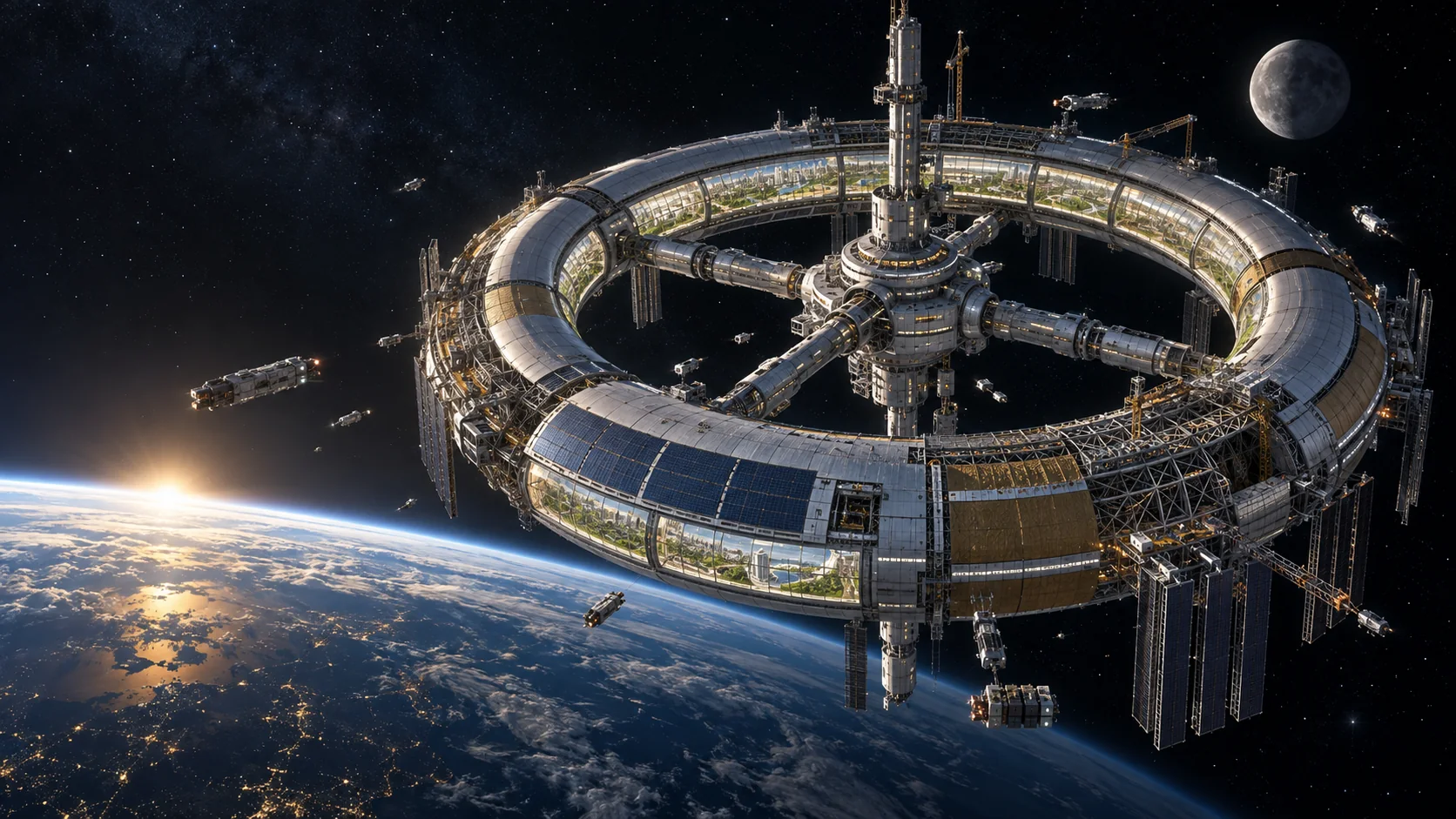
Orbitarium One
Designing the first orbital city as a spacecraft, an ecosystem and a society — in that order, and with the public in the room from day one.
A city that must never forget it is a spacecraft.
Popular culture — including Elysium — made the giant ring instantly recognisable. Orbitarium One removes the cinematic shortcuts and asks the harder question: what would we have to prove before anyone was invited to live there?
This article is not a claim that a vast orbital settlement can be financed or built today. It is a structured public design exercise. Every attractive rendering hides a chain of systems that must work together: pressure structure, rotation, shielding, power, heat rejection, food, water, medicine, governance, logistics, emergency response and a credible reason for the city to exist.
The project begins with a strict rule: no single beautiful shape is allowed to decide the mission. Geometry follows population, location, construction method, gravity target, failure strategy and social contract. A ring may be an excellent civic diagram and still lose to a cylinder or a smaller modular cluster once mass, redundancy or assembly risk is modelled.
Large settlements in space are not a new subject. NASA’s 1977 Space Settlements: A Design Study treated permanent habitation as a combined engineering, architectural and social problem. Orbitarium One uses that tradition as a starting point, not as a finished blueprint.
Your choices become a living project brief.
Select one answer in each question. Your draft is saved automatically on this device. At the end, you can send the complete brief and a design note to the moderated community review.
Primary form
Which geometry deserves the first full feasibility study?
Pioneer population
How large should the first genuinely civic settlement be?
Gravity policy
What should the residential rim optimise for?
First location
Where should construction, logistics and risk be balanced?
Founding economy
What pays for maintenance before the settlement diversifies?
Founding governance
Who controls life-critical infrastructure and public rules?
Founding age mix
Which age structure should the first civic cohort prioritise?
Growth strategy
How should the city pass from outpost to permanent settlement?
How fast must the city turn?
The simplified relation is a = ω²r. This is a first-order calculator, not a human-factors certification model.
Comfort depends on more than the gravity number. Rotation rate, radius, gravity gradient, head movement and Coriolis effects all matter. NASA literature treats adaptation and human factors as central design constraints, not decorative details.
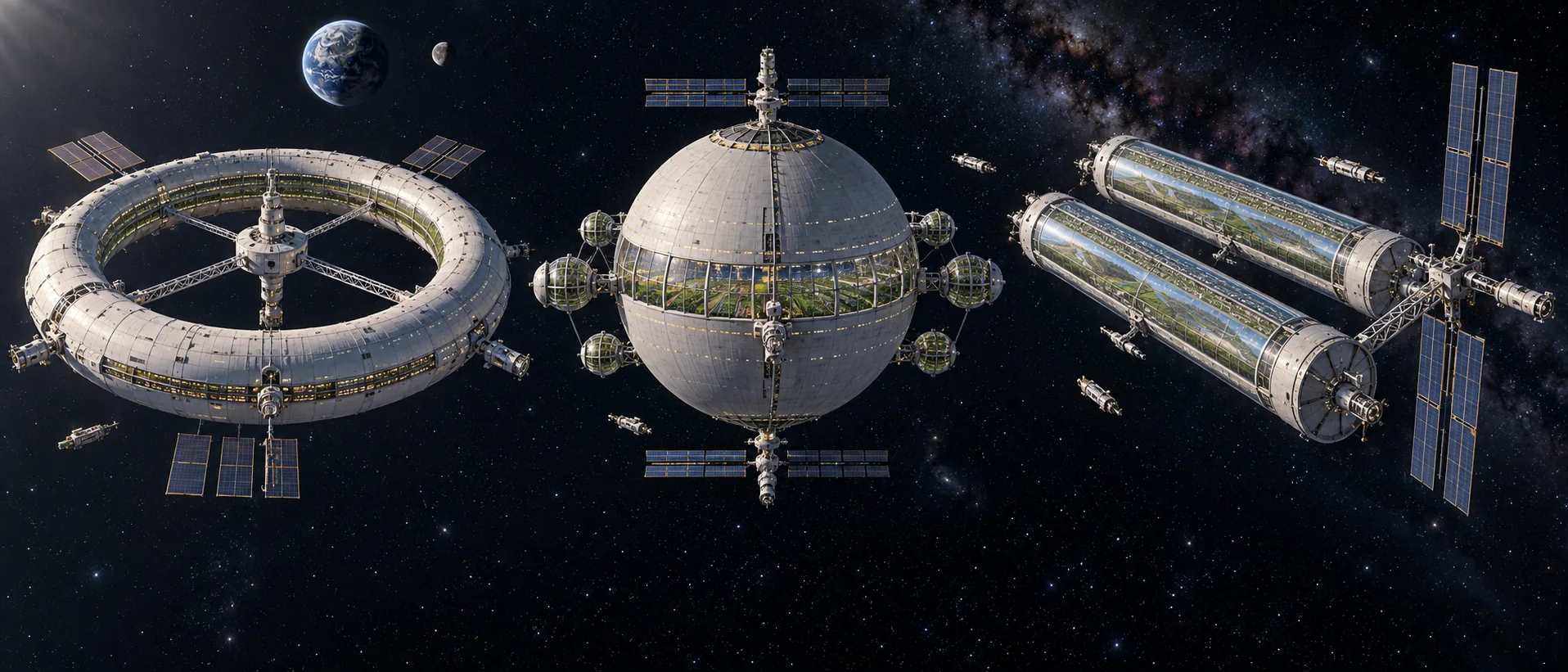
Ring, sphere, cylinder — or a smaller truth first?
Curved pressure shells distribute loads efficiently. A square can organise rooms, streets and modules, but it is a poor primary pressure vessel and produces no useful uniform gravity merely by being rotated.
Best public diagram
A ring separates a non-rotating docking hub from a rotating residential rim. It offers a legible civic centre and manageable sightlines, but the spokes, bearings, transfers and uneven structural loads are difficult.
Best expansion case
A long cylinder can create enormous continuous land area, yet end caps, attitude control, illumination and catastrophic containment become city-scale engineering challenges.
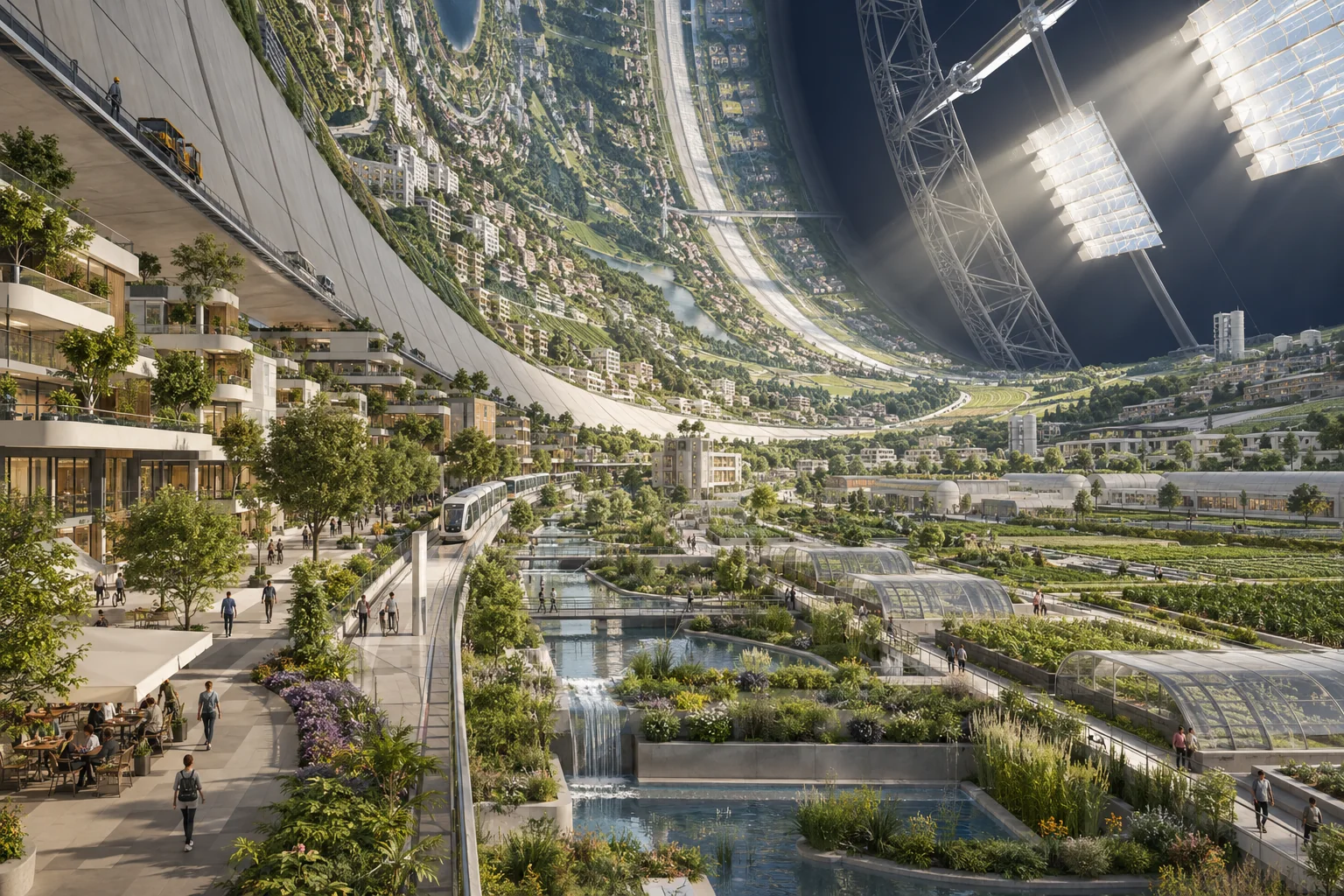
The ring is the easy part to draw.
The real architecture is a network of loops, reserves and repair paths. Each life-critical function needs monitoring, isolation, manual fallback and a strategy for degraded operation.
Air, water and waste
ISS systems have demonstrated 98% overall water recovery with the brine processor, but a city also needs nutrient recovery, food production, microbial control and buffers large enough to survive maintenance outages.
Radiation defence
Beyond Earth’s protective environment, solar particles and galactic cosmic rays can damage tissue. Shielding, storm shelters, exposure forecasting and location choice must be designed together.
Food and ecology
ESA’s MELiSSA programme models a closed loop as separate biological compartments for waste conversion, nitrification, oxygen, water and food production. Orbitarium needs the same discipline: ecosystems must be engineered, measured and recoverable.
Assembly and repair
A settlement too large to launch whole must be assembled, inspected, upgraded and repaired in orbit. Robotics, standard interfaces, local manufacturing and replaceable pressure zones become constitutional infrastructure.
Habitability and health
NASA standards connect volume and layout to crew size, mission duration, privacy, recreation, medical care and task flow. A city cannot treat these as late-stage interior decoration.
Governance and legitimacy
Who controls oxygen, power, movement, data and emergency authority? A credible charter needs rights, transparent system metrics, due process, independent safety review and a lawful path to leave.
People are not payload.
A passenger list becomes a city only when it contains enough skills, institutions, relationships and spare capacity to survive ordinary life as well as extraordinary failure.
There is no scientifically established “minimum population” for an orbital civilisation. Genetic diversity is only one part of the question and can be supported by managed reproductive medicine and stored biological material. The harder near-term constraint is functional: can the community operate hospitals, power systems, farms, schools, maintenance, manufacturing, courts, emergency services and democratic institutions without exhausting a small number of indispensable specialists?
That is why Orbitarium One uses 2,000 residents as a debate baseline, not a discovered law of nature. It is large enough to imagine several independent teams for critical work, a genuine civic life and a range of ages and professions. It is still small enough that the first settlement can be divided into pressure neighbourhoods, each capable of isolation and partial autonomy. The model must be tested against sickness, conflict, simultaneous equipment failures and the loss of transport from Earth.
Research outpost
Five hundred people could operate a sophisticated station, but specialist bottlenecks would remain severe. Many services would have one team, one clinic or one workshop. Governance might resemble an expedition more than an open city, and family life could be subordinated to mission needs.
Civic district
Two thousand residents allow overlapping technical teams, schools, cultural institutions, a broader medical service and elected neighbourhood representation. The challenge is economic depth: the city still depends heavily on a narrow set of export activities and transport links.
Diversified town
At ten thousand, specialisation and internal markets become more credible. The habitat also becomes much harder to evacuate, feed and expand. Construction must therefore shift from a heroic project to repeatable industrial production before this scale is authorised.
City from day one
A fifty-thousand-person opening sounds socially rich, but it concentrates unproven risk. It requires enormous transport, medical, housing and life-support capacity before operational learning has accumulated. Orbitarium treats this as an expansion horizon, not a responsible first occupancy.
How large should the first ring be?
Radius is not chosen by a skyline image. It follows rotation limits, gravity target, structural mass, shielding, deck depth and the area needed for housing, public space, logistics and repair. A radius near 900 metres produces roughly 1 g at about one revolution per minute in the simplified model above. That does not certify comfort or feasibility; it simply creates a useful baseline for human-factors research.
The pressure hull should be divided into cells rather than treated as one continuous atmosphere. Streets and parks can cross those boundaries through protected transfers, but a local fire, contamination event or puncture must not threaten the entire population.
Why does Orbitarium exist?
A settlement cannot be justified solely by selling homes to its own construction workers. Its first economy might combine microgravity and vacuum manufacturing, research, spacecraft servicing, energy, communications, logistics and cultural production. Every revenue model must be stress-tested against launch price changes and the loss of a major customer.
Life-support reserves, medical capability and safe return cannot be cut automatically during a recession. They need legally protected funding, much like a public utility or central bank reserve, because insolvency in orbit can become a physical emergency within hours.
Residents at opening
Enough functional overlap for a civic district without accepting the risk of opening at full city scale.
Residential radius
A useful first-order reference for approximately one revolution per minute at an Earth-like gravity target.
Founding economy
Multiple revenue streams reduce dependence on one customer, employer or space-based commodity.
Rights before occupancy
Life-support operators hold exceptional power, so enforceable civic protections must exist before residents arrive.
The charter should be treated as a safety system. Residents need enforceable access to air-quality, radiation, water and maintenance data. Emergency powers must expire automatically and be reviewable. Infrastructure operators need a duty to disclose degraded margins. Workers must be able to report risk without retaliation. Children born in the settlement cannot be assumed to have accepted an employment contract or political order designed before their birth.
The right to leave is equally important. A city is not meaningfully voluntary if transport is controlled by one employer or if debt makes return impossible. Orbitarium therefore needs a mobility fund, protected passenger capacity and agreements with Earth-side jurisdictions before permanent families arrive. These are not secondary ethical questions. They determine whether the settlement is a community or a company town with a vacuum outside.
Finally, the city must preserve ordinary human freedom. Green space cannot be justified only as an oxygen machine; privacy cannot be measured only as cabin volume; education cannot be reduced to workforce replacement. The architecture should leave room for unprogrammed time, dissent, art, belief, sport, friendship and bad ideas that can fail safely. A technically closed loop should not become a socially closed one.
Grow through proof, not promises.
No phase begins because a date arrived. It begins only when the previous phase passes measurable safety, maintainability and social-readiness gates.
Ground systems and civic charter
Test closed-loop subsystems, rotating-room human factors, governance simulations, digital twins, emergency law and transparent public metrics.
Uncrewed orbital construction yard
Demonstrate autonomous assembly, pressure-cell manufacture, inspection, shielding placement, thermal control and repair without putting residents at risk.
Rotating research demonstrator
A small crew validates transfer between rotating and non-rotating zones, medical effects, maintenance workload, agriculture and evacuation.
Pioneer district
Hundreds — not thousands — test civic services, schooling, mixed work, family policy, representation and long-duration supply resilience.
Orbitarium One
Expansion toward the public baseline of 2,000 residents begins only after the habitat proves it can grow without weakening safety, ecology or rights.
What can end the project?
The most dangerous failure is not a dramatic hull breach. It is normalisation of small degradations across connected systems until the city loses margin and no one owns the whole risk.
| Risk | Design response | Proof required |
|---|---|---|
| Pressure loss | Small isolatable cells, automatic shutters, refuge zones. | Full-scale destructive and repair tests. |
| Rotation instability | Mass balancing, active control, independent safe spin-down. | Hardware-in-loop and orbital demonstrator. |
| Radiation event | Distributed shielding and reachable storm shelters. | Measured dose maps and occupancy drills. |
| Ecological collapse | Multiple loops plus stored reserves and sterile restart capacity. | Multi-year closed-loop trials with fault injection. |
| Supply interruption | Local repair, standard parts, strategic inventories. | Survival through planned logistics blackout. |
| Governance capture | Rights charter, independent courts, auditable infrastructure data. | Constitutional simulation and resident ratification. |
| Public-health emergency | Isolation wards, local diagnostics, air-zone control. | Medical exercises without immediate Earth support. |
| Economic failure | Diverse revenue and protected life-support reserve. | Stress test without growth assumptions. |
Start with evidence. Mark the unknowns.
These sources do not prove that Orbitarium One is ready to build. They define the foundation from which honest feasibility work should begin.
The landmark interdisciplinary study of large permanent settlements, covering structure, life support, economics and society.
Rotation dynamics, gravity gradients, Coriolis forces, comfort and engineering options.
Human factors, habitability, environmental health, privacy, medical and architectural requirements.
A concrete demonstration of regenerative life support — and a reminder that water recovery is only one loop.
An engineering approach to waste conversion, nitrification, oxygen, water and food production.
Health risks, risk modelling, biological effects and shielding research beyond Earth’s atmosphere.
Technologies for autonomous assembly, repair, refuelling and large structures in orbit.
Why local oxygen, water, feedstock and construction materials may change the economics of large habitats.
Turn your choices into a public design brief.
Your selections stay on this device until you submit them. Community submissions are moderated before they enter the shared discussion and tally.
Community signal
Loading approved design briefs…


