The sky is not a single threat. Asteroid impacts, solar storms, orbital debris and rare high-energy events operate on different timescales—and demand different kinds of preparation.
Here are four principal hazards, the evidence behind them, and the methods scientists use to monitor and reduce risk. We distinguish observed effects from scenarios that remain uncertain.
Risk is not the same as spectacle. A dramatic illustration does not mean a disaster is imminent.
Illustration from the Space Lovers Club media library.
01 / Near-Earth objects
Asteroids: rare impacts, measurable orbits.
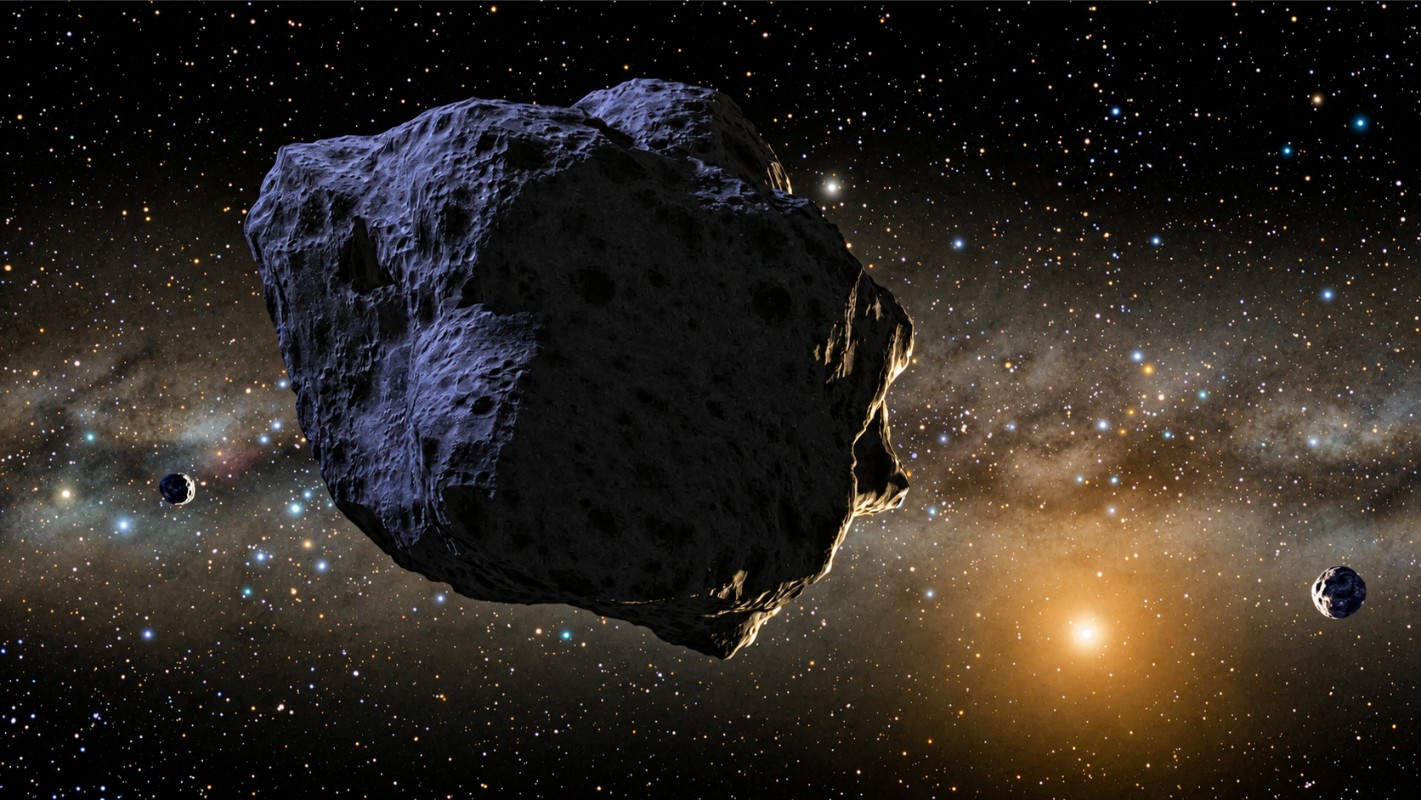
Rocky and metallic bodies pass through Earth’s neighbourhood. Most known objects do not threaten us, but finding smaller, darker bodies early remains a central challenge of planetary defence.
Artist’s impression. An impact’s outcome depends on the object and where it enters the atmosphere or strikes.
What determines the damage?
Diameter matters, but it is not the whole story. Density, composition, entry angle, speed and the impact location decide how much energy reaches the ground. A small object may break apart high in the atmosphere. A larger one may cause a destructive airburst or strike the surface. The roughly 20-metre Chelyabinsk object in 2013 exploded in the air; shattered windows injured more than a thousand people.
An object of tens of metres could cause severe local damage in an unlucky location. Hundreds of metres raise the possibility of regional consequences. Kilometre-scale impacts could disrupt climate and food systems on a much wider scale. The Chicxulub impactor, about 10 kilometres across, is linked to the mass extinction 66 million years ago. These are scenarios by size, not forecasts for the coming decades.
NASA says no known asteroid larger than 140 metres has a significant chance of striking Earth in the next century. “Known” is important: surveys are still finding objects, and probabilities change as new observations refine an orbit. The 2024 YR4 case showed that process in public. Initial calculations raised concern, but later measurements removed a significant Earth-impact risk for 2032 and beyond. Apophis will pass close to Earth in 2029 without colliding with it.
A tested deflection principle
In 2022 NASA’s DART spacecraft struck Dimorphos, the moonlet of asteroid Didymos. The impact shortened its orbital period by about 33 minutes. This demonstrated a kinetic-impact technique in one real system; it did not prove that every threatening asteroid can be handled the same way. Size, structure, trajectory and warning time would govern a future response.
Other options remain studies
A gravity tractor would use a spacecraft’s pull over a long period. A nuclear standoff intervention has been examined for difficult scenarios. Neither is a routine, deployed planetary shield. The most valuable defence today is early discovery, reliable orbit calculation and international coordination.
NASA’s infrared NEO Surveyor mission is designed to improve detection of hard-to-see near-Earth objects. Its schedule should be checked against the current NASA mission page, rather than treated as a fixed launch date.
What we can say now
There is no identified large asteroid on a significant Earth-impact course within the next 100 years. That is reassuring, not a reason to stop searching.
02 / Our active star
Solar storms threaten technology, not the planet itself.
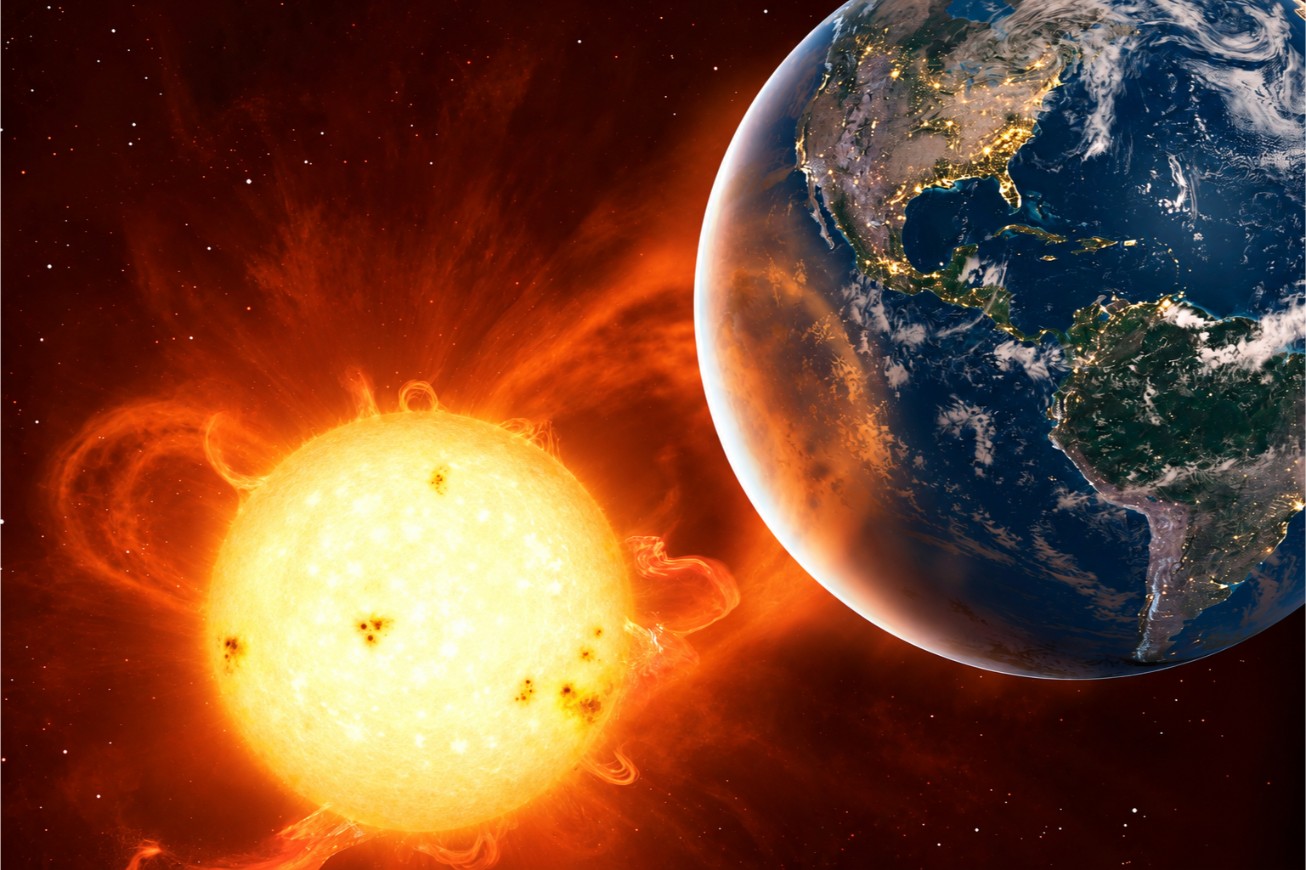
The Sun can disrupt technologies on which modern life depends. The most credible concern is not a scorched Earth; it is interrupted electricity, radio, navigation and satellite services.
Solar activity can drive space-weather effects at Earth. Illustration from the site’s media library.
Three related phenomena
A solar flare is a burst of electromagnetic radiation. Energetic particles can create a radiation storm that matters especially to spacecraft and polar aviation. A coronal mass ejection, or CME, is a cloud of magnetised plasma; when it reaches Earth with a suitable magnetic orientation, it can drive a geomagnetic storm. The atmosphere and magnetic field protect people at ground level from most direct biological effects, but our infrastructure is exposed in other ways.
Geomagnetically induced currents can flow through long power lines and stress transformers. Disturbed ionospheric conditions can reduce the accuracy or availability of satellite navigation and high-frequency radio. Satellites may experience charging, electronics faults and increased drag as the upper atmosphere heats and expands. Aviation operators may reroute polar flights when communications or radiation conditions require it.
The 1859 Carrington event is a historical reference point: telegraph systems malfunctioned and aurorae were seen unusually far from the poles. But our power grids and satellites are not telegraph networks, and the precise losses from a modern equivalent cannot be stated as a single reliable figure. Regional network design and operational decisions matter greatly.
Monitoring
NOAA’s Space Weather Prediction Center and space-based observatories watch solar activity and issue forecasts and alerts. Instruments near Earth help assess the approaching solar wind before it reaches the magnetosphere.
Resilience
Operators can use forecasts, grid procedures, satellite safe modes, redundant communications and recovery plans. These measures reduce vulnerability; they cannot prevent the Sun from producing a storm, nor guarantee that every service will remain uninterrupted.
Why we avoid a single “chance of disaster” number
Published estimates depend on how an extreme storm is defined, the time period and the model. A percentage without those assumptions would imply more certainty than the evidence supports. NOAA provides live forecasts and alerts for the practical question: what is happening now?
03 / A human-made hazard
Orbital debris puts space services and crews at risk.
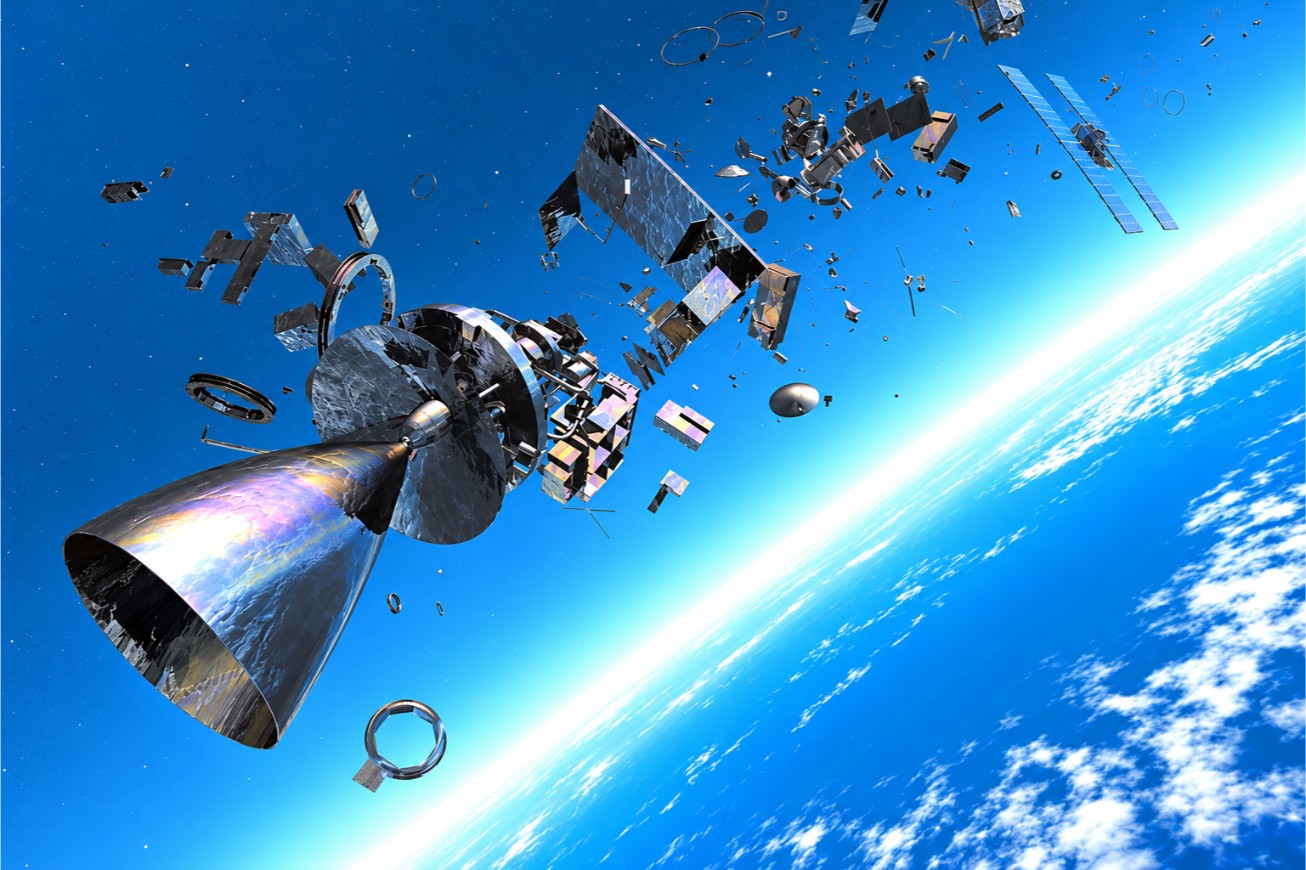
Dead satellites, spent rocket stages and fragments share orbital space with operating spacecraft. The immediate hazard is collision in orbit; the risk to people on the ground from re-entry is a separate, much smaller problem.
Illustration. Actual debris is widely dispersed; this image does not show the physical density of near-Earth space.
Why even small fragments matter
Objects in low Earth orbit can travel at several kilometres per second. Their relative closing speed can be even higher, so a small fragment may damage a satellite or a crewed habitat. Large objects can often be tracked and avoided; many small pieces cannot be followed individually. Spacecraft therefore combine shielding, tracking information and, where possible, collision-avoidance manoeuvres.
ESA’s statistics, updated in October 2026, list roughly 47,000 objects regularly tracked in Earth orbit. Statistical models estimate far more small fragments—around 1.5 million pieces between 1 and 10 centimetres. These figures refer to different size groups and methods; they should not be mixed into one simple count of “satellites”.
The Kessler syndrome describes a possible self-sustaining chain of collisions in crowded orbital regions. It is a long-term environmental concern, not proof that all launches are about to become impossible. ESA’s 2026 report warns that debris can continue to grow through collisions even when new debris creation is reduced. Meanwhile, most re-entering material burns up; some parts can survive and reach the ground, so uncontrolled re-entry deserves monitoring and responsible design.
Prevent new debris
Launch operators can avoid releasing unnecessary objects, prevent explosions by safely depleting stored energy, and plan end-of-mission disposal. Post-mission orbital clearance rules differ by authority and orbit; there is no single universal five-year law.
Remove what is already there
Active debris removal is being developed and tested, but capture, ownership, cost and safe re-entry remain hard problems. It should be described as an emerging capability, not a fully operating planetary clean-up service.
Why this matters to people on Earth
Weather forecasts, navigation, communications and Earth observation depend on a sustainable orbital environment. Protecting it is a practical part of protecting those services.
04 / The distant universe
Gamma-ray bursts and supernovae belong in the science—not the alarm cycle.
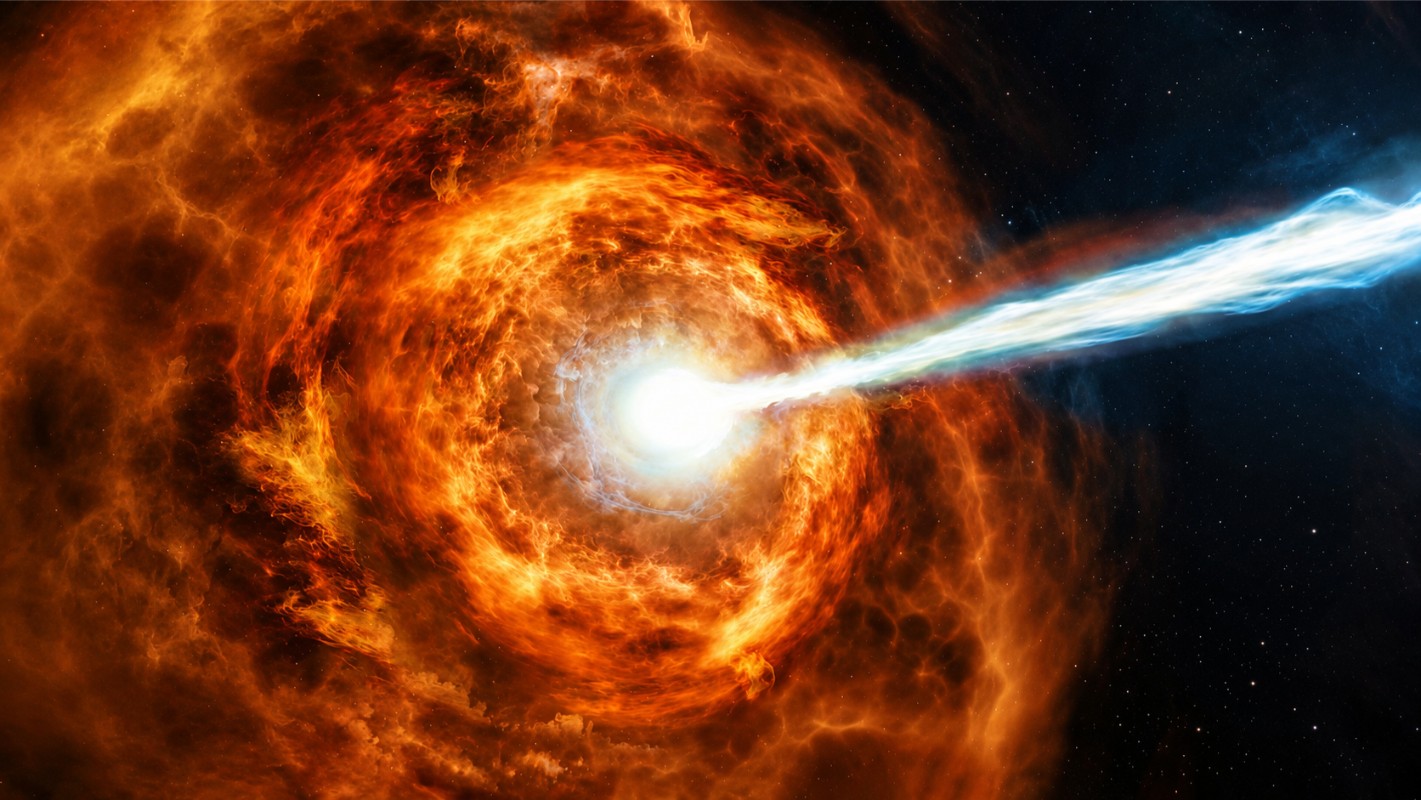
High-energy stellar events can be powerful enough to affect a planet’s atmosphere under particular conditions. For Earth, the key words are nearby, directed toward us and very rare.
Concept artwork. A gamma-ray burst is not a visible beam in the night sky.
What the models explore
Some gamma-ray bursts are produced when massive stars collapse; others come from compact-object mergers. Their intense emission is concentrated into jets. A sufficiently nearby burst pointed at Earth might alter upper-atmosphere chemistry and reduce ozone, increasing ultraviolet exposure after the event. The size and persistence of any effect depend on distance, energy, direction and the atmospheric model. A nearby supernova could also affect Earth’s radiation environment, but “nearby” is an astronomical condition, not a forecast of a current event.
Researchers have explored whether ancient extinction episodes could have involved cosmic events. These remain hypotheses, not established explanations. Claims that a burst would inevitably destroy all electronics or wipe out life worldwide go beyond what the evidence establishes.
We cannot deflect a stellar explosion. Astronomy instead studies how such events work, where they occur and how planetary atmospheres respond. Current observations support a calm assessment: there is no identified nearby source of an imminent threat.
Perspective
Astronomy studies rare extremes because they teach us about stars, chemistry and the limits of planetary protection. Their scientific importance is not a measure of near-term danger.
Evidence and further reading
Follow the measurements, not the dramatic headline.
The figures and mission plans in this article can change. The linked agencies maintain current observations and explain how uncertainty is revised. Content reviewed 31 October 2026.