

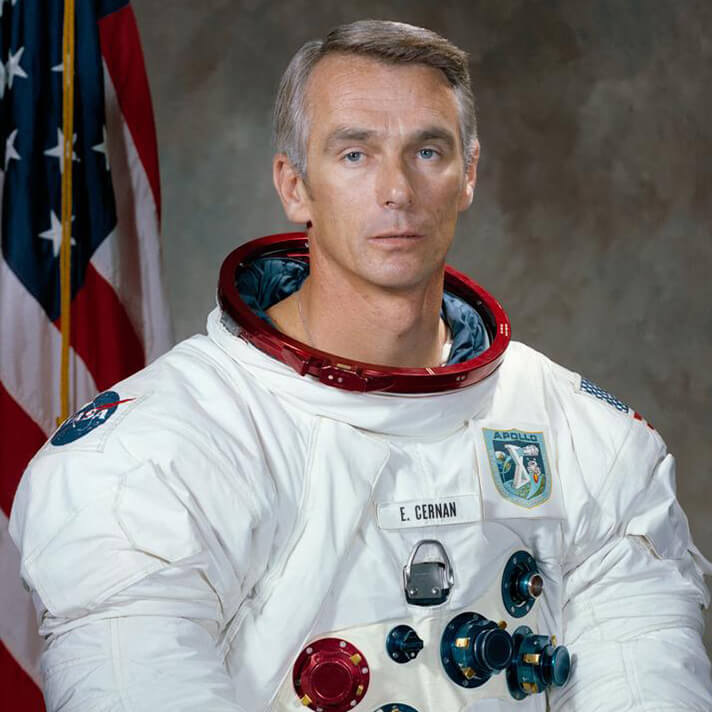
Eugene Andrew Cernan (born March 14, 1934, in Chicago; died January 16, 2017, in Houston) was an American astronaut, naval aviator, electrical engineer, and the last human (so far) to walk on the Moon during the Apollo program. He was of Slovak descent and held the rank of Captain in the U.S. Navy.
Education and Military Service
Cernan graduated from Proviso Township High School in Maywood, Illinois, in 1952, then earned a bachelor’s degree in electrical engineering from Purdue University in 1956. He was commissioned through the Navy ROTC, became a naval aviator, and performed more than 200 carrier landings as a pilot on jet attack aircraft. In 1963, he completed a master’s degree in aeronautical engineering at the U.S. Naval Postgraduate School in Monterey, California. Over his career, he logged more than 5,000 flight hours, including 4,800 on jets.
NASA Astronaut Career
Selected as an astronaut in October 1963, Cernan flew three missions: Gemini 9A (pilot), Apollo 10 (lunar module pilot), and Apollo 17 (commander)—the final Apollo Moon landing.
Gemini 9A (June 1966)
Cernan flew with Thomas Stafford on Gemini 9A. During this flight, he became the second American to conduct extravehicular activity (spacewalk), spending over two hours outside the spacecraft while orbiting Earth. The mission demonstrated rendezvous techniques with the Augmented Target Docking Adapter, though some original plans (like using the Astronaut Maneuvering Unit) were cut short by visor fogging and physical exhaustion.
Apollo 10 (May 1969)
As lunar module pilot for Apollo 10, Cernan and Stafford piloted „Snoopy” to within about 15 km of the Moon’s surface, testing every phase of a lunar landing except the final descent. Apollo 10 was a critical „dress rehearsal” for Apollo 11, confirming plans and systems for the first Moon landing.
Apollo 17 (December 1972)
Cernan commanded Apollo 17, the last human mission to the Moon. Alongside Harrison Schmitt (lunar module pilot) and Ronald Evans (command module pilot), he spent three days on the lunar surface, performing three moonwalks that totaled over 22 hours and covered about 21 miles using the Lunar Rover Vehicle. They collected a record 115 kg of lunar samples in the Taurus–Littrow valley. Upon leaving the lunar surface, Cernan famously became the last human to set foot on the Moon as of 2025.
Legacy and Later Work
After Apollo 17, Cernan assisted in planning the Apollo–Soyuz Test Project and became a special assistant to the Apollo program manager. He retired from NASA and the Navy as Captain in 1976. Cernan later founded The Cernan Corporation, consulted in aerospace, and wrote his autobiography „The Last Man on the Moon”. He was awarded multiple medals and honors for his contributions to space exploration.
Cernan logged a total of more than 566 hours in space and spent 73 hours on the lunar surface. His career bridged the formative period of spaceflight, and his role as „the last man on the Moon” endures as an iconic chapter in human history
