

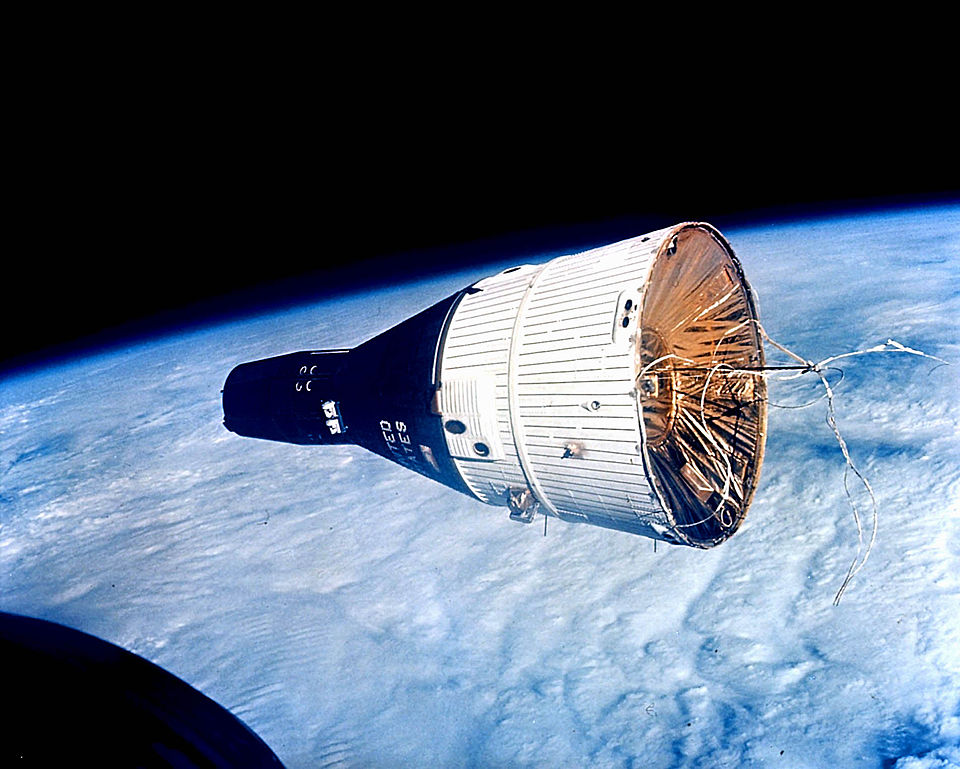
Program Gemini, carried out between 1963 and 1966, was another milestone in the race to the Moon.
Originally it was to be called Mercury Mark II, referring to the earlier Mercury project, but with a Roman numeral II to reflect the new two‑person missions.
In the end the name Gemini was chosen, inspired by the constellation of the Twins.
The main goal of the program was to practice the tasks essential for a successful lunar mission: orbital docking, enduring about two weeks in weightlessness inside a capsule, and spotting potential problems while there was still time to fix them. Key achievements included successful orbital rendezvous, the first spacewalk in U.S. astronautics, and a major improvement in the precision of orbital maneuvers.
For Gemini, nine new astronauts were recruited, and later another fourteen, already with the future Apollo program in mind.
Like the Mercury Seven, the “New Nine” had to undergo a rigorous series of psychological and physical tests during selection. They also drew media attention, though slightly less than their predecessors, and—just like them—signed an exclusive contract with Life magazine. It was worth 500,000 dollars a year, to be shared equally within the group; since the same sum had previously been split among only seven Mercury astronauts, the newcomers were less motivated to give interviews.
The “Original Fourteen,” which included figures such as Collins and Aldrin, had stronger technical and scientific backgrounds than earlier groups, but less experience as pilots. They were also a bit younger than their predecessors.
Capsule “fit for a pilot”
The Gemini spacecraft quickly earned the nickname “Gusmobile” because Virgil Ivan “Gus” Grissom, the second American in space, was deeply involved in its design and construction. As a pilot, he wanted a real pilot’s spacecraft. While the Mercury capsule was sometimes mocked by pilots outside the space program, Gemini was treated much more seriously. Most importantly, the pilot could fully control the capsule on all axes; the role of mission control on the ground was largely limited to updating the onboard computer data.

Gemini, despite its improvements, was still cramped – each astronaut had about 1 m³ of space. The spacecraft kept the conical, aerodynamic shape of its predecessor and was about 5.6 m long with a maximum diameter of 3 m. It consisted of two main sections: a crew module and a propulsion module.
In the nose of the crew module were the parachutes and the radar. Between the nose section and the crew cabin were the propellant and oxidizer tanks, along with eight thrusters for controlling the spacecraft’s attitude during reentry. The cabin itself housed the seats, a primitive onboard computer and other instruments needed to fly the capsule. The propulsion module contained, among other things, four solid‑fuel rockets and the life‑support systems.
In 1961 the Glenn L. Martin Company proposed that NASA use its Titan II ballistic missile as the launch vehicle for the new space program.
Engineers agreed, because Titan II was more powerful than the other rockets available to NASA at the time.
By May 1963 Titan II had a serious issue: unstable combustion in the engine caused the thrust to fluctuate, making the whole vehicle oscillate.
These vibrations would not have been a major problem for unmanned flights, but for a crew they would have been dangerous to their health.
The U.S. Air Force began work on the necessary modifications, but the pace did not satisfy NASA, which was rushing to meet Kennedy’s goal of landing a man on the Moon before the end of the decade.
At one point NASA even considered abandoning Titan II and switching to Wernher von Braun’s Saturn I rocket. However, the Air Force soon introduced the required fixes – including adding pressure‑relief piping in the oxidizer lines – and Titan II was finally cleared for flight.

Launch of the Titan II rocket, 23 March 1965.
The new two‑stage launcher was nearly 33 meters tall and 3 meters in diameter. The first stage was powered by two engines with a combined thrust of 195 tons, and the second stage by a single engine producing 45 tons of thrust. These parameters allowed it to place up to 3,600 kilograms of payload into low Earth orbit. Over its operational lifetime the rocket flew 12 times, and every one of those flights was successful.
Before astronauts could fly, two test missions had to be carried out – Gemini 1 and Gemini 2. The first of these, Gemini 1, was an orbital mission intended to test the rocket’s performance and its structural integration with the capsule. Other objectives included measuring launch vehicle performance, determining the accuracy of orbital insertion and testing the malfunction‑detection system. Tracking and measurements lasted, as planned, 4 hours and 50 minutes. After that the capsule continued to circle Earth for more than three days before, again as planned, burning up in the atmosphere.
Gemini 2, by contrast, was a suborbital mission focused on verifying the durability of the heat shield and the systems of the Gemini spacecraft. The flight lasted just over 18 minutes, and this time the capsule was recovered; today it can be seen on display at a museum at Cape Canaveral.
At the beginning of 1964 the prime and backup crews for Gemini 3 were announced. When Alan Shepard, a member of the prime crew and the first American in space, was diagnosed with Ménière’s disease, it fell to the backup crew – Walter Schirra and John Young – to fly the mission. It was the first multi‑person spaceflight for the United States, though not for the world; once again the Soviets led the way, having sent three cosmonauts into space a few months earlier.
Interestingly, Gemini 3 was the only mission in the program whose capsule had its own name. Gus Grissom, inspired by the musical The Unsinkable Molly Brown, suggested calling the spacecraft The Molly Brown. It was a reference to his debut mission, during which his capsule sank. At first NASA considered the name embarrassing for the agency, but after hearing his alternative suggestion – Titanic – it agreed to the original name.

The next mission, Gemini 4, was longer than the previous ones, lasting four days. This duration made it possible to test how the human body copes with space conditions over a longer period. The mission’s most important milestone was the first spacewalk in U.S. history. During the EVA, the capsule carrying Ed White and James McDivitt was supposed to maintain a constant distance of six meters from the Titan II second stage so that White could reach it using a hand‑held maneuvering gun. Although that final objective was not achieved, the remaining elements of the EVA were considered a success. White’s spacewalk lasted 20 minutes; as he drifted in the void of space, he admired the beauty of our planet and was so enthralled that it was hard to persuade him to return to the spacecraft. Even though NASA had banned mission nicknames, the crew commemorated the event by informally naming the flight American Eagle.

Thanks to the innovation of using fuel cells to power the spacecraft, missions starting with Gemini 5 could last longer—up to two weeks. The first fourteen‑day flight was Gemini 7, with Frank Borman and James Lovell on board.
During Gemini 7 the crew carried out as many as 20 scientific experiments, more than on any other mission. Its most important achievement, however, was the orbital rendezvous with Gemini 6A, crewed by Walter Schirra and Thomas Stafford; at closest approach the two capsules came within about 30 centimeters of each other, a feat that demanded extraordinary precision.
Hygiene was another major concern; spending two weeks in a cramped, windowless “tin can” made it easy to neglect. To reduce the buildup of skin flakes in the cabin, the astronauts washed their hair with anti‑dandruff shampoo every day for two weeks before launch, and once in orbit they removed their pressure suits so their skin could retain moisture more easily.
Despite these efforts, the measures did not solve the hygiene problem in space. After splashdown, two of the three divers assigned to secure the capsule vomited as soon as they opened the hatch.
Agena was an uncrewed spacecraft used in the Gemini program for docking practice, beginning with Gemini 8. It was usually launched a few hours before the crewed mission so it could reach its target orbit and wait there for the astronauts.
During Gemini 8 the first docking with an Agena was carried out. After locating the target and closing to within 46 meters, the crew spent half an hour visually inspecting it to make sure it had not been damaged during launch. Once they received clearance to proceed, Neil Armstrong began closing in at a relative speed of 8 centimeters per second, and the docking was completed successfully.

After docking, a serious problem suddenly appeared. While the astronauts were out of contact with mission control, the combined Gemini 8–Agena stack began to roll. Not knowing the cause, the pilots decided to undock as a precaution, but this only made the spacecraft spin faster; the rate reached about one revolution per second, and the crew was close to blacking out when Armstrong calmly tracked down the fault. It turned out that thruster number 8, responsible for pitch control, had jammed in the “on” position.
Stopping the roll took about 30 minutes and consumed 75 percent of the maneuvering fuel, so for the crew’s safety mission control ordered an emergency splashdown. Armstrong, who tended to downplay problems, later summed up the flight laconically: “It was a non‑trivial situation.”
Subsequent flights took place regularly, about every two months. During that time press interest in spaceflight faded, and space no longer seemed as strange and dangerous to the public as it had during Project Mercury.
The final four Gemini missions focused on refining orbital rendezvous and docking as well as spacewalks. While the meet‑ups and dockings went largely by the book, all the spacewalkers except Aldrin struggled with numerous difficulties, most of them caused by Newton’s third law—action and reaction—which made moving around and pushing off objects in weightlessness unexpectedly hard. On top of that, working in a 21‑layer spacesuit was a major challenge; Gemini 9’s Eugene Cernan compared its stiffness to a rusty suit of armor, his heart rate climbed to 195 beats per minute during EVA, and he lost six kilograms over the course of the four‑day mission.
The Gemini 10 spacewalk was also problematic. After completing only a few of his assigned tasks, Michael Collins became wedged between the Gemini capsule and the Agena; once he freed himself, he became tangled in the 15‑meter umbilical that connected him to the spacecraft, and his EVA had to be cut short after just 39 minutes. Gemini 11 brought little progress in EVA techniques either: despite careful preparation, Dick Gordon’s planned two‑hour spacewalk was terminated after only 44 minutes when he became exhausted and sweat in his helmet impaired his vision. In one respect, though, Gemini 11 was ahead of its time—thanks to the early communications satellite Telstar 1, viewers in eighteen countries could watch the Titan II launch live.
Preparation for Gemini 12’s spacewalks—and the EVAs themselves—was handled far more professionally. Lessons from previous extravehicular activities led to improved training, most notably the introduction of underwater simulations, since moving under water comes closest to working in weightlessness. During the mission Aldrin performed three EVAs totaling five and a half hours, far surpassing the records of earlier spacewalkers. He mounted a camera on the side of the spacecraft, carried out a micrometeoroid experiment, took a series of photographs and completed a range of relatively simple manual tasks. Gemini 12’s primary objective was achieved: it showed that productive, safe work in microgravity was possible.
Most of the planned secondary goals, including scientific experiments, were also completed. Among other things, the crew studied how a tadpole develops in zero gravity and took extensive photographs of the sky, although they were unable to boost the spacecraft to a higher orbit because of a propulsion problem.

he Gemini program was a major success for NASA: each mission achieved its primary goal and most of its secondary objectives. Overall, the flights went largely by the book, with only minor exceptions. Together, they provided the foundation for the success of the Apollo program.
