

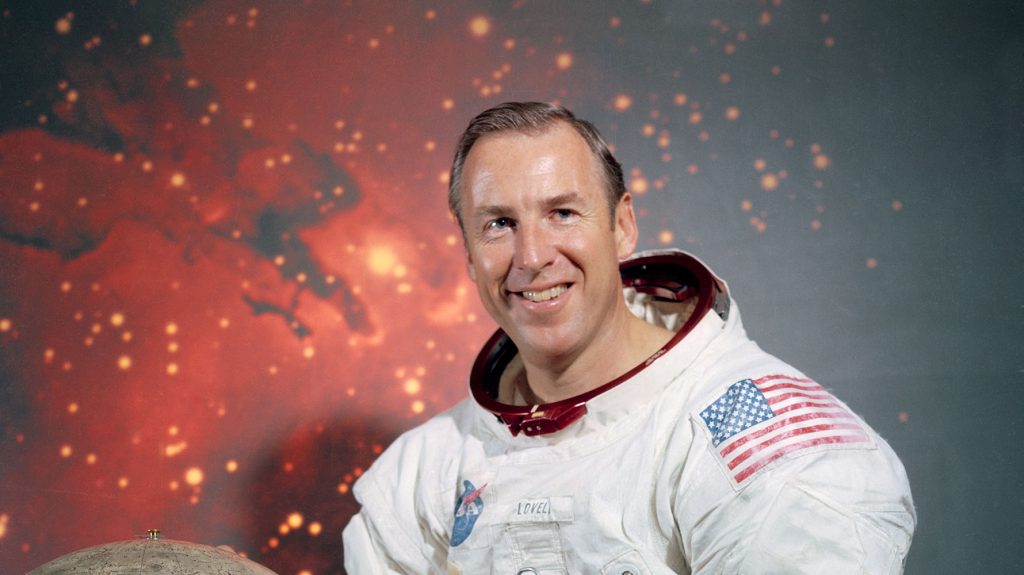
James Arthur Lovell Jr. (born March 25, 1928, in Cleveland, Ohio; died August 7, 2025, in Lake Forest, Illinois) was an American astronaut, U.S. Navy pilot and commander, best known as the commander of the Apollo 13 mission and as one of the most experienced astronauts of the Gemini and Apollo programs.
In 1946 he finished high school in Milwaukee, Wisconsin, then studied for two years at the University of Wisconsin before transferring to the United States Naval Academy, which he graduated from in 1952 with a bachelor’s degree in science. He served as a naval aviator, later attending the U.S. Naval Test Pilot School at Patuxent River, Maryland, where from 1958 to 1962 he was a test pilot responsible for the F4H Phantom program. In 1971 he also completed studies at Harvard Business School, and subsequently served as an instructor pilot and safety engineer with Fighter Squadron 101 at Naval Air Station Oceana in Virginia, leaving the U.S. Navy in March 1973.
Selected as an astronaut in 1962 (after narrowly missing out in the original Mercury Seven selection in 1959), Lovell first flew as pilot of Gemini 7 with commander Frank Borman on a nearly 14‑day endurance mission that set a record for human spaceflight duration and included a close‑rendezvous with Gemini 6A. He later commanded Gemini 12 with Buzz Aldrin as pilot, the final Gemini mission, which successfully demonstrated improved techniques for spacewalking and orbital operations.
In the Apollo program Lovell served on the backup crew of early missions and was then assigned as command module pilot of Apollo 8, the first crewed flight to orbit the Moon in December 1968, flying with commander Frank Borman and lunar module pilot William Anders and circling the Moon ten times before returning safely to Earth. He went on to command Apollo 13 in April 1970, which was intended to be the third lunar landing; after an oxygen tank explosion in the service module forced the crew to abort the landing, Lovell, Jack Swigert, and Fred Haise used the lunar module as a lifeboat and executed a free‑return trajectory around the Moon to reach Earth safely, in one of NASA’s most challenging and celebrated rescues.
Over four spaceflights—Gemini 7, Gemini 12, Apollo 8, and Apollo 13—Lovell accumulated more than 715 hours in space, at one time a record, and became one of only three people to travel to the Moon twice, though unlike some colleagues he never walked on its surface. After Apollo 13 he served as deputy director of the Johnson Space Center, left NASA and the Navy in 1973 for a business career, and later co‑authored the book “Lost Moon: The Perilous Voyage of Apollo 13,” which formed the basis for the film “Apollo 13,” in which he was portrayed by Tom Hanks.
