

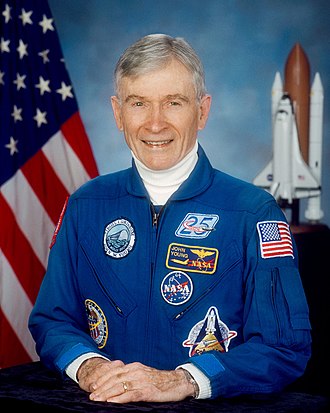
John Watts Young (born September 24, 1930, in San Francisco, California, died January 5, 2018, in Houston, Texas) was an American astronaut, United States Navy captain, and the ninth person to walk on the surface of the Moon.
He completed high school in Orlando, Florida, and in 1952 graduated from the Georgia Institute of Technology with a bachelor’s degree in aeronautical engineering, with honors. After commissioning in the U.S. Navy, he served for several years as a naval aviator. He was then sent to the Navy’s test pilot school, and from 1959 spent three years at the Naval Air Test Center at Patuxent River, Maryland. Over the course of his flying career he accumulated more than 15,100 hours in the air on a wide variety of aircraft types.
In September 1962 Young was selected by NASA for its second group of American astronauts. He went on to fly in all three of the agency’s major crewed programs of that era: Gemini, Apollo, and the Space Shuttle. He was in the second group of astronauts to orbit the Moon, and even after turning 70 he remained an active astronaut, to the point that his participation in yet another spaceflight was seriously considered. He finally left NASA in December 2004.
Young made his first spaceflight on March 23, 1965, as pilot of Gemini 3 alongside Virgil “Gus” Grissom, on the first crewed mission of the Gemini program. During the flight the crew manually changed both the altitude and the plane of their orbit—maneuvers that had not previously been carried out on crewed missions—and also performed a manually controlled deorbit burn. In December 1965 he was a member of the backup crew for Gemini 6A as the alternate to Thomas Stafford. His second spaceflight took place from July 18 to 21, 1966, when he commanded Gemini 10 with Michael Collins as pilot. During this mission Gemini 10 docked with two different Agena target vehicles, using them to raise the spacecraft’s orbit, while during one of two spacewalks Collins retrieved a micrometeoroid detector from one of the Agena stages.
Young’s third flight, from May 18 to 26, 1969, was as command module pilot of Apollo 10. The mission, commanded by Thomas Stafford with Eugene Cernan as lunar module pilot, was the second Apollo mission to enter lunar orbit and served as a full dress rehearsal for the first lunar landing. In lunar orbit Young remained in the command and service module while Stafford and Cernan took the lunar module down to within about 15 kilometers of the Moon’s surface; the successful completion of all objectives cleared the way for a landing on the next flight. His fourth mission, from April 16 to 27, 1972, was as commander of Apollo 16, with Thomas Mattingly as command module pilot and Charles Duke as lunar module pilot. This fifth lunar landing mission saw the lunar module Orion touch down in the Descartes Highlands. On April 20 Young stepped onto the lunar surface, and over three moonwalks he and Duke explored the area using a Lunar Roving Vehicle.
In addition to his prime missions, Young served on the backup crews of Apollo 7, Apollo 13, and Apollo 17, and before the Apollo 1 fire had been assigned to the backup crew for a planned second test flight of the Apollo spacecraft.
From April 12 to 14, 1981, Young commanded the first crewed flight of the Space Shuttle program, STS‑1, piloting the orbiter Columbia with Robert Crippen as pilot. This fifth spaceflight of his was the maiden mission of an operational shuttle and was dedicated to an end‑to‑end test of its systems in real flight conditions; after two days in orbit the mission ended with a landing at Edwards Air Force Base in California. Young’s sixth and final spaceflight took place from November 28 to December 8, 1983, again as commander of Columbia on STS‑9, the first Spacelab mission. The crew included Ulf Merbold from the Federal Republic of Germany, the first non‑American to fly on a U.S. shuttle, as well as pilot Brewster Shaw and mission and payload specialists Owen Garriott, Robert A. Parker, and Byron Lichtenberg. During this ten‑day scientific mission, conducted in the Spacelab module in Columbia’s payload bay, the crew worked in two shifts around the clock, carrying out a wide program of experiments. In total, across his six flights, Young spent more than 34 days in space.
In August 1986 Young was slated to make a seventh journey into space as commander of mission STS‑61‑J, which was to deploy the Hubble Space Telescope. The Challenger disaster led to a stand‑down of the shuttle program, and that flight was canceled. From January 1974 to May 1987 he served as head of NASA’s Astronaut Office. From May 1987 to February 1996 he was a special assistant to the director of the Johnson Space Center, and from February 1996 he served there as technical director. He retired from NASA in December 2004 after 42 years of service.
The Association of Space Explorers posthumously awarded him the Universal Astronaut Insignia for orbital flight number 17.
