

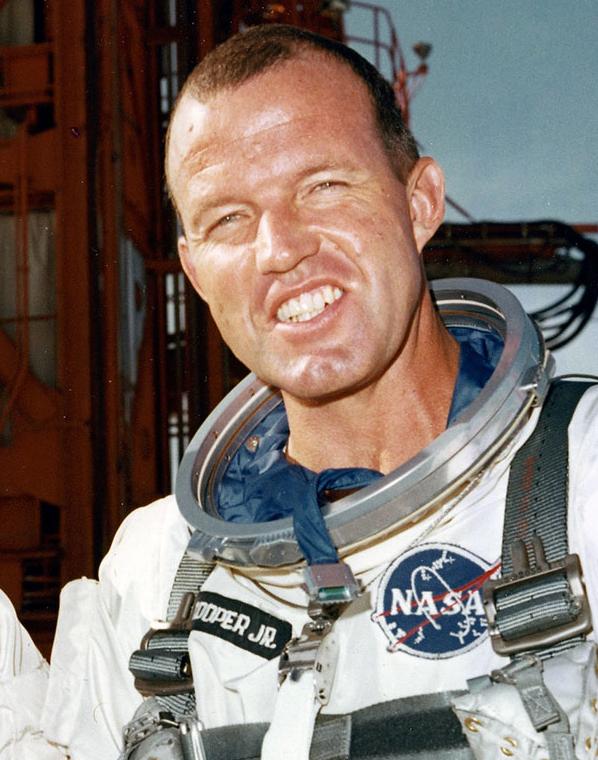
Leroy Gordon “Gordo” Cooper Jr. (born 6 March 1927 in Shawnee, Oklahoma, died 4 October 2004 in Ventura, California) was a United States Air Force colonel and pilot, engineer, and astronaut. He flew in space as part of the Mercury and Gemini programs.
Cooper’s school years were spent in Shawnee, Oklahoma, and in Murray, Kentucky. It was during this time that he took his first steps into aviation, flying an obsolete Chance Vought UO-1 aircraft. After graduating from high school in 1945, he enlisted in the United States Marine Corps, with which he spent the end of World War II on one of the Pacific islands.
After the war ended, in 1946 he moved to Hawaii, where he lived with his parents. There he began his studies at the University of Hawai‘i in Honolulu, which he continued until 1949. In Hawaii he met Trudy, his first wife. They married in 1947 and began traveling together by air; Trudy Cooper was the only astronaut’s wife who held a pilot’s license.
Even before completing his studies in Hawaii, Leroy was recalled to active duty. He successfully completed pilot training, earning his military pilot wings, and with the rank of second lieutenant was assigned to the 525th Bomb Squadron, stationed in Neubiberg near Munich. During his four-year stay in Germany, he did not neglect his education and regularly attended evening courses at the European division of the University of Maryland.
From 1954 to 1956, he studied at the Air Force Institute of Technology at Wright-Patterson Air Force Base near Dayton, Ohio. He graduated with a degree in aeronautical engineering. He then spent several years at Edwards Air Force Base in California, working as a test pilot.
Cooper was one of 110 test pilots who took part in the selection for the first group of American astronauts intended for flights in the Mercury program. On 2 April 1959, together with six other pilots, he was officially named a member of the group known as the “Mercury Seven” or “Original Seven.”
During the first two crewed flights of the Mercury program, Mercury-Atlas 6 and Mercury-Atlas 7, Cooper served as CapCom, maintaining radio contact with the astronauts in orbit. During the Mercury-Atlas 8 flight on 27 June 1962 he was backup pilot to Wally Schirra.
Cooper’s own flight was the last in the Mercury program. As one of the seven astronauts still waiting for their chance (Deke Slayton had earlier been grounded by doctors because of a heart arrhythmia), on 13 November he was assigned as pilot of the capsule named “Faith 7.” On 15 May 1963, aboard Mercury-Atlas 9, he launched on his first spaceflight. He orbited Earth 22 times and spent more time in space than all previous American astronauts combined. He was also the first American astronaut to sleep in orbit.
The goal of the flight was to study the effects of weightlessness on a relatively long human stay in space for that era. During reentry and splashdown, the astronaut was forced to fire the capsule’s retrorockets manually, because most of the spacecraft’s onboard systems had failed. The Mercury-Atlas 9 mission lasted 1 day, 10 hours, 19 minutes, and 49 seconds.
After this mission, the next planned long-duration Mercury flight, in which Alan Shepard was to participate, was canceled. Cooper had been designated as Shepard’s backup. By that time, NASA’s attention was already focused on the Gemini program.
On 21 August 1965, Cooper, as commander of Gemini 5, launched into space in a two‑man capsule together with Charles Conrad. During what was then a record-breaking flight lasting 7 days, 22 hours, 55 minutes, and 14 seconds, the astronauts tested orbital maneuvering operations. Cooper also became the first astronaut to travel to orbit for a second time. After a successful splashdown on 29 August 1965, he became the record holder for total time spent in space. Over his two flights he spent a total of 9 days, 9 hours, 15 minutes, and 3 seconds off the Earth.
In November 1966, during Gemini 12, the final crewed flight of the Gemini program, he served as backup commander of the mission.
Cooper also took part in the Apollo program. In May 1969 he was the backup commander of Apollo 10, the mission that served as the full dress rehearsal for the Moon landing. He had an excellent chance of becoming the fifth person to walk on the lunar surface. However, this did not happen because Alan Shepard, who had returned to active flight status after a long break due to health problems, was appointed by NASA as commander of Apollo 13. Shepard and his crew were later reassigned to Apollo 14, because he needed more time to prepare for the mission.
On 31 July 1970, Gordon Cooper left NASA, discouraged in part by the conflict surrounding the Apollo 13 mission. He went into business and worked as a technical consultant for various companies.
Toward the end of his life he developed Parkinson’s disease. He died on 4 October 2004 at his home in Ventura, California. On 29 April 2007, his ashes—together with the ashes of 206 other people—were placed aboard a SpaceLoft XL rocket that carried out a commemorative suborbital “flight of remembrance.” On 3 August 2009, part of the astronaut’s ashes were launched into space again, this time on a Falcon 1 rocket, which, however, failed two minutes after liftoff and did not reach its target. Cooper’s ashes finally reached Earth orbit thanks to a Falcon 9 rocket launched on 22 May 2012.
The Association of Space Explorers posthumously awarded him the Universal Astronaut Insignia for orbital flight number 8.
