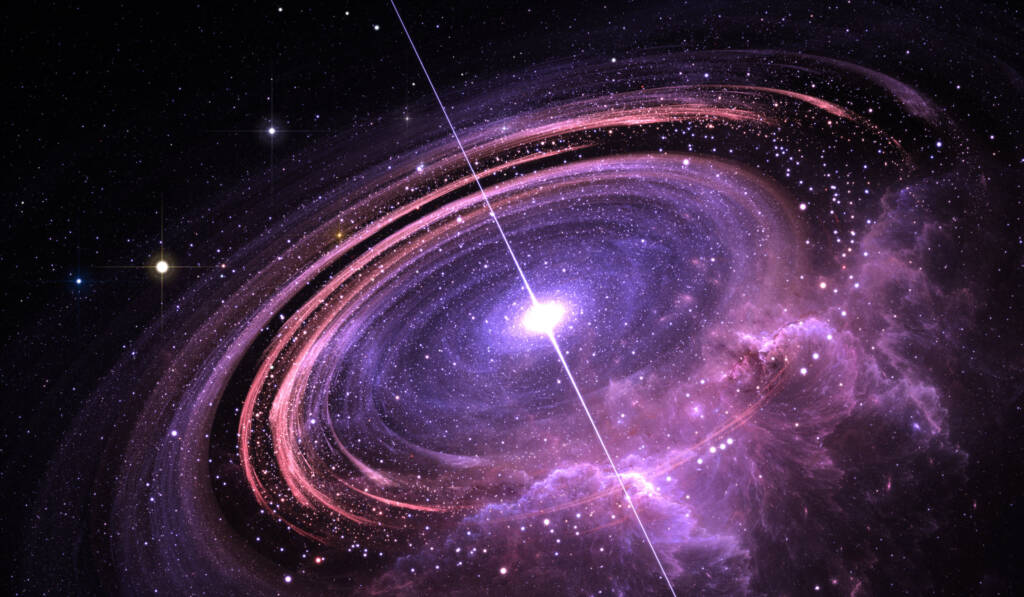
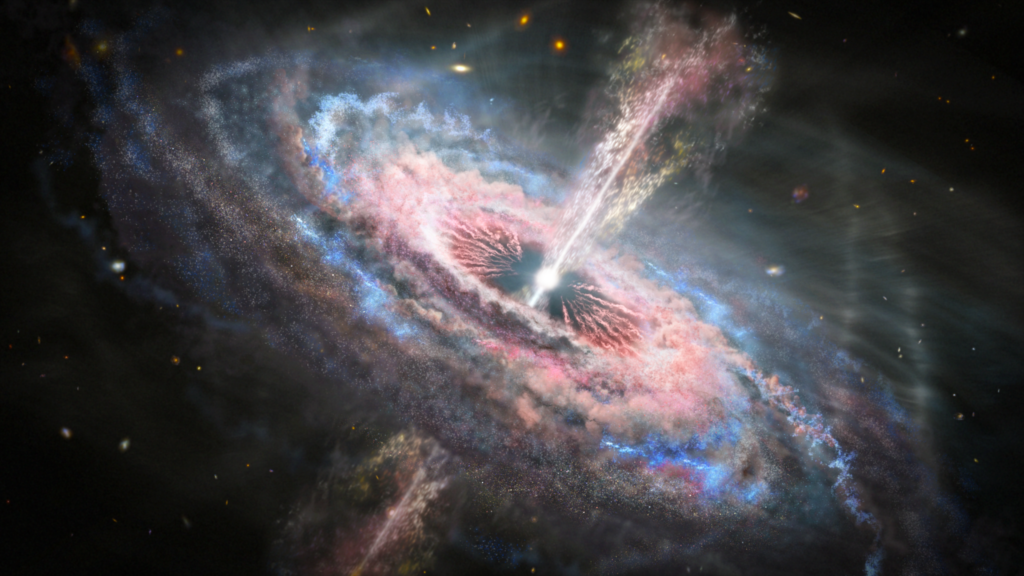
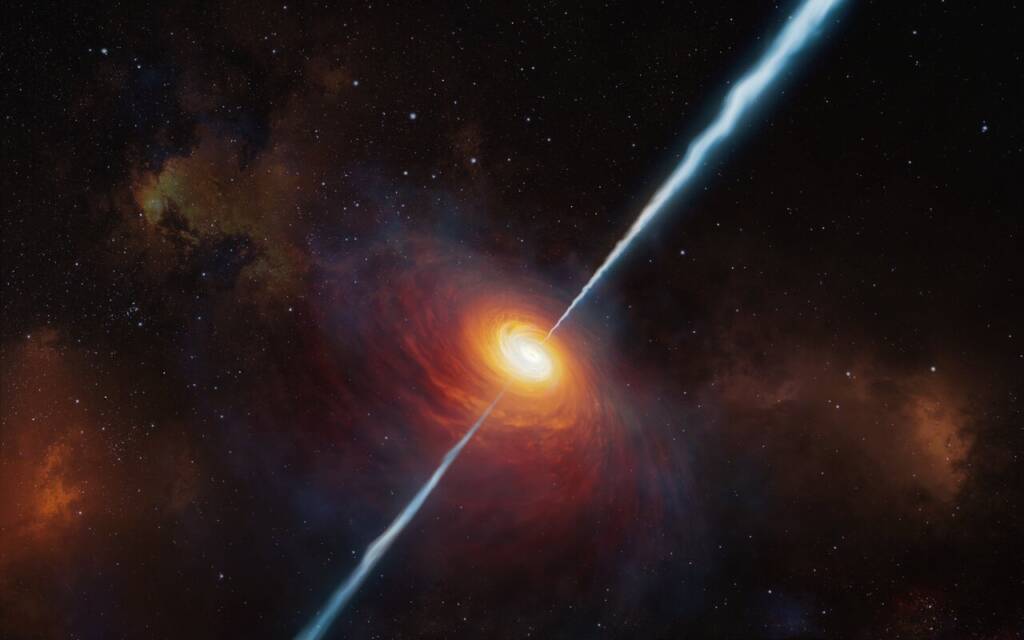
Quasar (quasi-stellar radio source) – is an incredibly bright and distant active galactic nucleus, powered by a supermassive black hole consuming surrounding matter. A quasar is a source of continuous electromagnetic radiation of immense power, outshining entire galaxies. These are among the brightest objects in the Universe, located billions of light-years from Earth and appearing star-like. In reality, it is a type of active galaxy.
In the heart of a quasar lies a supermassive black hole (with a mass of thousands to billions of Suns), surrounded by a spinning accretion disk of hot matter.
The accretion disk heats up to extreme temperatures, emitting radiation in every range (X-ray, radio, optical, gamma).
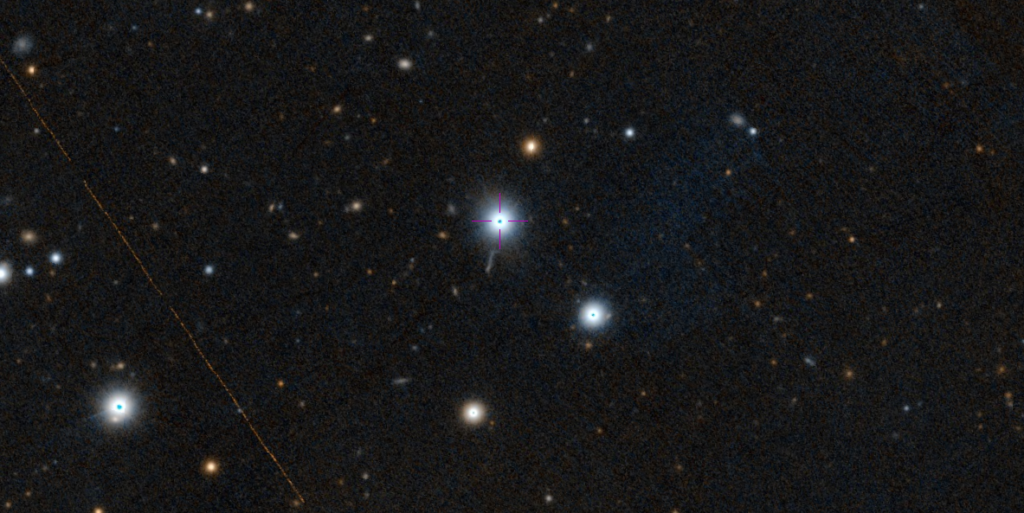
The first identified quasar was 3C 273. It is the first quasar ever discovered (1963) and identified, being an exceptionally bright, active nucleus of an elliptical galaxy. Located in the constellation Virgo at a distance of about 2.5 billion light-years, it is the brightest quasar in the Earth’s sky. It consists of a supermassive black hole consuming matter.
Quasars are often considered an early stage of evolution for some galaxies, and our Milky Way may have also passed through such a phase.
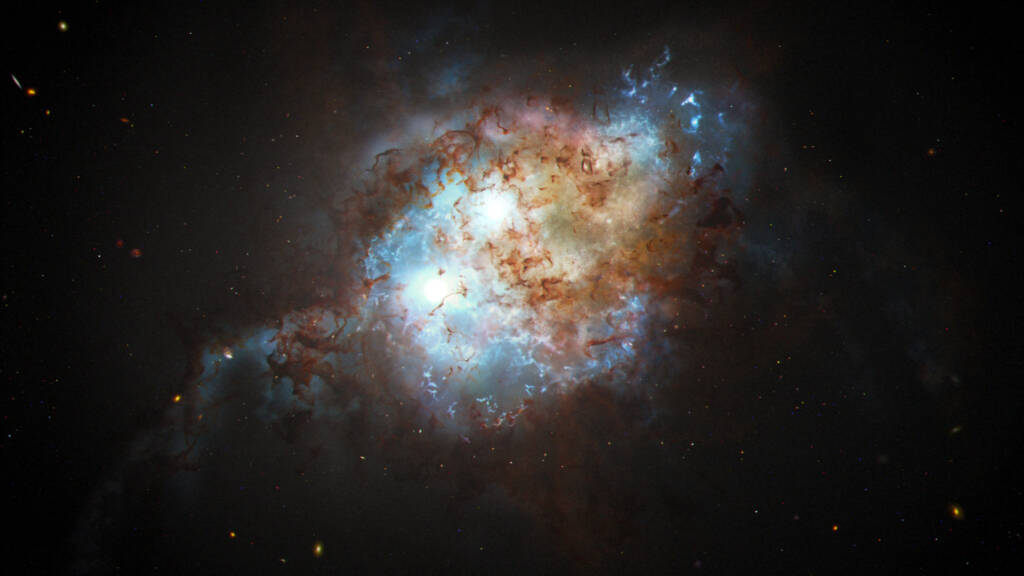
A double quasar is a rare astronomical phenomenon in which two supermassive black holes are actively consuming matter in the center of colliding galaxies. These are key objects for understanding the evolution of the early Universe, often heralding a galaxy merger; it is estimated that one such system occurs for every 1000 ordinary quasars. Two bright galactic nuclei (quasars) are located in close proximity, gravitationally bound, leading to their future collision.
They are formed when two galaxies collide and their central supermassive black holes begin to accrete matter simultaneously.
Quasars are like the longest-reaching cosmic rulers, dating back as far as 13 billion years. Scientists propose using these extraordinary cosmic objects to determine distances in the Universe.