

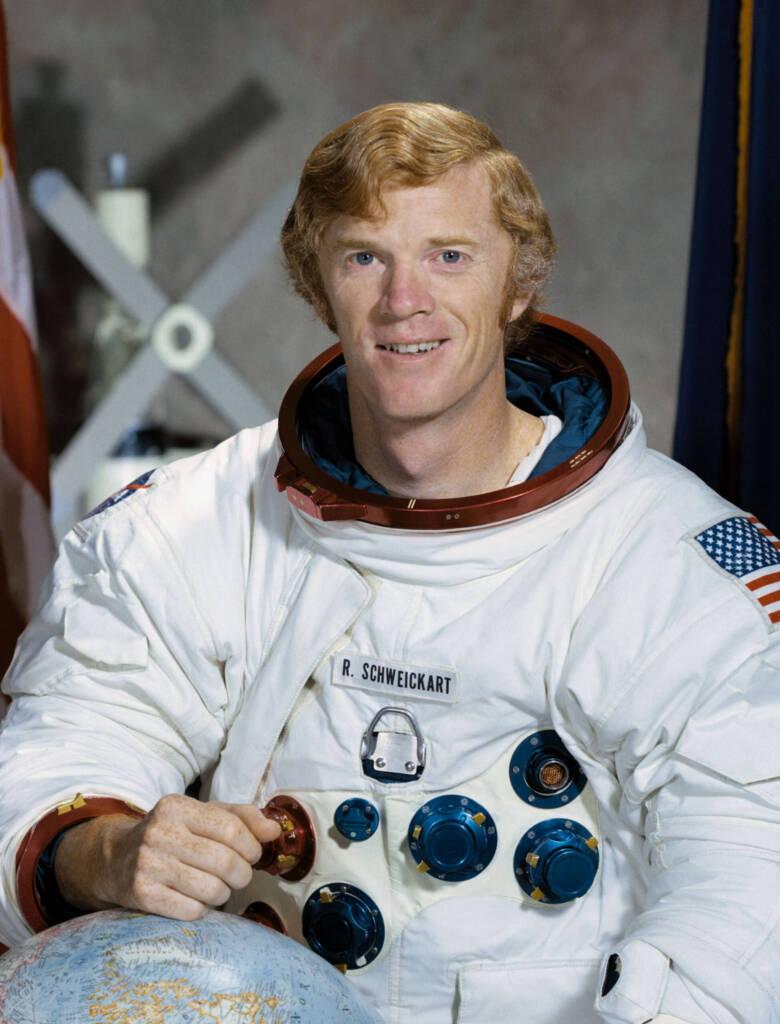
Russell Louis “Rusty” Schweickart (born October 25, 1935, in Neptune, New Jersey) is an American former astronaut and test pilot best known as the lunar module pilot of Apollo 9, the first crewed flight test of the lunar module.
During that 1969 mission he spent about 241 hours in space and carried out a 46‑minute spacewalk that tested the portable life‑support backpack later used by astronauts walking on the Moon.
Schweickart earned a bachelor’s degree in aeronautical engineering from the Massachusetts Institute of Technology (MIT) in 1956, followed by a master’s degree in aeronautics and astronautics from MIT in 1963.
From 1956 to 1963 he served as a fighter pilot in the U.S. Air Force and the Massachusetts Air National Guard, reaching the rank of captain and accumulating more than 4,000 flight hours, including about 3,500 hours in high‑performance jet aircraft.
Before joining the astronaut corps he worked as a research scientist at MIT’s Experimental Astronomy Laboratory, studying upper‑atmospheric physics, star‑tracking and stabilization of stellar images.
Selected in October 1963 as part of NASA’s third astronaut group, Schweickart initially served on backup crews for early Apollo test flights.
From March 3 to 13, 1969, he flew as lunar module pilot on Apollo 9 with commander James McDivitt and command module pilot David Scott, in the first crewed mission to test the lunar module and full Apollo configuration in Earth orbit.
During Apollo 9 he and McDivitt separated the lunar module “Spider” from the command module, flew it independently out to roughly 160 km, then redocked, while Schweickart’s EVA qualified the portable life support system for later Moon landings.
After Apollo he was backup commander for Skylab 2, the first crewed Skylab mission, where he led the development of hardware and procedures that allowed astronauts to deploy an emergency sunshade and free a jammed solar array, effectively saving the space station.
In total he logged just over 10 days in space on Apollo 9 and received NASA’s Distinguished Service Medal, the Federation Aéronautique Internationale De la Vaulx Medal, and a special Emmy Award for helping transmit the first live television pictures from space.
Schweickart left the astronaut office in 1974 and NASA in 1977, moving to NASA Headquarters for a time as Director of User Affairs in the Office of Applications, where he worked on promoting practical uses of space technology.
He then served as science and technology advisor to California governor Jerry Brown and spent over five years on the California Energy Commission, including a term as its chairman.
In later decades he held leadership roles in several technology companies and co‑founded the B612 Foundation, which advocates for detecting and mitigating hazardous asteroids, while remaining active as a public voice on space exploration and planetary defense.
