


Salyut Space Station Program
Salyut was a series of Soviet space stations developed during the 1970s and 1980s. Designed for simplicity, these stations consisted of a single module launched into orbit by a single carrier rocket. The program was officially designated as DOS (Long-duration Orbital Station).
Technical Specifications
The dimensions of the Salyut stations were primarily determined by the payload capacity of the Proton rocket and the constraints of Soviet infrastructure. To remain undetected by American spy satellites during transport, each station had to fit within a standard railway car for the journey from the Khrunichev plant in Moscow to the Baikonur Cosmodrome.
Dimensions: The stations were single cylinders ranging from 13.6 to 16 meters in length.
Diameter: Varied by section from 2 to 4.15 meters.
Volume: Total pressurized volume reached 83 m³, with approximately 50 m³ of living space.
Power System: Energy was generated via solar panels (initially four panels, later refined to three larger ones starting with Salyut 4) and stored in nickel-cadmium batteries.
Propulsion: For orientation and stabilization, the stations used two main correction engines and 32 smaller thrusters (140 N thrust).
Structural Segments
The station was divided into three functional areas:
1. Transfer Compartment
A 3-meter long section (2m diameter) containing the docking node. With a pressurized volume of 8 m³, it served as the entry point for manned Soyuz craft and Progress resupply vehicles, as well as an airlock for extravehicular activities (spacewalks).
2. Working Compartment
The primary living and research area, measuring approximately 9 meters in length. This section housed:
Life support systems and food supplies.
Gym equipment and sanitation facilities.
Control consoles and over a dozen portholes for scientific observation.
3. Assembly (Equipment) Section
A 3.5-meter long unpressurized section containing the main propulsion systems (initially 4000 N thrust). In advanced models like Salyut 6 and 7, this section was upgraded with a second docking port, allowing two spacecraft to be attached simultaneously. To accommodate this, the engines were relocated to the outer edges and their thrust was adjusted to 3000 N.
Station Description
Salyut 1 (DOS 1)
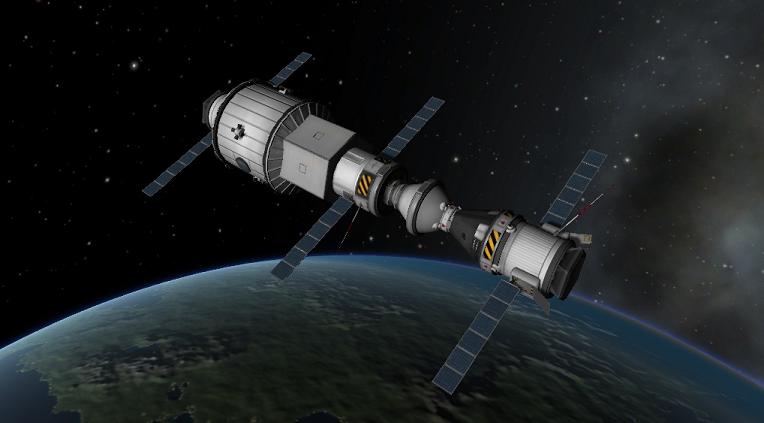
Salyut 1 was the first space station launched into low Earth orbit by the Soviet Union on April 19, 1971.
Salyut 1 originated as a modification of the military Almaz space station program then in development. The basic structure of Salyut 1 was adapted from the Almaz with a few modifications and would form the basis of all Soviet space stations through Mir.

The craft was described as being 20 m in length, 4 m in maximum diameter, and 99 m3 in interior space with an on-orbit dry mass of 18,425 kg . Of its several compartments, three were pressurized , and two could be entered by the crew. Equipment aboard Salyut 1 included a telescope, spectrometer, electro-photometer, and television. The crew checked improved on-board spacecraft systems in different conditions of flight and conducted medico-biological research. The main instrument, a large solar telescope, was inoperative because its cover failed to jettison. Different scientific work in the areas of biology, astronomy and Earth observation were performed. There was enough ECS consumables, fuel, water, and food aboard for the station to continue in manned operation for two months.

The Soyuz 11 launch proceeded without any difficulties. The first orbital correction in the set of rendezvous maneuvers to head for Salyut 1 was made on the fourth orbit.
Following a one-day solo flight Soyuz 11 docked with the space station Salyut 1 on June 07, 1971.
Aboard Soyuz 11, the Igla automatic rendezvous and docking system was switched on when the spacecraft was 7 km from Salyut 1. There was no manual intervention in the process; Georgi Dobrovolsky simply made reports to the ground of the rendezvous and docking system’s progress. Docking itself took place out of tracking range. There was considerable suspense in mission control during the 90-minute wait until reacquisition. Before leaving radio contact, telemetry showed a signal that the docking mechanism had depressurized, which would have prevented the cosmonauts from opening the hatch and entering the space station. But when the station came back in view, it turned out that all went normally and the crew had already entered the station. The first crew of the station were Viktor Patsayev (top left), Georgi Dobrovolsky (left) and Vladislav Volkov (right).

Viktor Patsayev entered first, turned on the air regenerator, and replaced two failed fans. The crew report said that the station atmosphere was unpleasant, with a strong burned smell. It will take 20 hours for all of the air in the station to cycle through the ECS scrubbers, so the crew is told to spend the first night aboard their Soyuz.
Salyut 1 was moved to a higher orbit in July–August 1971 to ensure that it would not be destroyed prematurely through orbital decay. In the meantime, Soyuz capsules were being substantially redesigned to allow pressure suits to be worn during launch, docking maneuvers, and re-entry. The Soyuz redesign effort took too long however, and by September, Salyut 1 was running out of fuel. It was decided to conclude the station’s mission and on October 11, the main engines were fired for a deorbit maneuver. After 175 days, the world’s first space station burned up over the Pacific Ocean.
After the Salyut 1 program followed successful launches of five more stations – Salyut 3, 4, 5, 6, 7. The program ended on February 7, 2991. Salyut 7 was the last space station of the Salyut Program, which was replaced by Mir.

Salyut 2 (Almaz 1)
Salyut 2, launched on April 3, 1973, was in fact a prototype of the top-secret Almaz space station, meaning „Diamond” — the designation Salyut was given to hide its true purpose. Although it shared the same name as the first station built by Vasily Mishin, it was completely different. Its designer was Mishin’s rival – Vladimir Chelomey. It was created for military purposes. It featured a large telescope that occupied the entire height of its cabin. Due to the faulty operation of the third stage of the Proton rocket, the new station gained too rapid a rotation, which practically made it impossible to use for manned missions. Salyut 2 orbited the Earth for 55 days, until May 28, 1973.

Kosmos 557 (DOS 3)
The station designated DOS 3, whose name was taken over by the Almaz station, was launched into orbit on May 11, 1973, three days before the launch of the American Skylab station. A software error while the station was momentarily out of range of Soviet flight control led to the firing of the station’s correction engines, which continued to operate until the fuel was completely exhausted. Since the station was already in orbit and had been detected by Western radars, Soviet authorities announced that the craft was a satellite named Kosmos 557. The station lasted only 11 days in orbit and, like its predecessor, was useless.
Salyut 3 (Almaz 2)

Salyut 3 (Almaz 2) Salyut 3 was launched on June 25, 1974. It also belonged to the Almaz military program. For the first time, movable solar panel surfaces were used, automatically directed towards the Sun, which allowed for a more economical fuel management for the correction engines. The functionality of the interior spaces was increased while maintaining the same volume; furthermore, the station was equipped with an automatic return capsule (lander). Two crews were sent to the new station. The first, consisting of Pavel Popovich and Yuri Artyukhin, arrived in the Soyuz 14 spacecraft on July 5 and worked for 15 days; the second launched on August 26, 1974, in Soyuz 15, but the docking operation failed, and the crew of Gennady Sarafanov and Lev Dyomin returned to Earth after two days. On September 23, 1974, a lander containing film canisters was recovered from the station. The station itself ended its life on January 25, 1975, after 214 days of flight. The station served for testing reconnaissance sensors and cameras. On January 24, 1975, orbital tests of a 23 mm Nudelmann onboard cannon were conducted (some sources claim it was a 30 mm Nudelmann NR-30 cannon). Positive results were obtained in firing at distances from 500 to 3000 meters. During the trials, a target satellite was destroyed. The following day, the station’s re-entry into the atmosphere began.
Salyut 4 (DOS 4)

Salyut 4 (DOS 4) The Salyut 4 station was launched into orbit on December 26, 1974, just before the end of the Salyut 3 satellite base’s existence. This station featured a modified design. Instead of 4 solar panel arrays, only 3 arrays were installed, but with a larger wingspan. Two were placed opposite each other on the „sides” of the base, and the third was perpendicular to them, on the back of the base. Swivel mounts were used, allowing each panel to be directed separately toward the Sun without rotating the entire station. This simplified the operation of the base while improving the electricity supply. It was a faithful copy of the DOS 3 station, but unlike it, the Salyut 4 mission ended in success. Two crews, brought up by the Soyuz 17 and Soyuz 18 capsules, stayed on board. The second crew spent 63 days on board. In doing so, it set a new Soviet record, coming seriously close to the record of the third Skylab crew (84 days). Salyut 4 was the first Soviet station visited by more than one crew. On November 17, 1975, the unmanned Soyuz 20 spacecraft, a prototype of future cargo ships, docked with Salyut. On February 16, 1976, Soyuz 20 detached from the base and landed on Earth. The Salyut 4 station remained in orbit for over two years before burning up in the atmosphere on February 3, 1977.
Salyut 5 (Almaz 3)

Salyut 5 (Almaz 3) The Salyut 5 station was launched into orbit on June 22, 1976. It was the third and final station of the Almaz program. It was visited by two crews—on board Soyuz 21 and Soyuz 24. On February 26, 1977, a lander detached from the base containing research materials, the specific nature of which was not clarified, and successfully returned to Earth. The Salyut 5 base itself ended its existence on August 8, 1977.
Salyut 6 (DOS 5)

Salyut 6, launched on September 29, 1977, was a breakthrough in space station design despite its external similarity to its predecessors. It was equipped with a second docking port, which allowed the station to be visited by automatic Progress transport vehicles, delivering fuel and supplies on board. The station was visited by 5 long-term crews and 11 short-term crews, including cosmonauts from Warsaw Pact countries as part of the Interkosmos program. The very first crew of the station set a record for orbital stay duration, remaining on the station for 96 days. The longest stay on board Salyut 6 was 185 days. One of the cosmonauts who visited this station was the first Pole in space, Mirosław Hermaszewski, who participated in the Soyuz 30 mission in 1978. After the manned expeditions to the station were completed, a docking test of a heavy TKS module (designated as Kosmos 1267), developed using unused elements of the Almaz program, was conducted using the station.
Salyut 7 (DOS 6)

Salyut 7 Salyut 7, which was structurally very similar to Salyut 6, was launched on April 19, 1982. It was visited by 6 long-term expeditions and four short-term ones. In addition to the experiments conducted on board the station, it was used for further testing of docking techniques for heavy station modules, referred to as heavy Kosmos modules. These trials were essential for the construction of the (planned) modular space station, Mir.
DOS 7 The next project of the Salyut program, similar in construction to the previous two stations but equipped with six docking ports, was launched into space in 1986 and became the core module of the significantly larger Mir orbital station. The DOS 7 module itself weighed 20.4 tons. The station was expanded over the following 10 years and served cosmonauts until 2001.
