

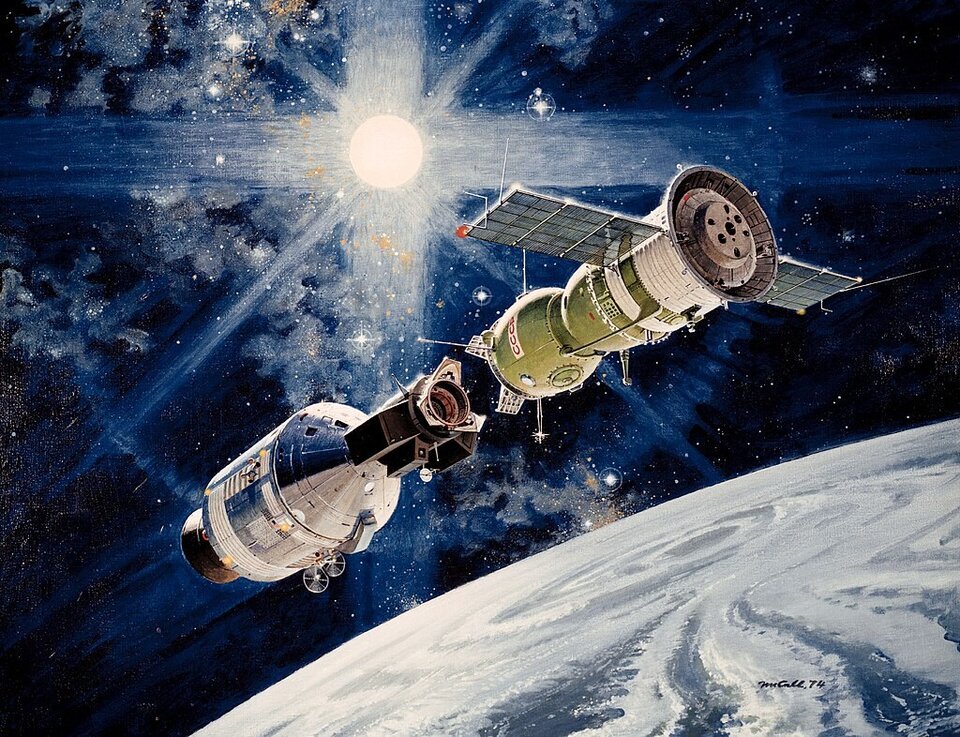
Soyuz – a series of Soviet and later Russian spacecraft. The program was initiated in the early 1960s as part of the Soviet lunar landing program. The program includes both the capsule and the launch vehicle, both named “Soyuz”. It should be noted that the name Soyuz Program strictly speaking refers only to the first capsule flights aimed at preparing for lunar missions. From the Soyuz 11 mission onward, flights were carried out under other programs – Almaz, Salyut, Mir and ISS.

The lunar landing was abandoned when mounting technical problems made it obvious that the Americans would reach it first. However, Soyuz survived the end of Soviet dreams of the Moon and developed into a series of civilian and military vehicles, used mainly in conjunction with space stations. Soyuz capsules have been produced for almost 50 years – during this time more than 240 vehicles have been built (pplx://action/translate). The Soyuz spacecraft have proved to be the most long-lived crewed spacecraft in history. They owe their longevity, among other things, to the ease of modification, modernization and adaptation to a variety of missions.

The primary design objective was to minimize the total mass of the vehicle. To this end, it was decided above all to reduce the mass of the landing module to an absolute minimum. This goal was achieved in two ways. First, all systems not needed during atmospheric reentry and landing were placed in a separate, jettisonable orbital module, connected to the landing module by a hatch. Every kilogram of mass saved in this way subtracts as much as two kilograms from the total mass of the vehicle – the orbital module does not need to be protected by a heavy heat shield or equipped with braking parachutes. Second, the landing module was to have a shape with the best possible surface-to-volume ratio – a sphere or a shape as close to a sphere as possible. In the end, a hemisphere capped with a cone was chosen, which joined it to a hemispherical heat shield.
Generations of capsules
Soyuz capsules have undergone many modifications over their history and can be divided into several generations. Soyuz vehicles numbered from 1 to 11 (1967–1971) were the first generation – they carried a three-person crew without spacesuits. They had characteristically curved solar panels and used the Igla automatic docking system, which required the use of radar antennas. This generation included both the original Soyuz capsules and capsules adapted for docking with the orbital stations of the Salyut program. The first 9 units of this generation were not equipped with an internal airlock, and the crew’s transfer to the station required carrying out a spacewalk.

The second generation, comprising vehicles numbered from 12 to 40 (1973–1981), was used exclusively for transporting crews to the space station. The vehicles were devoid of solar panels, instead using batteries. The two-person crew wore spacesuits throughout the entire flight.
The third generation consisted of Soyuz-T class vehicles (1976–1986). They used newly designed, flat solar panels and once again could carry a three-person crew, in spacesuits. The vehicle used in the Soyuz-Apollo program was a prototype of the third generation of Soyuz spacecraft.

Soyuz-TM constituted the fourth generation of the spacecraft (1986–2003) and was used mainly to transport crews to the Mir space station. They were equipped with a new automatic docking system, Kurs. Soyuz-TMA (2003–2012) and its improved version Soyuz-TMA-M (2010–2016) were designs developed as crew transport and lifeboat capsules for the International Space Station (ISS). They were fitted with new onboard computer displays, new parachutes, and many minor improvements. Soyuz-MS (from 2016) is probably the final version of the vehicle and is intended for servicing the ISS. The first flight (Soyuz MS-01) took place in July 2016.
Modifications and derivatives
The Soyuz capsule formed the basis for many vehicles, many of which never entered service. In its earliest form, the capsule was intended to be capable of a journey to the Moon without the need for an enormous launch vehicle such as Saturn V or the Soviet N1, instead performing a series of docking maneuvers with upper stages of the Soyuz launch vehicle left earlier in orbit and using their fuel for acceleration. Another development program was the Zond vehicle, which was to allow two cosmonauts to perform a circumlunar flyby. Several military variants were also planned – including “destroyers” – but these projects were never realized.
Soyuz P and Soyuz PPK – “fighter” variants intended to inspect and, if necessary, destroy enemy satellites – the projects were abandoned when the USSR successfully tested the unmanned killer satellites Polot 1 and Polot 2.
Soyuz R – a reconnaissance and command vehicle consisting of two Soyuz spacecraft: a component remaining permanently in orbit, built on the basis of a Soyuz in which the descent and orbital modules were replaced by an instrumentation section, and a transport module equipped with a docking ring that delivered the crew to orbit – the project was cancelled and replaced by the Almaz project.
The most successful derivative program of Soyuz is the series of uncrewed cargo vehicles Progress, which use the navigation and automatic docking system from the Soyuz capsule but do not include a crew module.

Launch vehicle
The Soyuz-2 launch vehicle currently in service is a direct development of the R-7 rocket, the world’s first intercontinental ballistic missile. The rocket consists of four jettisonable boosters, which in Russian terminology form its first stage, and a two-stage central core. Various versions of the Soyuz rockets have been in service in the Soviet Union and Russia for over 40 years, and under an agreement between Russia and the European Space Agency, Soyuz-2 began flights from the European spaceport in French Guiana in 2011. By the year 2000, a total of 1,628 rockets of all R-7 variants had been launched, with a reliability rate of 97.5%. R-7 / Soyuz is therefore the most widely used and one of the most successful rockets in history.

Present and future
At present, Soyuz vehicles form the backbone of the Russian space program. After the disaster of the American Space Shuttle Columbia and the final flight of the shuttle Atlantis, they became the only means of transporting crews to the International Space Station. Only in 2020 did they gain competition in the form of Crew Dragon spacecraft.
In August 2005, Space Adventures, a company specializing in organizing space tourism, announced plans to restore Soyuz to its original role and use a modified capsule for circumlunar tourist flights.
