

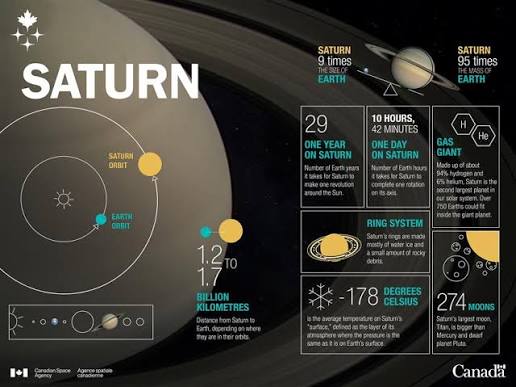
Saturn is the sixth planet from the Sun and the second-largest planet in the Solar System, surpassed in size and mass only by its nearby gas giant sibling, Jupiter. Orbiting at an average distance of roughly 1.43 billion kilometers (9.58 Astronomical Units), Saturn is the most distant planet easily visible to the naked eye. Named after the Roman god of agriculture and time, Saturn appears in our night sky as a bright, yellowish star, but through a telescope, it reveals itself as one of the most visually stunning objects in the cosmos.
As a gas giant, Saturn possesses no solid, defined surface. It is composed overwhelmingly of hydrogen and helium, the same lightweight elements that dominate the Sun. Despite its enormous volume—capable of containing over 760 Earths—Saturn holds the unique title of being the least dense planet in the Solar System. With a bulk density lower than that of liquid water, Saturn boasts a world where extreme physics and fluid dynamics reign, generating high-speed atmospheric jet streams, a massive polar hexagon storm, and an intense internal heat source powered by deep helium precipitation.
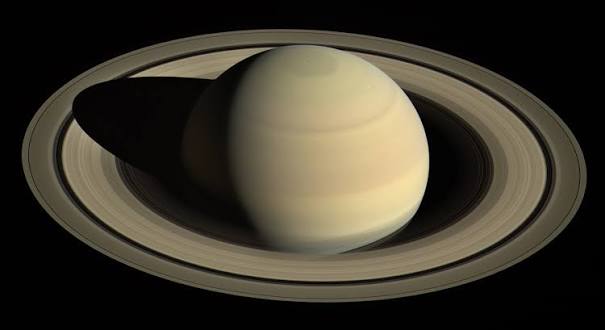
What truly elevates Saturn into a class of its own, however, is its magnificent ring system. Spanning hundreds of thousands of kilometers while measuring as little as 10 meters thick in places, Saturn’s rings consist of billions of shimmering particles of pure water ice and rocky debris. Beyond its rings, Saturn commands a sprawling satellite kingdom of over 140 known moons. These range from Titan, a giant world with a dense nitrogen atmosphere and liquid hydrocarbon lakes, to Enceladus, a small icy moon hiding a global subsurface ocean that spews organic-rich geysers into space. From early flybys by the Pioneer and Voyager probes to the decade-long discoveries of the Cassini-Huygens mission, Saturn remains a crown jewel of planetary exploration and a vital key to understanding how solar systems form and evolve.
I. COSMIC ADDRESS AND METRICS OF THE RINGED PLANET
Positioned deep within the outer Solar System beyond Jupiter, Saturn serves as the ultimate archetype of a gas giant planet. Its physical dimensions, extreme rotation rate, and unusual bulk density combine to create an environment whose physical proportions challenge our terrestrial intuition.
1. The Second-Largest Planet: Mass, Radius, Density, and Gravity
Saturn is a true heavyweight of the Solar System, second only to Jupiter in sheer size and gravitational influence.
质量: Saturn has a total mass of 5.683 x 10 to the power of 26 kilograms, which equals approximately 95.2 Earth masses. While massive, its mass is less than one-third that of Jupiter (which weighs 318 Earth masses).
半径与体积: The mean volumetric radius of Saturn is 58,232 kilometers—roughly 9.14 times the radius of Earth. In terms of interior capacity, Saturn’s immense volume could swallow over 763 Earths.
密度: Saturn possesses an exceptionally low bulk density of just 0.687 grams per cubic centimeter, making it the least dense planet in the Solar System by a wide margin.
地表重力: Measured at the 1-bar atmospheric pressure level (the standard operational equivalent for a gas giant’s surface), Saturn’s gravity is 10.44 meters per second squared. This is only 1.06 times Earth’s surface gravity (9.81 meters per second squared). Despite being 95 times more massive than Earth, its vast radius spreads its mass over a huge area, meaning an astronaut standing on a cloud platform at 1-bar pressure would weigh virtually the same as on Earth.
2. Unique Density: The Planet That Would Float on Water
The defining physical metric of Saturn is its unbelievably low bulk density—a direct result of its elemental composition.
Chemical Recipe: The planet consists overwhelmingly of the two lightest elements in the periodic table: hydrogen (around 96 percent by volume) 和 helium (around 3 percent), with trace amounts of methane, ammonia, and water ice.
Comparison to Water: Liquid water has a standard density of 1.000 gram per cubic centimeter. Because Saturn’s bulk density is only 0.687 grams per cubic centimeter, its average density is roughly 31 percent lower than that of water.
The Cosmic Bathtub Analogy: As a popular thought experiment in planetary science, if one could construct a bathtub vast enough to hold it, Saturn would float on water. While the extreme pressure of its deep interior compresses its core to high densities, the vast, fluffy outer envelope of gaseous molecular hydrogen keeps the planet’s overall average weight remarkably light.
3. Orbital Position, Revolution, and Extreme Polar Oblateness
Saturn orbits in the cold depths of the outer Solar System, traversing an orbital path that dictates both its prolonged seasonal cycles and its physical shape.
Orbital Distance: Saturn orbits the Sun at an average semi-major axis distance of 1.43 billion kilometers (约 9.58 Astronomical Units). At perihelion (closest point), it draws in to 1.35 billion kilometers (9.05 AU), while at aphelion (furthest point), it recedes to 1.51 billion kilometers (10.12 AU).
缓慢的革命: Saturn takes 29.45 Earth years (or 10,759 Earth days) to complete a single revolution around the Sun.
Extreme Polar Oblateness (Flattening): Saturn is the most oblate (squashed) planet in the Solar System. Driven by its ultra-rapid rotation and low average density, centrifugal force pushes its fluid equatorial region outward while flattening its poles:
Equatorial Radius: 60,268 kilometers.
Polar Radius: 54,364 kilometers.
Difference: Its equatorial radius is roughly 5,904 kilometers wider than its polar radius—a flattening factor of nearly 10 percent. This squashed profile is so pronounced that Saturn’s equatorial bulge is clearly visible through a basic back-garden telescope.
4. The Saturnian Day: Measuring the Internal Clock
Precisely calculating the length of a day on a gas giant is one of the most stubborn challenges in planetary geophysics. Because Saturn has no solid surface features, landmarks, or mountains to track as it spins, scientists must rely on tracking the rotation of its deep interior.
The Problem of Atmospheric Shear: Saturn’s outer cloud decks do not rotate as a rigid body. Powerful equatorial jet streams blow eastward at speeds exceeding 1,800 kilometers per hour, causing equatorial clouds to complete a circuit faster than higher-latitude cloud decks.
The Magnetic Field Paradox: On Jupiter, planetary scientists measured the rotation rate of its core by tracking its tilted magnetic field, which sweeps around like a lighthouse beam, emitting rhythmic radio pulses. On Saturn, however, NASA’s Cassini spacecraft discovered that Saturn’s magnetic field is almost perfectly aligned with its rotational axis (with an inclination angle under 0.01 degrees). This symmetry prevented scientists from using standard magnetic tracking to determine internal rotation.
Radio Emission Fluctuations: Radio detectors aboard Voyager and Cassini picked up Saturn Kilometric Radiation (SKR) emissions that suggested a day length of roughly 10 hours and 39 minutes. However, Cassini later observed that the northern and southern hemispheres emitted SKR pulses at slightly different rates that drifted over time, proving the radio signals were tied to atmospheric weather patterns rather than core rotation.
Seismic Ring Chronometry: The puzzle was finally solved late in the Cassini mission using an innovative technique called ring seismology. Scientists treated Saturn’s ring system as a giant seismograph. Gravitational oscillations rising from deep within Saturn’s fluid interior create spiral density waves within the C ring. By measuring these ring ripples, geophysicists calculated Saturn’s true internal rotation period to be 10 hours, 33 minutes, and 38 seconds.
II. INTERIOR ARCHITECTURE AND ATMOSPHERIC DYNAMICS
Beneath its calm, golden cloud decks, Saturn is a fluid world of extreme physical forces. Driven by high internal temperatures, rapid rotation, and continuous phase transitions of lightweight elements, the ringed planet operates as a dynamic thermal engine that fuels some of the most striking atmospheric structures in the Solar System.
1. Interior Model: From Gas to Metallic Hydrogen
Like its neighbor Jupiter, Saturn lacks a sharp boundary between its atmosphere and interior. Instead, it undergoes a continuous transition through exotic states of matter as depth and pressure increase toward the center.
Gaseous Outer Atmosphere: The top layer consists primarily of molecular hydrogen (roughly 96 percent by volume) 和 helium (roughly 3 percent), along with trace amounts of methane, ammonia, and water vapor. Pressures range from fractions of a bar at the upper cloud deck to thousands of bars deeper down.
Liquid Molecular Hydrogen Layer: At depths around 10,000 kilometers beneath the 1-bar pressure level, ambient pressures surpass 10 gigapascals and temperatures rise past 2,000 degrees Celsius. Under these conditions, gaseous hydrogen compresses into a dense, transparent fluid of liquid molecular hydrogen.
Liquid Metallic Hydrogen Layer: At a depth of approximately 30,000 kilometers, where pressure crosses a critical threshold of roughly 200 gigapascals, molecular bonds break down completely. Hydrogen atoms are crushed together so tightly that their electrons decouple and flow freely—a process known as pressure ionization. This creates a vast, churning ocean of liquid metallic hydrogen that acts as an electrical conductor, powering Saturn’s global magnetic field.
The Core: At the center sits a dense, diffuse core of heavy elements (silicates, iron, and ice) estimated to weigh between 9 and 22 Earth masses. Rather than a rigid sphere, gravity and ring seismology data suggest the core is a “fuzzy,” slushy mixture of heavy elements gradually blended into the surrounding liquid metallic hydrogen mantle.
2. Internal Heat Source: The Engine of “Helium Rain”
Saturn orbits at nearly 10 Astronomical Units from the Sun, receiving less than 1 percent of the solar irradiance that reaches Earth. Yet, heat measurements reveal that Saturn radiates 2.5 times more energy into space than it receives from the Sun.
Standard cooling models based on primordial heat left over from formation (the Kelvin-Helmholtz mechanism) cannot account for all of this extra warmth—Saturn should have cooled off much more than it has over its 4.5-billion-year lifespan.
Helium Phase Separation: The explanation lies in an ongoing internal heat engine known as helium rain. Deep within Saturn’s upper liquid hydrogen mantle, temperatures and pressures drop into a regime where helium becomes insoluble in liquid hydrogen—much like oil separating from water.
Gravitational Energy Release: As helium droplets condense out of the hydrogen mixture, they form heavy “raindrops” that sink downward through the lower-density hydrogen toward the deeper metallic layer. As this helium rain falls through thousands of kilometers of fluid, friction converts gravitational potential energy directly into kinetic and thermal energy.
Atmospheric Helium Depletion: This process continuously depletes helium from Saturn’s upper atmosphere—explaining why spectrographs detect less helium in Saturn’s upper cloud decks (about 3 percent by volume) than in Jupiter’s or the Sun’s (about 10 percent).
3. Wind Systems and Cloud Bands
Saturn’s visible disk presents a smoother, more muted golden-yellow palette compared to the vibrant, high-contrast reds, browns, and whites of Jupiter.
Muted Coloration: Saturn’s lower surface gravity spreads its atmospheric layers vertically, making them deeper and fluffier than Jupiter’s. High-altitude photochemical ammonia hazes blanket the upper atmosphere, obscuring the colorful ammonium hydrosulfide cloud decks below.
Extreme Jet Streams: Driven by internal heat rising from the deep mantle, Saturn features some of the fastest atmospheric winds in the Solar System. Its primary equatorial jet stream blows continuously eastward at staggering speeds exceeding 1,800 kilometers per hour (roughly 500 meters per second)—more than four times faster than Jupiter’s equatorial winds.
Banded Zoning: Alternating belts (descending cool gas) and zones (rising warm gas) organize the atmosphere into parallel horizontal bands, though wind shear and thermal gradients are broader and less turbulent at mid-latitudes than on Jupiter.
4. The Great Hexagon: The Polar Jet Stream
The northern pole of Saturn features one of the most remarkable geometric anomalies in planetary meteorology: The Great Hexagon.
Scale and Permanence: First discovered by the Voyager spacecraft in 1980 and later imaged in high-resolution by NASA’s Cassini orbiter, the Hexagon is a stable, six-sided wave pattern in the northern polar jet stream. Each side of the hexagon is roughly 13,800 kilometers long—wider than the entire diameter of Earth.
Polar Vortex Engine: At the exact center of the Hexagon sits a towering, eye-wall polar hurricane spanning 2,000 kilometers across, with winds howling at over 500 kilometers per hour.
Physics of Formation: Fluid dynamics experiments on Earth have demonstrated that the Hexagon is a stand-off planetary Rossby wave. When a narrow, high-speed jet stream flows through a fluid rotating at different latitudes, shear instability naturally locks the jet stream into a stable, symmetric polygonal wave structure. On Saturn, the absence of solid surface topography allows this wave pattern to remain perfectly stationary relative to the planet’s internal rotation for decades or centuries.
5. Great White Spots: Generation-Spanning Storms
While Jupiter features the centuries-old Great Red Spot, Saturn experiences periodic, planetary-scale eruptions known as Great White Spots.
The 30-Year Cycle: Occurring roughly once every Saturnian year (every 28 to 30 Earth years), these mega-storms have been observed and documented by astronomers in 1876, 1903, 1933, 1960, 1990, and most recently in 2010.
Convective Eruption Physics: Between storm cycles, Saturn’s upper atmosphere cools, allowing water vapor to act as a barrier to thermal convection. Over three decades, heat builds up in the deep interior until the barrier ruptures, triggering an explosive, catastrophic upwelling of moist, buoyant warm gas.
Atmospheric Encirclement: The 2010 Great White Spot—imaged in real time by the Cassini spacecraft—erupted in the northern mid-latitudes. Within weeks, the storm head expanded to over 10,000 kilometers wide, throwing off a tail of turbulent eddies that wrapped around the entire planet, encircling Saturn in a brilliant white ring of ammonia ice clouds that persisted for over six months before dissipating.
III. THE ICONIC RING SYSTEM
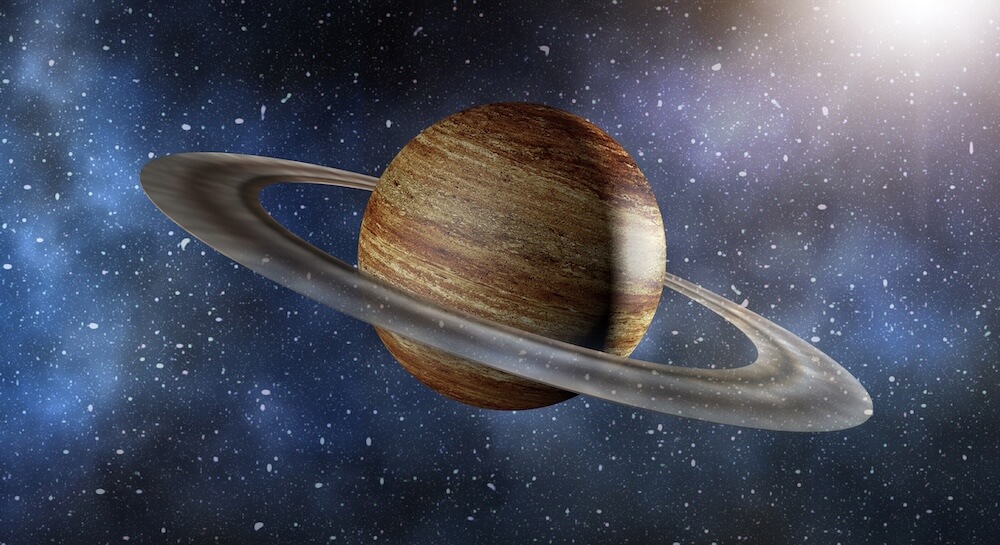
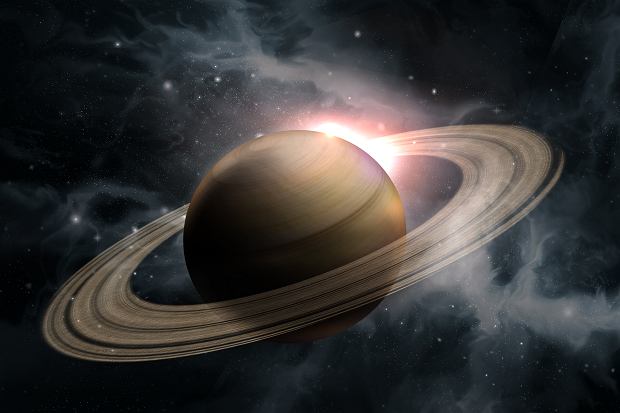
Spanning hundreds of thousands of kilometers while remaining razor-thin, Saturn’s ring system is the most extensive and brilliant planetary structure in the Solar System. Far from a solid disk, the rings are a dynamic, ever-changing environment governed by orbital resonance, micro-collisions, and electromagnetic interactions with Saturn’s magnetosphere.
1. Structure and Composition
Despite spanning an enormous width across space, Saturn’s rings are remarkably delicate and thin.
成分: The ring material consists overwhelmingly of pure water ice (roughly 99 percent), with trace amounts of rock dust, tholins, and complex organic compounds. This high ice purity accounts for their high reflectivity (albedo) when illuminated by sunlight.
Particle Dimensions: The rings are composed of trillions of individual ice fragments ranging in size from microscopic dust grains and pebble-sized ice crystals to house-sized boulders tens of meters in diameter.
Extreme Thinness: While the main ring system stretches over 282,000 kilometers across, its vertical thickness ranges from just 10 meters to roughly 1 kilometer in places. If the ring system were scaled down to the size of a standard sheet of paper, it would be hundreds of times thinner than the paper itself.
Mass Estimate: Data from the Cassini spacecraft’s gravity passes revealed that the total mass of the ring system is relatively low—approximately 0.4 times the mass of Saturn’s icy moon Mimas (or roughly 1.5 x 10 to the power of 19 kilograms).
2. Main Sections and Divisions
Saturn’s rings are partitioned into several primary rings and distinct orbital clearings (divisions), named alphabetically in the order of their discovery:
Main Rings (Inner to Outer):
D Ring: The innermost, extremely faint ring located just above Saturn’s cloud tops.
C Ring (Crepe Ring): A wide, relatively dark, transparent ring containing high concentrations of silicates.
B Ring: The largest, brightest, and most massive of all the rings, containing dense bands of ice chunks.
A Ring: The outermost of the prominent main rings visible from Earth through small telescopes.
Divisions and Clearings:
Cassini Division: A prominent 4,800-kilometer-wide clearing separating the A and B rings. Once thought to be completely empty, it contains faint ring material cleared out primarily by a 2:1 orbital resonance with the moon Mimas (particles in the gap complete two orbits for every one orbit of Mimas, receiving systematic gravitational tugs that sweep them away).
Encke Gap: A sharp, 325-kilometer-wide clearing within the outer A ring, kept open by the small embedded moon Pan.
Outer Diffuse Rings:
F Ring: A narrow, dynamic ring located just outside the main disk, constantly twisted and braided by nearby shepherd moons.
G and E Rings: Faint, diffuse outer rings. The E Ring is exceptionally broad, spanning hundreds of thousands of kilometers, and is continuously replenished by ice geysers erupting from the moon Enceladus.
3. Formation Mechanism: How Old Are the Rings?
The origin and age of Saturn’s rings have been subject to intense debate in planetary science, centered around two competing models:
The Roche Limit Disruption Model (Young Rings): According to this leading hypothesis supported by Cassini data, roughly 100 million to 200 million years ago (during the era of the dinosaurs on Earth), an ancient icy moon or large comet strayed too close to Saturn, crossing its Roche limit—the distance where planetary tidal forces exceed an object’s internal self-gravity. Saturn’s tidal forces ripped the icy body apart, shredding its outer ice mantle into the flat equatorial ring disk seen today while its dense core sank into the planet.
The Primordial Accretion Model (Ancient Rings): An alternative theory proposes that the rings are ancient remnants left over from the formation of the Solar System 4.5 billion years ago, representing gas and ice in the circumplanetary disk that failed to coalesce into a satellite. However, the high purity of the ring ice poses a challenge to this model, as 4.5 billion years of meteoroid dust bombardment should have darkened the ice significantly more than observed.
4. Shepherd Moons: Gravitational Sculptors
The sharp edges and narrow widths of certain rings are maintained through the gravitational action of small satellites known as shepherd moons.
The Shepherding Mechanism: As a shepherd moon orbits near a ring boundary, it transfers angular momentum to the ring particles via gravitational encounters. A moon orbiting inside a ring speeds up nearby particles and pushes them outward, while a moon orbiting outside slows particles down and drags them inward.
Prometheus and Pandora: The tiny moons Prometheus (inner shepherd) and Pandora (outer shepherd) orbit on opposite sides of the narrow F ring. Their opposing gravitational pushes keep the F ring’s dust particles tightly confined within a narrow ribbon, while Prometheus periodically pulls “streamers” and creates channels in the ring material during its closest approaches.
Pan and Daphnis: Moons embedded directly inside ring gaps—such as Pan in the Encke Gap and Daphnis in the Keeler Gap—act as snowplows, clearing orbital paths and creating giant vertical waves (reaching several kilometers high) along the edges of the surrounding ring walls.
5. Ring Spokes: Electrostatic Dust Interactions
During high-phase solar illumination, dark or bright radial streaks resembling the spokes of a bicycle wheel appear across Saturn’s dense B ring, sweeping around the planet alongside its magnetic field.
Discovery and Behavior: First observed by Voyager 1 in 1980 and later studied in detail by Cassini, these “spokes” form rapidly within minutes, stretch across thousands of kilometers, and persist for several hours before fading away.
Levitating Dust Dynamics: Spokes are caused by electrostatic levitation. When solar ultraviolet light and high-energy particles from Saturn’s magnetosphere strike the tiny, sub-micrometer dust grains resting on the surface of ice boulders in the B ring, they build up a static electrical charge.
Magnetic Alignment: Repelled electrostatically from the larger ice boulders, these charged micro-dust particles float vertically above the ring plane. As Saturn’s magnetic field sweeps past, it aligns these levitating dust particles into radial features that scatter sunlight, creating the visible spoke patterns.
6. “Ring Rain”: The Death of Saturn’s Rings
Saturn is actively losing its ring system through a continuous process known as ring rain.
Mechanism: Micrometeorite impacts and solar ultraviolet radiation ionize tiny water ice particles within the rings. Once electrically charged, these ice grains become bound to Saturn’s magnetic field lines.
Atmospheric Infall: Gravitational pull along with electromagnetic forces causes a steady stream of water ice particles to drain out of the ring plane, spiraling along magnetic field lines into Saturn’s upper atmosphere at high southern and northern latitudes.
Estimated Lifetime: Ground-based spectroscopic observations paired with Cassini’s “Grand Finale” measurements confirm that the rings are losing material at a staggering rate—tons of water rain down onto the cloud tops every second. Scientists estimate that at this current depletion rate, the entire main ring system will completely disappear in 100 million to 300 million years, making Saturn’s iconic rings a temporary, transient feature in cosmic history.
IV. MAGNETOSPHERE AND SPACE INTERACTIONS
Saturn is encased in a colossal magnetic bubble that dominates a volume of space far larger than the planet itself. Powered by deep internal currents and populated by plasma continuously spewed from icy moons, Saturn’s magnetosphere is an energetic environment where electromagnetic forces, solar wind dynamics, and planetary rotation converge.
1. Magnetic Field Generation: The Symmetry Paradox
Like Earth and Jupiter, Saturn generates its magnetic field through an internal dynamo mechanism operating deep within its interior. However, Saturn’s magnetic field presents an unexpected physical puzzle.
The Metallic Hydrogen Dynamo: As Saturn rotates rapidly, convective currents within its deep, electrically conductive layer of liquid metallic hydrogen act as a dynamo, generating a powerful planetary magnetic field.
Dipole Moment: Saturn’s magnetic field strength at its equator is roughly 21 microteslas—slightly weaker than Earth’s surface magnetic field. However, because Saturn is vast, its magnetic dipole moment is approximately 580 times greater than Earth’s.
Near-Perfect Axial Symmetry: On planets like Earth and Jupiter, the magnetic axis is tilted relative to the rotational axis (Earth’s magnetic pole is tilted by roughly 11 degrees; Jupiter’s by 10 degrees). On Saturn, data from the Cassini spacecraft revealed that the magnetic tilt is less than 0.01 degrees.
The Shielding Layer Problem: Standard dynamo theory requires a magnetic tilt to sustain field generation against decay over long timescales. Planetary geophysicists hypothesize that a stably stratified, non-convecting layer of liquid helium rain surrounding the deep dynamo acts as a filter, “smoothing out” non-symmetric magnetic components before they reach the outer mantle.
2. Magnetospheric Extent and Solar Wind Interactions
Saturn’s magnetic field creates a vast magnetospheric cavity that carved out a protective haven within the solar wind stream.
Dimensions and Scale: On the Sun-facing side, the boundary where solar wind pressure balances the pressure of Saturn’s magnetic field (the magnetopause) extends to 20 to 22 Saturn radii (roughly 1.2 million to 1.3 million kilometers). On the night side, the solar wind stretches the magnetic field into an elongated magnetotail extending hundreds of millions of kilometers past the planet, reaching beyond the orbit of Saturn’s moons.
Extreme Compressibility: Because the density of the solar wind varies wildly in the outer Solar System, Saturn’s magnetosphere expands and contracts dynamically like a giant lung. Strong solar wind gusts can compress the magnetopause inward to nearly half its normal size within hours.
Internal Plasma Sources: Unlike Earth’s magnetosphere (which is populated primarily by solar wind ions), Saturn’s magnetic bubble is stuffed with internal plasma. The icy moon Enceladus constantly injects roughly 200 kilograms per second of water vapor and ice grains into orbit through its south polar geysers. Solar ultraviolet light ionizes this water, transforming it into a heavy torus of water-group ions (water, hydroxyl, and oxygen ions) that rotates alongside Saturn’s magnetic field lines.
3. Ultraviolet and Infrared Auroras
Where Saturn’s magnetic field lines intersect its polar upper atmosphere, energetic charged particles plunge downward along field lines, exciting atmospheric gases and triggering luminous auroral ovals at both poles.
Mechanisms of Excitation: Saturn’s auroras are driven by two main sources: high-energy electrons accelerated inward from the solar wind interaction at the magnetopause, and internal plasma currents driven by the planet’s rapid rotation trying to drag the lagging Enceladus plasma torus along with it.
Ultraviolet Auroras: Because Saturn’s upper atmosphere is composed mostly of molecular and atomic hydrogen, its brightest auroral emissions occur in the ultraviolet spectrum. Photons are emitted when magnetospheric electrons strike hydrogen molecules, exciting them and causing them to glow in ultraviolet light—a phenomenon imaged extensively by the Hubble Space Telescope.
Infrared Auroras: In the infrared spectrum, auroral activity is dominated by emissions from trihydrogen cations (ionized molecules composed of three hydrogen atoms). Energetic particle impacts ionize molecular hydrogen, producing these ionized hydrogen molecules that emit strongly in the infrared as they cool, allowing ground-based observatories and space telescopes to map thermal structures and ionospheric winds near Saturn’s poles.
4. Saturn Kilometric Radiation and Variability
Saturn is a powerful natural radio transmitter, continuously emitting intense low-frequency radio waves into space.
Kilometric Radio Waves: Discovered by Voyager 1 in 1980, Saturn Kilometric Radiation consists of radio waves emitted at frequencies between 100 and 400 kilohertz (with wavelengths on the order of a kilometer). This radiation is generated near the polar regions by electrons spiraling along magnetic field lines via a process known as the Cyclotron Maser Instability.
Modulation and Clock Variability: Because radio emissions on gas giants are typically tied to internal magnetic fields, planetary scientists initially used Saturn Kilometric Radiation emissions to measure Saturn’s internal rotation rate (the “Saturn clock”).
The Pulsation Mystery: Cassini revealed that the period of these radio pulses is not fixed. Instead, the radio clock drifts by fractions of a percent over seasonal timescales. Furthermore, radio pulses from the Northern and Southern Hemispheres exhibit slightly different periods that cross over each other as Saturn moves through its 29.5-year solar orbit. This variation confirmed that Saturn Kilometric Radiation emissions are strongly influenced by upper-atmospheric winds, seasonal solar illumination, and magnetospheric plasma currents rather than being rigidly locked to the deep planetary core alone.
V. TITAN: THE LARGEST MOON AND A UNIQUE ATMOSPHERE
Measuring 5,150 kilometers in diameter, Titan is the second-largest moon in the Solar System—larger than the planet Mercury and nearly as large as Mars. It stands alone among all satellites in the Solar System as the only moon possessed of a substantial atmosphere, creating an alien landscape dominated by complex organic chemistry, active liquid weather, and subsurface aquatic environments.
1. Titan as an Early Earth Analogue: Dense Atmosphere
Titan’s most defining characteristic is its dense, opaque atmospheric blanket, which completely hides its surface from visible-light cameras.
Atmospheric Pressure and Density: Surface pressure on Titan is roughly 1.5 bars—50 percent higher than sea-level atmospheric pressure on Earth. Combined with Titan’s low gravity (about 14 percent of Earth gravity), Titan’s air is roughly four times denser than Earth’s, making it the only place in the Solar System where a human fitted with a simple artificial heat source and oxygen mask could flap artificial wings and fly.
Atmospheric Composition: The atmosphere is composed of 95 percent molecular nitrogen, 4.9 percent methane, and trace amounts of hydrogen and complex hydrocarbons (such as ethane, acetylene, propane, and hydrogen cyanide).
Photochemical Orange Haze: Sunlight striking high-altitude methane and nitrogen molecules breaks them apart, driving complex photochemical reactions that assemble carbon-nitrogen compounds called tholins. These suspended organic nanoparticles form an impenetrable, reddish-orange photochemical haze that enshrouds the entire moon.
Prebiotic Analogue: Scientists consider Titan a frozen, deep-freeze analogue of early Earth prior to the emergence of oxygen-producing life. Studying Titan’s atmospheric chemistry provides direct insights into the prebiotic organic synthesis that occurred on Earth over 4 billion years ago.
2. Hydrocarbon Hydrological Cycle: Methane Lakes and Rain
Titan is the only world in the Solar System besides Earth known to possess stable, flowing bodies of liquid on its surface. However, at surface temperatures averaging minus 179 degrees Celsius, water ice is as hard as granite, and the hydrological cycle is powered instead by liquid hydrocarbons.
Liquid Methane Weather: Methane plays the exact same role on Titan that water plays on Earth. Methane exists near its triple point at Titan’s surface temperatures and pressures, allowing it to exist simultaneously as gas, liquid, and solid.
Methane Clouds and Monsoon Downpours: Solar heating causes surface methane to evaporate into the atmosphere, where it condenses into towering methane clouds that trigger intense seasonal convective downpours, carving deep river channels across the landscape.
Polar Lakes and Seas: High-resolution radar mapping by the Cassini spacecraft revealed hundreds of liquid bodies concentrated in Titan’s high polar latitudes. The largest seas (such as Kraken Mare, Ligeia Mare, and Punga Mare) span hundreds of thousands of square kilometers and are filled with ultra-pure mixtures of liquid methane, ethane, and dissolved nitrogen, reaching depths of over 100 meters.
3. Dunes, Cryovolcanism, and a Subsurface Ocean
Beneath its dense orange sky, Titan features a surprisingly familiar array of geological landforms shaped by wind, liquid erosion, and internal thermal activity.
Equatorial Organic Sand Dunes: Broad equatorial plains on Titan are covered in vast seas of linear sand dunes hundreds of meters high, stretching continuously for thousands of kilometers. Rather than quartz sand like Earth’s deserts, Titan’s sand grains consist of solid particles of insoluble tholins and complex organic compounds rained down from the upper atmospheric haze and shaped by global wind patterns.
Cryovolcanism (Ice Volcanism): Thermal anomalies and topographic domes (such as Doom Mons and Sotra Patera) suggest that Titan experiences cryovolcanism. Instead of molten rock lava, Titan’s cryovolcanoes erupt slurries of liquid water, ammonia, and ice, venting internal volatile gases into the atmosphere and constantly replenishing atmospheric methane.
Global Subsurface Water Ocean: Gravity field and radio tracking measurements during Cassini flybys revealed that Titan undergoes significant tidal flexing as it orbits Saturn. This flexing confirms the existence of a global, subsurface ocean of liquid water mixed with dissolved ammonia (acting as an antifreeze) located roughly 100 kilometers beneath its frozen ice shell.
4. Astrobiology on Titan: Prebiotic Chemistry and Exotic Life
Titan is a premier target for astrobiological research because it offers two completely separate, distinct environments capable of supporting chemical complexity and potential life.
Prebiotic Synthesis: The upper atmosphere and surface act as a massive natural laboratory for prebiotic chemistry. The synthesis of complex amino acid precursors, nucleobases, and organic polymers provides a window into the building blocks that preceded biological evolution on Earth.
Hypothetical Non-Water-Based Life: Astrobiologists theorize that Titan’s surface methane lakes could host exotic, non-water-based life (methanogens). Hypothetical organisms could utilize liquid methane as a solvent, consume dissolved hydrogen and acetylene, and exhale methane without needing liquid water.
Habitable Subsurface Ocean: Deep below the surface, Titan’s warm, liquid water-ammonia ocean represents a potential habitat for terrestrial-style water-based microbial life, particularly if tidal activity or cryovolcanic conduits allow organic surface molecules to circulate downward into the deep ocean.
5. NASA’s Dragonfly Mission: Rotorcraft Exploration
To explore this exotic organic world, NASA selected the Dragonfly mission as part of its New Frontiers program—an unprecedented robotic exploration architecture designed to navigate Titan’s thick atmosphere.
Rotorcraft Lander Design: Dragonfly is an octocopter rotorcraft roughly the size of a Mars rover. Because Titan possesses an atmosphere four times denser than Earth’s paired with low gravity, flying a rotorcraft is significantly more energy-efficient on Titan than on Earth.
Nuclear Propulsion: Powered by a Multi-Mission Radioisotope Thermoelectric Generator (MMRTG), Dragonfly will use battery-stored nuclear power to fly between diverse geological sites, traveling dozens of kilometers in single hops.
Scientific Objectives: Dragonfly will land in the equatorial Shangri-La dune fields and gradually trek toward Selk Impact Crater, a region where ancient asteroid impacts once melted surface ice, mixing liquid water with surface organics for thousands of years.
Instrumentation: The rotorcraft carries a suite of mass spectrometers, gamma-ray and neutron spectrometers, meteorological sensors, and seismic packages to analyze organic chemistry, search for biosignatures, and study Titan’s habitability in real time.
VI. ENCELADUS AND THE FASCINATING WORLD OF OTHER MOONS
While Titan dominates Saturn’s satellite system in mass, the planet’s smaller icy moons comprise an remarkably diverse collection of worlds. Ranging from tiny geysering ice spheres to porous, tumbling debris rocks, these satellites reveal how intense tidal forces, ancient collisions, and subsurface oceans shape the worlds of the outer Solar System.
1. Enceladus: Subsurface Ocean, Geysers, and Organics
Measuring just 504 kilometers in diameter—small enough to fit within the borders of the United Kingdom—Enceladus is one of the most astrobiologically valuable targets in planetary exploration.
High Reflectivity (Albedo): Enceladus possesses the highest visual albedo of any body in the Solar System, reflecting nearly 100 percent of the sunlight that strikes its clean, snow-covered surface.
Tiger Stripes of the South Pole: The moon’s south polar region features four prominent parallel thermal fractures known as “Tiger Stripes” (Alexandria, Cairo, Damascus, and Baghdad Sulci). These fractures are significantly warmer than the surrounding frozen terrain, venting internal heat directly into space.
Hydrothermal Geysers: Cassini discovered massive cryovolcanic plumes erupting from the Tiger Stripes. Hundreds of geysers continuously spew jets of fine ice grains, water vapor, simple salts, carbon dioxide, methane, and complex macromolecular organic compounds hundreds of kilometers above the surface.
Global Subsurface Ocean: Gravity measurements, tidal libration analysis, and plume chemistry confirmed that Enceladus harbors a global liquid water ocean hidden beneath a 5-to-10-kilometer-thick ice shell at the south pole. Hydrothermal reactions at the ocean floor—evidenced by microscopic silica nanoparticles in the plumes—reach temperatures over 90 degrees Celsius, driven by deep tidal heating and mineral interaction, creating an environment exceptionally favorable for microbial life.
2. Enceladus’s Plumes as the Engine of the E Ring
Enceladus is not merely a passive body orbiting Saturn; it actively creates and maintains a major component of Saturn’s ring system.
Feeding the Ring: The cryovolcanic geysers erupting from Enceladus launch water vapor and ice particles into space at speeds exceeding the moon’s surface escape velocity (roughly 800 kilometers per hour).
The E Ring Torus: As Enceladus orbits Saturn at a distance of roughly 238,000 kilometers, its continuous eruptions disperse billions of fine ice crystals along its path, shaping the extremely wide, diffuse E Ring.
Self-Replenishing System: Without the ongoing geysering activity of Enceladus, solar radiation pressure, micro-meteoroid bombardments, and magnetospheric erosion would cause the E Ring to dissipate within a few thousand years.
3. Two-Toned Iapetus: The Two-Faced World
Iapetus, orbiting at a distant 3.5 million kilometers from Saturn, is a world defined by extreme physical contrasts.
Dual Hemispheres: Iapetus exhibits a striking visual asymmetry. Its leading hemisphere (Cassini Regio) is as dark as asphalt, reflecting only 3 to 5 percent of light, while its trailing hemisphere is brilliant white, reflecting nearly 50 percent of light.
Thermal Segregation Mechanism: Dark dust swept up from Saturn’s outer retrograde moons (such as Phoebe) lands on Iapetus’s leading side. This dark material absorbs solar heat, causing native water ice to sublimate away and migrate to the colder trailing hemisphere, permanently cementing a stark black-and-white color split across the moon.
Colossal Equatorial Ridge: Iapetus features a giant mountain ridge that runs precisely along its equator, reaching heights over 20 kilometers—more than twice the height of Mount Everest—and giving the moon the distinct appearance of a walnut.
4. Mimas: The “Death Star” Moon
Measuring 396 kilometers across, Mimas is the smallest known astronomical body in the Solar System that has pulled itself into a rounded, near-spherical shape through its own self-gravity.
Herschel Crater: Mimas is dominated by Herschel Crater, an immense impact basin measuring 130 kilometers wide—nearly one-third the entire diameter of the moon itself. The walls of Herschel Crater rise 5 kilometers high, with a central mountain peak reaching 6 kilometers above the crater floor. The impact that created Herschel came close to shattering Mimas completely apart.
Pop-Culture Likeness: Because of Herschel Crater’s immense scale relative to the moon’s curved disk, Mimas bears an uncanny visual resemblance to the “Death Star” space station from Star Wars.
Gravitational Resonance: Mimas plays a major dynamical role in Saturn’s rings. Its orbital period maintains a precise 2:1 gravitational resonance with particles orbiting in the Cassini Division, sweeping out the main gap between the A and B rings.
5. Hyperion: The Spongy, Chaotic Tumbler
Hyperion is a bizarre, irregularly shaped satellite measuring roughly 360 x 260 x 200 kilometers, standing apart from all other moons due to its strange physical structure.
Porous, Sponge-Like Structure: Hyperion has an exceptionally low bulk density (roughly 0.54 grams per cubic centimeter), indicating that more than 40 percent of its interior consists of empty space. Its surface is pockmarked with deep, sharp-edged craters that give it the porous appearance of a sea sponge.
Chaotic Rotation: Because Hyperion has a non-spherical shape, orbits on an eccentric path, and experiences tidal resonances with nearby giant Titan, it does not possess a fixed rotation period or axis. Instead, it tumbles chaotically through space, changing its orientation unpredictably over short timescales.
Electrostatic Charging: Cassini flyby data revealed that Hyperion builds up massive static electric charges on its porous surface (reaching hundreds of volts) as it moves through Saturn’s magnetospheric plasma streams.
6. Dione, Tethys, and Rhea: The Icy Mid-Sized Trio
Saturn’s mid-sized moons—Dione, Tethys, and Rhea—are heavily cratered worlds composed mostly of water ice with small fractions of rocky silicates.
Rhea: Saturn’s second-largest moon (1,527 kilometers in diameter) is a cold, ancient body covered in impact craters. It possesses a tenuous surface-bound exosphere composed of oxygen and carbon dioxide produced as magnetospheric ions split surface ice molecules apart.
Dione: Featuring bright, wispy ice cliffs across its trailing hemisphere—caused by tectonic fracturing that exposed fresh, clean ice beneath ancient cratered plains—Dione exhibits subtle evidence of past internal geological activity and potential subsurface liquid layers.
Tethys: Dominated by two massive geological features: Odysseus Crater, an enormous impact basin 450 kilometers across whose floor has flattened over time due to viscous ice relaxation, and Ithaca Chasma, a colossal tectonic rift valley system 100 kilometers wide and 3 to 5 kilometers deep that runs across three-quarters of the moon’s circumference.
VII. EXPLORATION HISTORY AND CASSINI’S SPECTACULAR FINALE
Human understanding of Saturn transformed from fuzzy telescopic observations into a detailed planetary science framework over four decades of robotic exploration. From brief flybys during the early space age to a flagship orbital mission that lasted over a decade, exploring the Saturnian system produced some of the most iconic achievements in deep-space engineering.
1. First Reconnaissance: Pioneer 11 and Voyagers 1 and 2
Before dedicated orbital missions were possible, space agencies launched flyby probes through the outer Solar System to complete initial reconnaissance of Saturn’s ring system and satellite family.
Pioneer 11 (1979): NASA’s Pioneer 11 became the first human-made spacecraft to visit Saturn. Flying within 21,000 kilometers of the cloud tops, Pioneer 11 discovered the narrow F ring, confirmed that Saturn possessed a global magnetic field, and measured the frigid temperatures of Titan’s upper atmosphere.
Voyager 1 (November 1980): Executing a high-priority trajectory designed specifically to conduct a close flyby of Titan, Voyager 1 gathered high-resolution atmospheric data that revealed Titan’s atmosphere was dense, nitrogen-rich, and opaque. While the flyby trajectory deflected Voyager 1 out of the ecliptic plane—ending its tour of the planets—it provided the first clear close-up images of Saturn’s complex ring structure and icy moons.
Voyager 2 (August 1981): Passing through the Saturnian system nine months later, Voyager 2 utilized its high-resolution cameras and photopolarimeter to measure delicate ring waves, discover spokes in the B ring, and record temperature gradients across the cloud decks before using Saturn’s gravity to swing onward toward Uranus and Neptune.
2. The Cassini-Huygens Mission: The Orbital Era
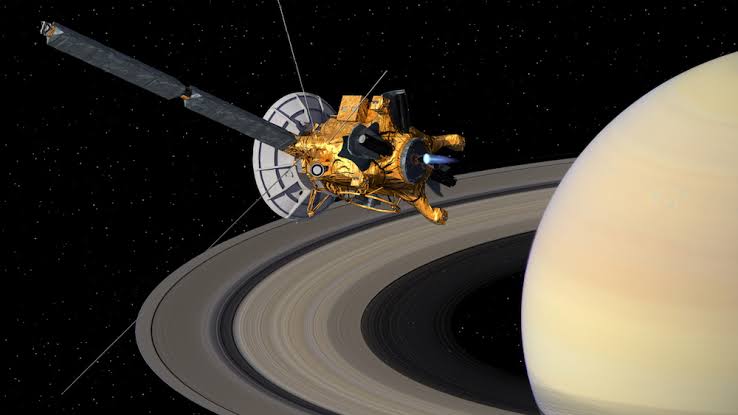
A joint flagship mission by NASA, the European Space Agency (ESA), and the Italian Space Agency (ASI), the Cassini-Huygens spacecraft arrived at Saturn on July 1, 2004, becoming the first probe to enter orbit around the ringed planet.
Unprecedented Longevity: Originally planned for a four-year primary science mission, Cassini was extended three times, operating in Saturn orbit for 13 years until September 2017.
Orbital Tour Metrics: Over its lifetime, Cassini completed 293 orbits around Saturn, executed 127 targeted flybys of Titan, performed 23 close passes of Enceladus, and returned over 450,000 high-resolution images alongside 635 gigabytes of scientific data.
System-Wide Discoveries: Cassini revolutionized our understanding of the outer Solar System by discovering the active liquid methane seas on Titan, the active hydrothermal geysers on Enceladus, the precise structure and mass of Saturn’s rings, and the detailed dynamics of the northern polar Hexagon.
3. The Huygens Probe Landing on Titan: First Touch in the Outer System
On December 25, 2004, the Cassini mothership detached the European-built Huygens probe, sending it on a 20-day coast toward Titan. On January 14, 2005, Huygens executed the most distant landing from Earth in human history.
Atmospheric Entry and Descent: Protected by a thermal heat shield, Huygens plunged into Titan’s dense upper air at speeds exceeding 20,000 kilometers per hour. Once slowed by atmospheric drag, the probe deployed parachutes and spent 2 hours and 27 minutes drifting down through Titan’s orange smog layers.
Descent Science: As it drifted downward, Huygens’s instruments sampled the chemical makeup of the air, recorded wind shear profiles, measured acoustic ambient sounds, and photographed a landscape filled with dark drainage channels, river valleys, and coastal baselines carving through bright icy highlands.
Touchdown on the Surface: Huygens made a soft landing on a damp, muddy floodplain saturated with liquid hydrocarbons, surrounded by smooth, rounded cobblestones of water ice. The probe continued transmitting data and surface images directly to Cassini for 72 minutes after touchdown before its batteries drained, providing humanity’s first direct ground-level view of a moon in the outer Solar System.
4. The Grand Finale: Cassini’s Diving Plunge and Atmospheric Reentry
By early 2017, after 13 years of continuous operation, Cassini was running out of chemical rocket propellant (hydrazine). To prevent the uncrewed spacecraft from ever colliding with and contaminating the potentially habitable environments of Enceladus or Titan with residual Earth microbes, NASA designed a dramatic, fatal mission ending known as The Grand Finale.
Ring-Grazing Orbits and Gap Plunges: Beginning in April 2017, mission controllers used a final gravity-assist flyby of Titan to nudge Cassini into a daring series of 22 narrow orbits. These trajectories sent the spacecraft diving repeatedly through the unexplored 2,000-kilometer gap between Saturn’s upper cloud tops and its innermost D ring at speeds exceeding 120,000 kilometers per hour.
High-Risk Science: During these gap dives, Cassini acted as an ultra-close planetary probe. It directly sampled the inner edge of the ring rain, gathered magnetic and gravitational field data at microscopic distances to determine core mass and ring age, and photographed the polar cloud decks at unprecedented resolutions.
The Final Plunge (September 15, 2017): On its final orbit, Cassini oriented its high-gain antenna toward Earth to stream real-time atmospheric data back home. Plunging into Saturn’s upper atmosphere at roughly 34 kilometers per second, the probe’s thrusters fired at 100 percent capacity to keep its antenna locked on Earth as atmospheric drag mounted. Within minutes, the intense friction vaporized the spacecraft, safely scattering its constituent atoms into Saturn’s atmosphere and bringing one of humanity’s greatest scientific journeys to an honorable end.
第八章 异常现象、事实与行星科学中的重大问题
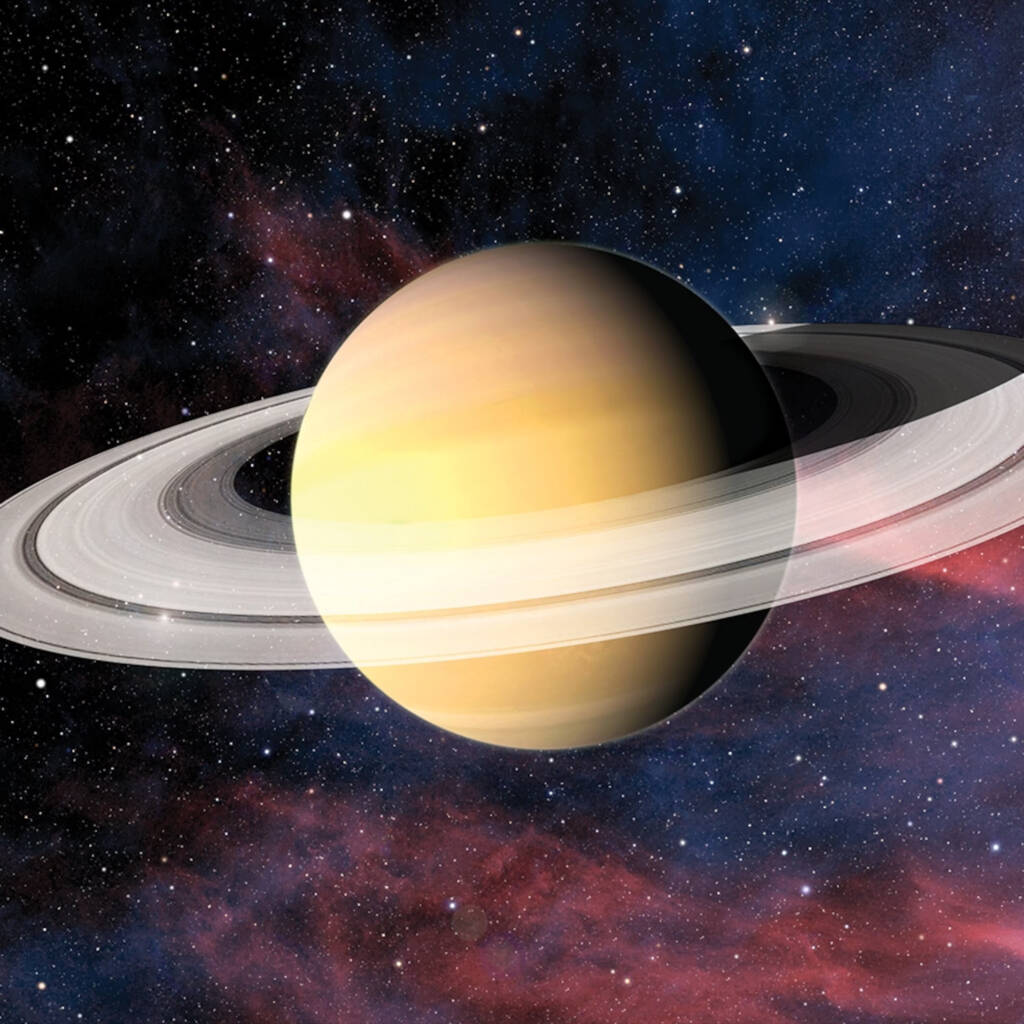
Saturn remains a world of deep scientific paradoxes. While it is one of the most studied planets in our solar system, its iconic rings, atmospheric physics, and strange radio environments present fundamental questions about how giant planets evolve over cosmic time.
1. Why Are Saturn’s Rings So Young Compared to the Planet Itself?
For decades, astronomers assumed that Saturn’s rings formed alongside the planet 4.5 billion years ago during the early days of the solar system. However, high-precision data from the Cassini spacecraft’s final orbits revealed a shocking truth: the rings are remarkably young, likely between 100 million and 200 million years old.
The Dirtiness Test: Space is full of micro-meteoroids and dark interplanetary dust. If the rings were 4.5 billion years old, millions of years of dust accumulation should have darkened their bright water-ice grains. Instead, the rings are over 99 percent pure, glittering water ice—resembling freshly fallen snow.
Mass Measurements: During its Grand Finale dives, Cassini measured the gravitational pull of the rings directly. The total mass proved to be surprisingly light (roughly 40 percent the mass of the small moon Mimas), indicating that the rings cannot be ancient primordial remnants.
The Cosmic Coincidence: This means that during the age of the dinosaurs on Earth, Saturn likely had no prominent rings at all. Humanity happens to be living during a brief, lucky window in solar system history when Saturn displays its magnificent icy crown.
2. The “Song” of Saturn: Natural Radio Wave Signals
Although sound cannot travel through the vacuum of space, Saturn is a prolific emitter of intense radio waves known as Saturn Kilometric Radiation (SKR).
Converting Radio to Sound: When space probes like Voyager and Cassini swept past Saturn, their radio plasma wave instruments detected low-frequency radio emissions generated by high-energy electrons spiraling along magnetic field lines near the poles—the same process that drives the planet’s auroras.
Acoustic Audio Translation: Scientists converted these raw radio frequency data into audible sound waves. The resulting “Song of Saturn” sounds like an eerie, haunting siren, featuring dramatic pitch glides, sweeping whistles, and atmospheric howls reminiscent of vintage science fiction soundscapes.
Drifting Clocks: These audio pulses revealed that the “radio clock” of Saturn fluctuates by small fractions over time and differs between the northern and southern hemispheres, proving that these radio sounds are tied to dynamic high-altitude winds and seasonal plasma flows rather than a static core.
3. How Much Longer Will the Era of the Rings Last?
Saturn’s rings are not permanent fixtures; they are currently caught in a multi-front tug-of-war that is rapidly draining their ice into the planet’s interior.
The Mechanics of Ring Destruction: Solar ultraviolet radiation and micrometeoroid impacts continuously ionize the icy ring particles, giving them a small electrical charge. Once charged, the particles are pulled along Saturn’s magnetic field lines, spiraling downward into the upper atmosphere under the relentless pull of gravity—a phenomenon known as ring rain.
Mass Drain Rate: Cassini directly sampled the innermost ring gaps and confirmed that a staggering amount of water-ice material—equivalent to an Olympic-sized swimming pool every half hour—drains into Saturn’s cloud tops.
Estimated Disappearance Timeline: Combined with the outward orbital migration of shepherd moons and solar radiation pressure, researchers estimate that the main ring system will be severely eroded in as little as 100 million years, and could vanish entirely within 300 million years.
4. Could Giant Diamond Reservoirs Form Deep Inside Saturn?
One of the most fascinating hypotheses in planetary meteorology suggests that deep within Saturn’s atmosphere, it may literally rain diamonds.
Methane Breakdown: In Saturn’s upper atmosphere, intense lightning strikes break down atmospheric methane gas ($CH_4$), liberating pure elemental carbon atoms.
Graphite Flakes: As these free carbon atoms float downward through the dense atmosphere, they cluster together to form soot-like clouds of graphite.
Crushing Pressure and Heat: As the graphite sinks thousands of kilometers deeper into the planet, environmental pressures reach over 100,000 times Earth’s sea-level pressure, while temperatures climb to thousands of degrees. Under these extreme conditions, the graphite is crushed into solid, gem-grade 钻石.
Liquid Diamond Oceans: At even deeper levels (around 30,000 kilometers down), the extreme heat and pressure become so intense that the solid diamonds melt into a liquid carbon state, potentially forming deep lakes or oceans of liquid diamond containing solid diamond “icebergs” floating near the metallic hydrogen mantle.
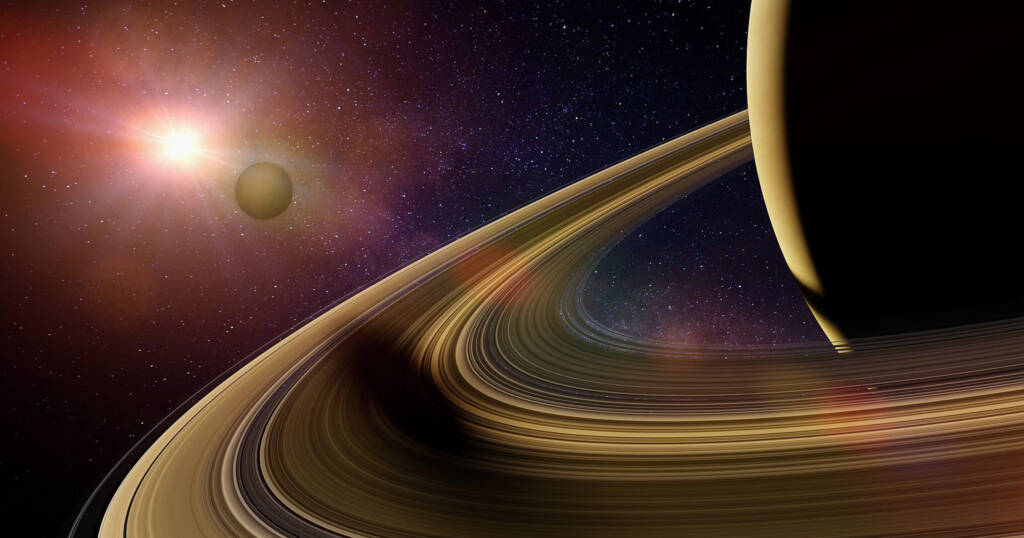
CONCLUSION: THE CROWN JEWEL OF THE SOLAR SYSTEM
Saturn remains one of the most compelling worlds in the night sky. From its rapid 10-hour rotation and hexagonal polar jet stream to its churning interior of liquid metallic hydrogen, it serves as a massive natural laboratory for extreme fluid dynamics and astrophysics. Its vast system of icy moons—anchored by Titan’s organic lakes and Enceladus’s hydrothermal ocean—continues to redefine our search for habitable environments beyond Earth. Though its glittering rings are a fleeting cosmic phenomenon bound to fade over geological time, Saturn stands today as an enduring testament to the dynamic, ever-evolving nature of our solar system.


