跳至内容 跳至页脚

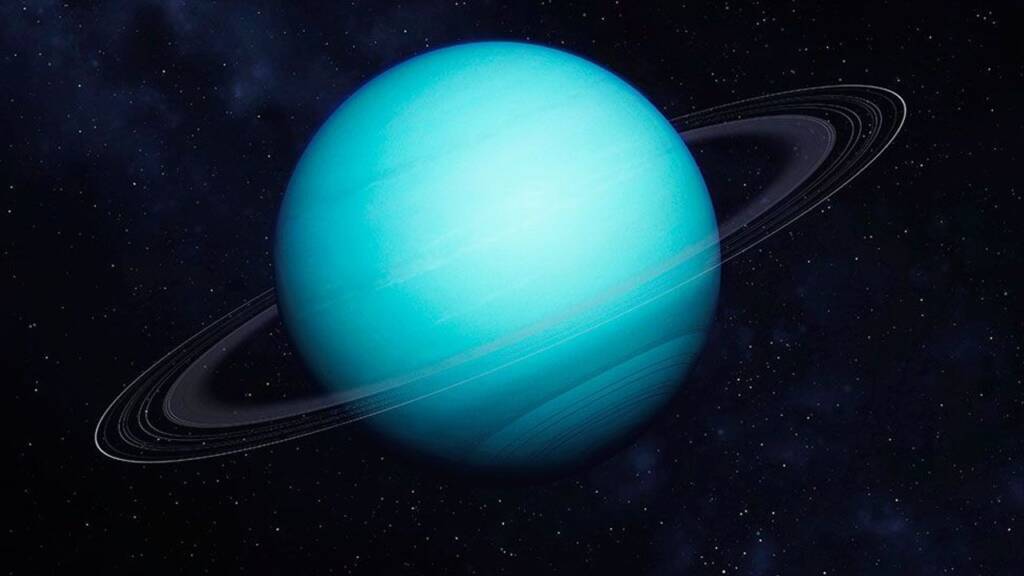
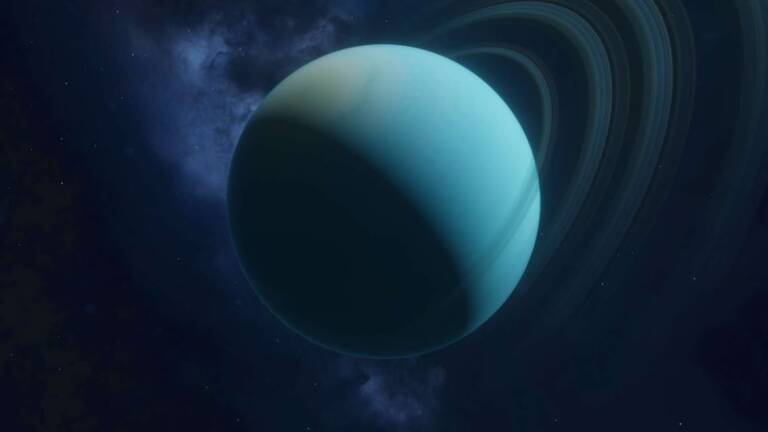
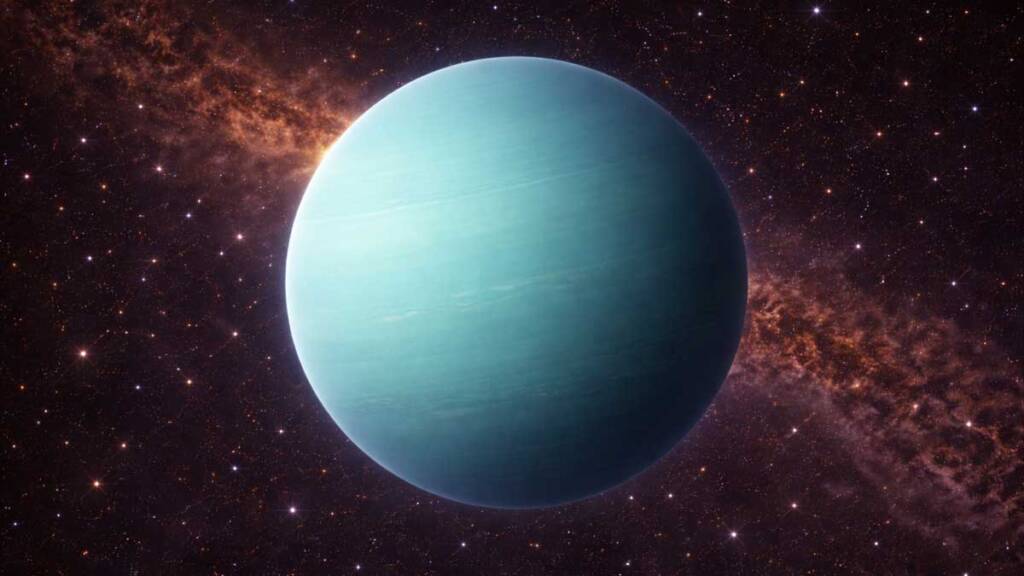
Uranus is the seventh planet from the Sun and the third-largest planet by radius in the Solar System. Orbiting at an average distance of roughly 2.87 billion kilometers (19.2 Astronomical Units), Uranus sits in the cold, dim outer reaches of our planetary family. Discovered on March 13, 1781, by astronomer William Herschel, Uranus made history as the very first planet discovered in modern times using a telescope, instantly doubling the known horizon of the Solar System. Named after the ancient Greek deity of the sky—the grandfather of Jupiter and father of Saturn—Uranus glimmers in the night sky as a faint, pale cyan disk.

Unlike the gas giants Jupiter and Saturn, which are composed almost entirely of hydrogen and helium, Uranus belongs to a distinct class of worlds known as Ice Giants. While it possesses a thick gaseous atmosphere, the vast bulk of the planet’s mass consists of a dense, hot fluid mantle of “icy” volatile materials—primarily water, methane, and ammonia—compressed under immense pressure above a small, rocky core. Methane in its upper atmosphere absorbs red light, imparting to Uranus its signature smooth, pale turquoise color.

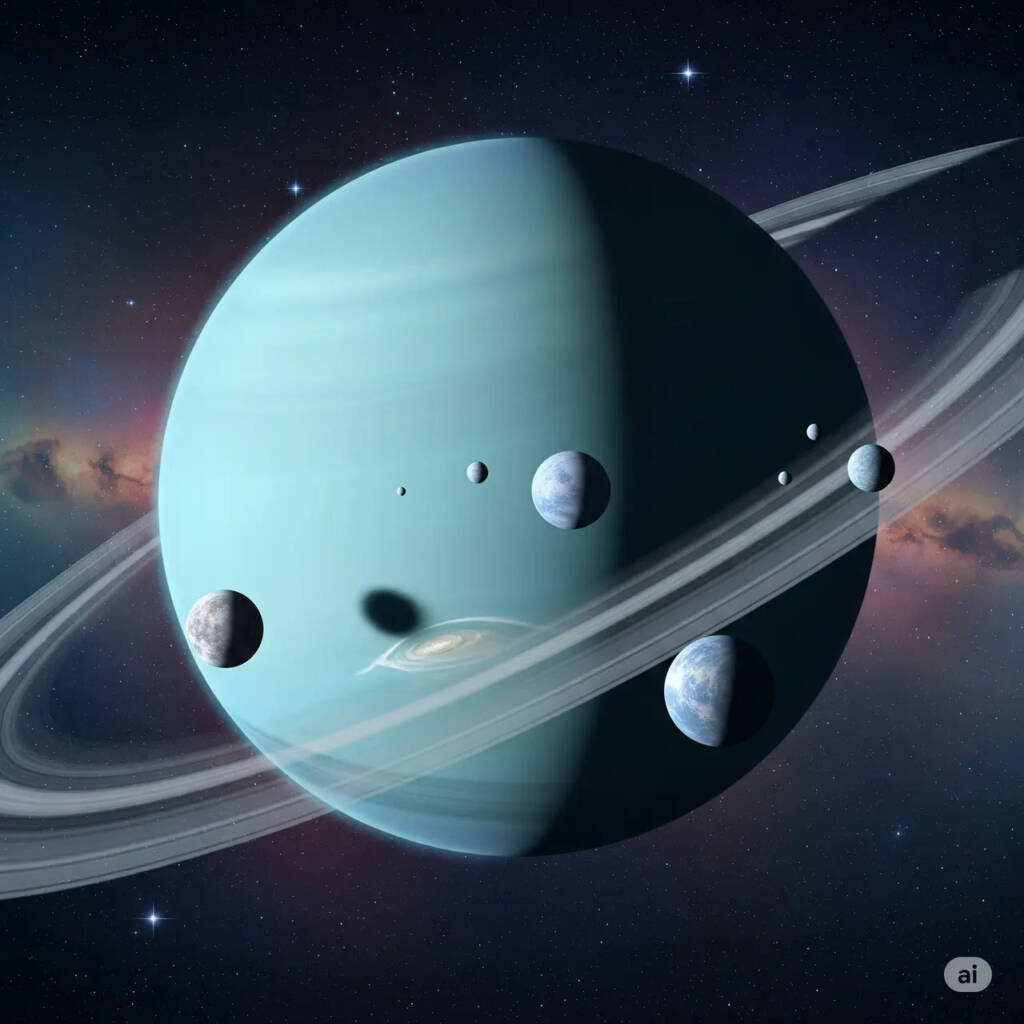
What truly sets Uranus apart from every other world in the Solar System is its astonishing axial tilt of 97.8 degrees. Essentially orbiting the Sun on its side like a rolling ball, this extreme tilt triggers the most radical seasonal variations known to planetary science, leaving its poles exposed to 42 years of continuous sunlight followed by 42 years of unbroken polar darkness. Surrounded by a system of 13 narrow, dark rings and a dynamic collection of 28 known moons named after literary characters from Shakespeare and Pope, Uranus remains one of our greatest planetary frontiers—having been visited close-up only once by NASA’s Voyager 2 probe in 1986.

I. COSMIC ADDRESS AND METRICS OF THE ICE GIANT

Orbiting in the frigid depths beyond Saturn, Uranus marks the transition from the gas giants to the vast, ice-dominated realm of the outer Solar System. Its discovery redefined humanity’s view of the cosmos, doubling the known radius of the Solar System overnight.

1. The First Planet Discovered in Modern Times

Throughout ancient history, humanity knew of only six planets—those visible to the naked eye from Earth. The discovery of Uranus shattered this ancient paradigm.

  • William Herschel’s Discovery (1781): On March 13, 1781, British astronomer Sir William Herschel was surveying faint stars in the constellation Gemini using a custom-built 6.2-inch reflecting telescope. He noticed an unusual, non-point-like object that moved slowly against the background stars over subsequent nights.

  • Comet or Planet: Herschel initially reported his observation as a comet. However, subsequent orbital calculations by Finnish-Russian mathematician Anders Johan Lexell confirmed that the object possessed a nearly circular orbit far beyond Saturn, proving it was a major new planet.

  • Naming Controversy: Herschel attempted to name his discovery Georgium Sidus (George’s Star) in honor of King George III. Unsurprisingly, international astronomers resisted the name. In 1783, German astronomer Johann Elert Bode proposed Uranus—the Latinized form of the Greek god of the sky, Ouranos—maintaining the classical mythological naming convention where Jupiter is the father of Mars, Saturn is the father of Jupiter, and Uranus is the father of Saturn.

2. Mass, Radius, Density, and Gravity: The First Ice Giant

Uranus serves as the primary archetype for the “Ice Giant” planetary class, possessing a fundamentally different internal composition than gas giants like Jupiter and Saturn.

  • 质量: Uranus has a total mass of 8.681 times 10 to the power of 25 kilograms, which equals roughly 14.5 Earth masses. While it is four times wider than Earth, it is the least massive of the four giant planets in the Solar System.

  • Radius and Volume: The volumetric mean radius of Uranus is 25,362 kilometers—approximately 3.98 times the radius of Earth. In terms of total capacity, Uranus could contain roughly 63 Earths.

  • 密度: Uranus has a mean density of 1.27 grams per cubic centimeter, making it the second-least dense planet in the Solar System after Saturn. This low density confirms that light volatiles (water, methane, and ammonia) dominate its overall volume rather than rock or iron.

  • 地表重力: Measured at the 1-bar atmospheric pressure level, the gravitational acceleration on Uranus is 8.69 meters per second squared, which is only 89 percent of Earth’s surface gravity. Despite being 14.5 times more massive than Earth, its broad radius spreads its mass over a large area, meaning an observer standing on a cloud deck at 1-bar pressure would weigh roughly 11 percent less than on Earth.

3. Orbital Position, Revolution, and Distance

Uranus moves through a vast, freezing orbit near the outer boundary of the planetary system.

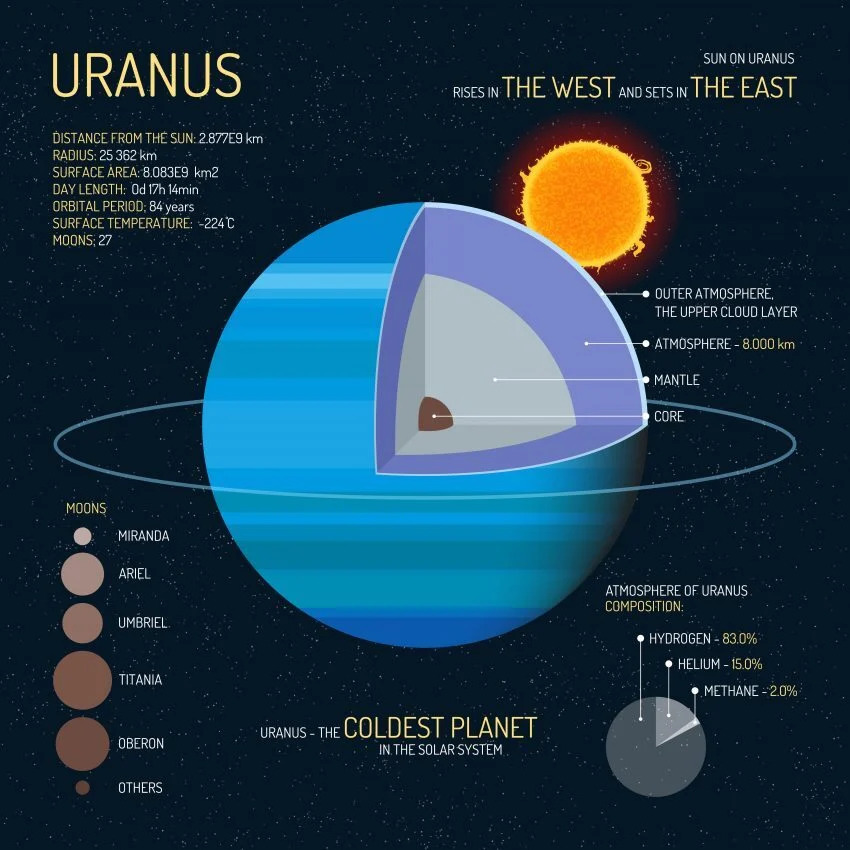
  • Extreme Distance: Uranus orbits the Sun at an average semi-major axis distance of 2.87 billion kilometers (approximately 19.2 Astronomical Units). At perihelion (closest point), it draws in to 2.74 billion kilometers (18.3 AU), while at aphelion (furthest point), it recedes to 3.00 billion kilometers (20.1 AU). Sunlight takes over 2 hours and 40 minutes to reach Uranus from the Sun.

  • Slow Revolution: Travelling along its massive orbit at a sluggish average speed of 6.8 kilometers per second, Uranus takes 84.01 Earth years (roughly 30,687 Earth days) to complete a single revolution around the Sun.

  • Low Orbital Eccentricity: Its orbit is nearly circular, with an eccentricity of just 0.046, and is tilted at a very shallow angle of 0.77 degrees relative to the ecliptic plane of the Solar System.

4. Observational Challenges and the Cyan Glow

Viewing Uranus from Earth presents severe observational difficulties due to its extreme distance and low illumination.

  • Naked-Eye Visibility Limit: Under exceptionally dark, rural skies with zero light pollution, Uranus shines at an apparent magnitude of roughly plus 5.6 to plus 5.9. This sits right at the theoretical limit of human naked-eye visibility. Ancient observers (including Hipparchus and John Flamsteed) actually cataloged Uranus multiple times over the centuries, but mistakenly logged it as a faint background star due to its slow movement.

  • Small Angular Diameter: Through backyard telescopes, Uranus appears not as a sharp star, but as a tiny, featureless pale disk spanning just 3.3 to 3.6 arcseconds across—requiring high magnification to resolve.

  • Origin of the Cyan Glow: The distinctive pale cyan-turquoise color of Uranus is caused by methane gas in its upper atmosphere. Solar light striking the cloud tops passes through a layer of methane, which strongly absorbs red and orange wavelengths of light while reflecting blue and green light back out into space.

II. INTERIOR ARCHITECTURE AND PHYSICS OF A VERY COLD WORLD

Unlike the gas giants Jupiter and Saturn—which are composed almost entirely of light hydrogen and helium gases—Uranus is an Ice Giant. Its interior is dominated by heavy volatile compounds compressed under extreme pressures, creating exotic states of matter and an energetic mystery that continues to puzzle planetary scientists.

1. Three-Layer Interior Model: Atmosphere, Mantle, and Core

Geophysical models derived from gravity measurements and Voyager 2 flyby data divide the interior of Uranus into three distinct structural layers:

  • Gaseous Upper Atmosphere: The outer envelope accounts for roughly 15 to 20 percent of the planet’s radius and 1 to 2 Earth masses. It consists primarily of molecular hydrogen (83 percent), helium (15 percent)methane (2 percent), gradually blending into the dense liquid fluid beneath.

  • Dense Icy Mantle: The vast majority of the planet’s mass (roughly 10 to 12 Earth masses) resides in its thick, slushy mantle. In planetary science, “ice” refers to volatile chemical compounds with freezing points above a few tens of kelvins—specifically water, methane, and ammonia. Rather than frozen solid ice, this layer is a scalding, high-density fluid ocean reaching temperatures of 2,000 to 5,000 degrees Celsius.

  • Small Rocky Core: At the exact center sits a relatively small core composed of silicate rock, iron, and nickel. It accounts for roughly 4 to 5 percent of the planet’s total mass (less than 1 Earth mass) and reaches central pressures exceeding 8 million atmospheres.

2. Exotic States of Matter in the Mantle: Supercritical and Ionic Fluids

Deep inside the mantle of Uranus, conditions exceed the critical points of water and methane, forcing matter into exotic states that cannot naturally exist on Earth’s surface.

  • Supercritical Water-Ammonia Ocean: Under pressures reaching millions of atmospheres, the boundary between liquid and gas vanishes. The mantle behaves as a dense, supercritical fluid—a hot, highly conductive soup that flows like a liquid but diffuses through materials like a gas.

  • Superionic Water: Near the bottom of the mantle, where pressures cross 100 gigapascals and temperatures exceed 2,000 degrees Celsius, water transitions into superionic ice. In this exotic state, oxygen atoms freeze into a solid crystalline lattice, while hydrogen ions (protons) move freely through the lattice like electrons in a metal, creating a material that is simultaneously a solid structure and an electrical conductor.

3. The Coldest Planet: The Missing Internal Heat Mystery

While Neptune sits 1.5 times farther from the Sun, Uranus holds the record for the lowest recorded atmospheric temperature in the Solar System, plunging to a frigid minus 224 degrees Celsius (49 Kelvin) in its upper troposphere.

  • The Energy Balance Anomaly: Most giant planets radiate significantly more heat into space than they receive from the Sun (Jupiter radiates 1.7 times more heat; Neptune radiates 2.6 times more). Uranus, however, radiates virtually no extra internal heat—its internal heat flux ratio is roughly 1.06, meaning it is in near-perfect thermal equilibrium with incoming solar radiation.

  • Hypothesis 1: The Giant Impact Barrier: A cataclysmic collision early in the planet’s history (the same event suspected of knocking Uranus onto its side) may have violently ejected most of the planet’s primordial formation heat into space.

  • Hypothesis 2: Thermal Layering (Convection Barrier): Compositional layering deep within the icy mantle may act as a thermal blanket, trapping internal heat deep near the core and preventing convective currents from bringing warmth up to the atmosphere.

4. Hypothetical “Diamond Rain” and Liquid Carbon Oceans

Deep inside the icy mantle, methane molecules ($CH_4$) are subjected to crushing pressures exceeding 20 gigapascals and temperatures over 2,000 degrees Celsius.

  • Pyrolysis of Methane: Laboratory experiments using ultra-intense shock lasers (such as those at the SLAC National Accelerator Laboratory) have confirmed that under these extreme conditions, methane molecules break apart. Carbon atoms detach from hydrogen and bind together into crystalline carbon structures.

  • Precipitation of Diamond Rain: These carbon crystals compress into solid diamonds. Because solid diamonds are denser than the surrounding water-ammonia fluid, they “rain” slowly downward through thousands of kilometers of the mantle, settling onto the outer boundaries of the rocky core.

  • Liquid Carbon Oceans: Near the core boundary, where temperatures surpass 4,000 degrees Celsius, calculations suggest these falling diamonds may melt, potentially creating vast seas of liquid metallic carbon featuring floating diamond “icebergs.”

III. EXTREME AXIAL TILT ANOMALY AND ATMOSPHERIC DYNAMICS

Uranus is the ultimate outsider of planetary dynamics. While most planets spin like upright tops as they orbit the Sun, Uranus moves through space like a bowling ball rolling along its lane—a bizarre orientation that creates the most radical seasonal shifts known in the Solar System.

1. “The Planet That Rolls on Its Side”: Extreme Axial Tilt

Every planet has a rotational axis tilted relative to its orbital plane (Earth is tilted by 23.5 degrees; Mars by 25 degrees). Uranus, however, takes this to an unprecedented extreme.

  • Axial Measurement: Uranus possesses an axial tilt of 97.77 degrees.

  • Retrograde Rotation: Because its tilt is greater than 90 degrees, its rotation is technically retrograde (spinning in the opposite direction of its orbital path, a trait shared only with Venus).

  • Orbital Profile: Rather than presenting its equator to the Sun, Uranus points its poles nearly directly at the Sun during the solstices. This means its rotational axis sits virtually parallel to its orbital plane.

2. The Giant Impact Hypothesis: A Cataclysmic Collision

The leading explanation for why Uranus orbits on its side points to a chaotic event during the early formation of the Solar System roughly 4.5 billion years ago.

  • The Impact Scenario: Planetary accretion models indicate that a protoplanetary body roughly 1 to 2 times the mass of Earth collided with Uranus at an oblique, glancing angle while the planet was still forming.

  • Structural Consequences: This mega-impact delivered enough angular momentum to tip the protoplanet onto its side without stripping away its primordial atmosphere.

  • Thermal Consequences: The impact may also explain the planet’s missing internal heat source—the collision could have violently disrupted the core or ejected much of the primordial internal thermal energy into space early on.

  • Satellite System Realignment: The collision likely generated an equatorial debris disk that later coalesced into the planet’s major moons, explaining why its rings and moon orbits are also tilted at 97.8 degrees, perfectly aligned with its tilted equator.

3. Extreme Seasons: 42 Years of Light, 42 Years of Dark

Because Uranus orbits the Sun once every 84 Earth years while tilted at 97.8 degrees, its polar regions experience extreme solar illumination cycles.

  • Solstice Conditions: During a polar solstice, one pole points almost directly toward the Sun, receiving 42 years of continuous, unbroken daylight. Meanwhile, the opposite pole points into deep space, plunging into 42 years of continuous, freezing polar darkness.

  • Equinox Conditions: At the equinoxes, the planet presents its equator to the Sun, causing the entire planet to experience rapid 17.2-hour day-night cycles similar to Earth.

  • Thermal Lag Paradox: Strangely, atmospheric temperature measurements reveal that the equatorial regions remain slightly warmer on average than the poles, despite the poles receiving more total annual solar radiation over an 84-year orbit. This indicates that efficient atmospheric convection and jet streams redistribute thermal energy globally across the planet.

4. Atmospheric Composition and Color: The Cyan-Turquoise Hue

Visible-light images of Uranus show a smooth, nearly featureless sphere of pale turquoise blue.

  • Gas Percentages: The upper atmosphere consists of roughly 83 percent molecular hydrogen, 15 percent helium2.3 percent methane, along with trace amounts of hydrogen deuteride, ethane, and ammonia.

  • Methane Red Absorption: Methane ($CH_4$) gas in the upper troposphere plays a crucial role in creating the planet’s color. Methane molecules absorb red and infrared wavelengths of incoming sunlight. The unabsorbed light—dominated by blue and green wavelengths—is scattered back out into space by Rayleigh scattering, giving Uranus its signature pale cyan-turquoise color.

  • Comparison with Neptune: While Neptune has a similar atmospheric methane concentration, Neptune appears a deeper, richer azure blue. Uranus has a thicker layer of high-altitude photochemical methane haze, which dilutes its color into a lighter, paler turquoise shade.

5. Wind Dynamics and Cloud Belts: Speeds Up to 900 km/h

When Voyager 2 flew past Uranus in 1986 during its southern summer solstice, the planet appeared as a featureless, blank blue ball. However, modern high-resolution imaging from the Hubble Space Telescope and Keck Observatory has revealed an active, dynamic weather system.

  • Retrograde vs. Prograde Winds: Like Earth and Jupiter, Uranus features strong atmospheric jet streams. At the equator, winds blow in a retrograde direction (opposite to planetary rotation) at speeds around 360 kilometers per hour. As latitude increases toward the poles, the winds shift into powerful prograde jet streams (blowing in the direction of rotation), reaching speeds up to 900 kilometers per hour (250 meters per second).

  • Equinoctial Storm Eruptions: As Uranus approached its 2007 equinox, solar illumination struck the equatorial regions directly for the first time in decades, triggering violent convective storms. Telescopes captured massive, highly reflective methane cloud features, bright polar collars, and dark spot storms sweeping across the mid-latitudes.

IV. UNIQUE MAGNETIC DYNAMICS

While every magnetized planet in the Solar System possesses a distinct magnetic bubble, Uranus operates on a completely alien electromagnetic rulebook. Its magnetic field is wildly asymmetrical, heavily tilted, and constantly off-center, creating a dynamic magnetosphere unlike anything else discovered in planetary science.

1. Asymmetric Magnetic Field: Offset and Displacement

On Earth, Jupiter, and Saturn, planetary magnetic fields act roughly like giant bar magnets aligned relatively close to their rotational poles. Uranus shatters this standard template.

  • Severe Magnetic Axis Tilt: Data from Voyager 2 revealed that the magnetic axis of Uranus is tilted at an extraordinary angle of 59 degrees relative to its rotational axis.

  • Massive Center Offset: The magnetic center does not even pass through the physical core of the planet. The source dipole is offset from the planet’s geometric center toward the south pole by roughly 30 percent of the planet’s total radius—a physical displacement of nearly 8,000 kilometers.

  • Quadrupole Components: Because the field source sits so far off-center, the magnetic field strength varies drastically across the surface, ranging from a weak 10 microteslas in one hemisphere to over 110 microteslas in another.

  • The Off-Center Dynamo Engine: Planetary geophysicists hypothesize that this asymmetry occurs because the magnetic field is not generated deep within a dense central iron or metallic hydrogen core. Instead, it is produced higher up in a thin, convective outer shell of super-conductive, ionic water and ammonia fluid circulating in the mantle, creating a turbulent, multi-polar dynamo.

2. The Corkscrew Magnetosphere: Dynamic Opening and Closing

Because Uranus rolls on its side while its magnetic field is tilted at 59 degrees and spinning every 17.2 hours, its magnetosphere undergoes a tumbling, chaotic motion as it interacts with the solar wind.

  • Tumbling Field Structure: As Uranus rotates, its magnetic poles sweep around in broad, sweeping circles through space. The magnetosphere is twisted by the planet’s rotation into a long, corkscrew-shaped magnetotail trailing behind the planet for millions of kilometers.

  • Daily Field Reconnection: As the magnetic poles tumble through space, the alignment between the planet’s field lines and the incoming solar wind changes continuously. On a daily basis, the magnetic shield dynamically “opens and closes.” When aligned, the solar wind connects directly to the planet’s magnetic field lines, injecting energetic particles deep into the magnetosphere before snapping closed hours later.

3. Spot-Like Auroras at Unconventional Latitudes

The severe misalignment between the magnetic and geographical poles creates unique auroral displays.

  • Off-Axis Auroral Rings: On Earth and Saturn, auroras form symmetrical rings centered tightly around the geographic north and south poles. On Uranus, because the magnetic poles sit near the equator and mid-latitudes, the planet’s auroras occur in localized, spot-like patches far away from the rotational poles.

  • Ultraviolet and Infrared Displays: Observed by the Voyager 2 probe, the Hubble Space Telescope, and the James Webb Space Telescope, these auroral spots glow brightly in the ultraviolet and infrared spectrums. They flash as brief, intense dots of light as energetic magnetospheric electrons crash down along offset magnetic field lines, exciting atmospheric hydrogen molecules in the upper atmosphere.

V. SYSTEM OF DARK RINGS

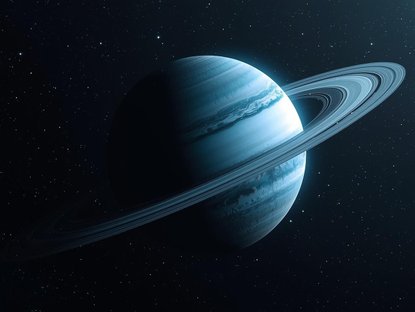
While Saturn’s brilliant, icy rings are easily visible through small Earth-based telescopes, Uranus is enshrouded by a narrow, faint, and dark ring system. The Uranian rings were the second planetary ring system ever discovered in the Solar System, offering crucial insights into celestial mechanics and ring dynamics.

1. Discovery of the Rings: Unveiled Through Stellar Occultation

Unlike Saturn’s rings—which were observed in the 17th century—the rings of Uranus remained hidden until late in the 20th century due to their extreme darkness and narrow widths.

  • The 1977 Discovery: On March 10, 1977, astronomers James L. Elliot, Edward W. Dunham, and Jessica Mink were aboard NASA’s Kuiper Airborne Observatory studying the atmosphere of Uranus as the planet prepared to pass in front of a faint background star (SAO 158687).

  • Stellar Occultation Method: As the star approached the planet’s disk, it briefly blinked off and on multiple times before passing behind Uranus, and then blinked in reverse order as it emerged on the other side. These systematic blinks revealed that five narrow rings were blocking the starlight, marking the first discovery of planetary rings since Galileo observed Saturn.

  • Voyager 2 and Space-Based Confirmation: Subsequent occultations and the Voyager 2 flyby in 1986 confirmed these inner rings and discovered additional faint bands, expanding the known ring system.

2. Unique Composition: Extremely Dark and Dust-Poor

The physical makeup of Uranus’s rings stands in sharp contrast to the bright, pure water-ice particles that form Saturn’s rings.

  • Ultra-Low Albedo: The rings of Uranus are among the darkest structures in the Solar System. They reflect only 2 to 5 percent of incoming sunlight, giving them an albedo comparable to coal or charcoal.

  • Organic and Carbon Richness: Spectrographic analysis indicates that the ring particles are composed of radiation-processed organic compounds, carbonaceous dust, and rock-ice conglomerates. Solar ultraviolet radiation and magnetospheric charged particles continually bombard methane ice embedded in the ring material, breaking molecular bonds and leaving behind a dark, carbon-rich crust known as tholins.

  • Large Boulder Composition: Unlike Saturn’s rings—which contain vast quantities of fine, microscopic ice dust—the main inner rings of Uranus consist mostly of large chunks ranging from 0.2 to 20 meters in diameter, with surprisingly little microscopic dust except in the faint outer rings.

3. System of 13 Known Rings

The Uranian ring architecture is organized into three distinct groups totaling 13 recognized rings, ordered here by increasing distance from the planet:

  • Zeta Ring: Spans 37,000 to 39,000 kilometers from the planet’s center. A broad, faint inner diffuse sheet roughly 2,500 kilometers wide.

  • Rings 6, 5, and 4: Located 41,800 to 42,600 kilometers out. Narrow, dark inner ringlets measuring 1 to 3 kilometers across.

  • Alpha and Beta Rings: Located 44,700 to 45,600 kilometers out. Slightly eccentric narrow bands measuring 5 to 12 kilometers wide.

  • Eta Ring: Located at 47,200 kilometers. A narrow core measuring roughly 2 kilometers wide with a faint outer companion structure.

  • Gamma and Delta Rings: Located 47,600 to 48,300 kilometers out. Dense, optically thick narrow ringlets measuring 1 to 4 kilometers across.

  • Lambda Ring: Located at 50,000 kilometers. A faint dust ring 1 to 2 kilometers wide discovered by Voyager 2.

  • Epsilon Ring: Located at 51,100 kilometers. The brightest, most massive, and widest main ring, ranging from 20 to 96 kilometers in width.

  • Nu Ring: Located at 66,100 kilometers. An outer dusty ring roughly 3,800 kilometers wide, distinctly reddish in color.

  • Mu Ring: Located at 86,000 kilometers. The outermost diffuse ring, spanning roughly 17,000 kilometers in width. It is distinctly blue and hosted by the small moon Mab.

4. Shepherd Moons: Stabilizing the Narrow Rings

Without an active confining mechanism, thin planetary rings naturally spread out and dissipate over time due to gravitational collisions among ring particles. The rings of Uranus remain razor-sharp and narrow thanks to shepherd moons.

  • Gravitational Shepherding: Small moons orbiting near ring boundaries exchange angular momentum with ring particles. A moon orbiting just inside a ring pushes lagging particles outward, while a moon orbiting just outside pulls faster particles inward, trapping the ring material in a narrow band between their orbits.

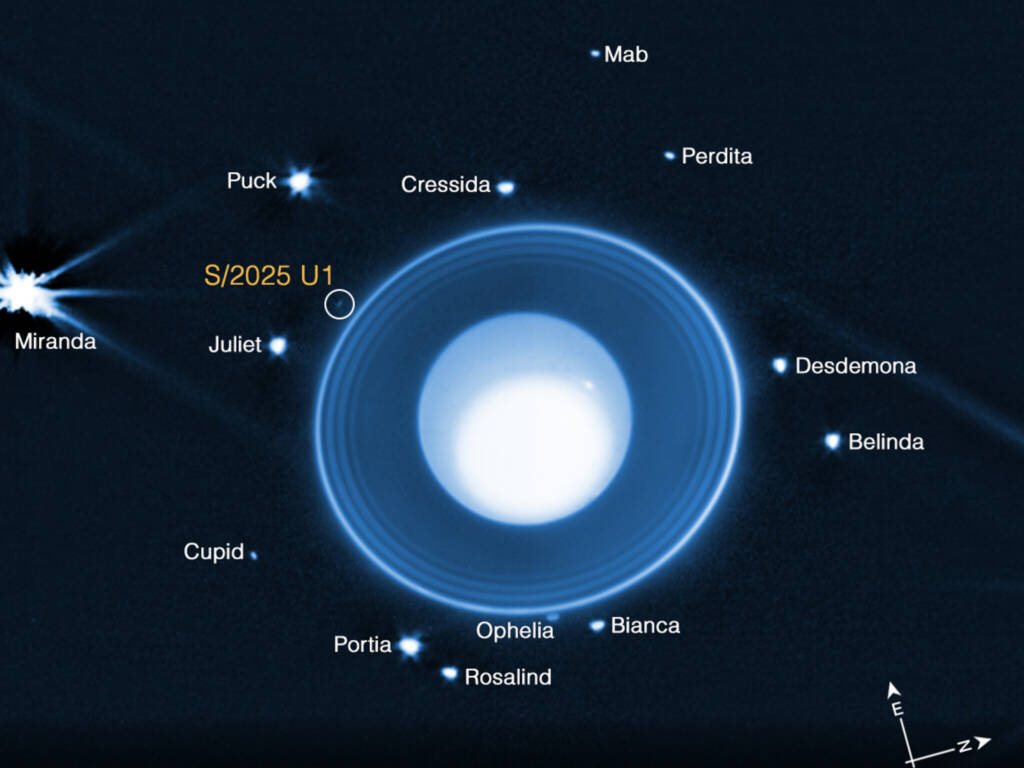
  • Cordelia and Ophelia: Voyager 2 discovered that the dense Epsilon ring is anchored by two small shepherd satellites:

    • Cordelia: Orbits just inside the inner edge of the Epsilon ring, acting as the inner shepherd.

    • Ophelia: Orbits just outside the outer edge of the Epsilon ring, acting as the outer shepherd.

  • Unseen Micro-Moons: Scientists suspect that other narrow ringlets (such as the Alpha, Beta, and Gamma rings) are maintained by smaller, undiscovered shepherd moons measuring under 10 kilometers across, embedded deep within the ring system.

VI. THE COMPLEX WORLD OF URANIAN MOONS

Uranus is orbited by a diverse system of 28 known moons. Unlike the satellite systems of Jupiter and Saturn—which are dominated by single massive moons like Ganymede or Titan—Uranus possesses a balanced collection of mid-sized icy satellites. Together, they reveal a violent history of ancient impacts, cryovolcanic resurfacing, and tectonic disruption.

1. Titania and Oberon: The Icy Giants

Titania and Oberon are the two largest moons of Uranus, orbiting in the outer region of the major satellite system. Both are composed of roughly equal parts water ice and silicate rock.

  • Titania (The Largest Moon): Measuring 1,578 kilometers in diameter, Titania is the largest moon of Uranus and the eighth-largest moon in the Solar System. Its surface is crisscrossed by a vast network of fault block valleys and canyons, most notably Belmont Chasma, which stretches for hundreds of kilometers. These massive canyons were formed early in Titania’s history when its liquid interior froze and expanded, cracking the outer ice crust open.

  • Oberon (The Outermost Major Moon): Measuring 1,523 kilometers across, Oberon is the second-largest moon of Uranus. It orbits furthest from the planet among the major moons, preserving a heavily cratered, ancient surface that has undergone little geological alteration since the early bombardment era. Its most prominent feature is Hamlet Crater, an ancient impact basin featuring a dark floor flooded with carbonaceous material, possibly extruded by early cryovolcanic activity.

2. Ariel and Umbriel: A Contrast in Light and Darkness

Ariel and Umbriel are similar in size—measuring 1,158 and 1,169 kilometers in diameter, respectively—yet they represent opposite geological extremes.

  • Ariel (The Youngest Surface): Ariel is the brightest and most geologically active major moon of Uranus, boasting a high surface reflectivity (albedo). Its surface is covered by extensive networks of smooth, flat-floored rift valleys (graben) bounded by parallel faults. These smooth valley floors are covered by flows of liquid ice-ammonia slurries (cryovolcanism) that erupted and flooded the canyon bases, erasing older impact craters.

  • Umbriel (The Darkest Major Moon): Orbiting between Ariel and Titania, Umbriel is an ancient, dark sphere that reflects only half as much light as Ariel. Its surface is densely saturated with ancient impact craters, showing virtually no evidence of internal tectonic or cryovolcanic resurfacing. Its most striking feature is Wunda Crater, a prominent 131-kilometer basin containing a bright, mysterious ring of clean water ice on its dark floor.

3. Miranda and Geological Chaos: Verona Chasma

Measuring just 471 kilometers across, Miranda is the smallest and innermost of Uranus’s major moons, yet it possesses the most wildly fractured and chaotic landscape in the Solar System.

  • Coronae Formations: Miranda’s surface is a jigsaw puzzle of contrasting terrains, featuring huge oval structures called coronae (Arden, Elsinore, and Inverness Coronae). These regions consist of concentric ridges, grooves, and sharp fault scarps wedged against ancient, cratered plains.

  • Verona Chasma (The Tallest Cliff in the Solar System): Miranda hosts Verona Chasma, a colossal fault scarp with vertical wall drops estimated to be 10 to 20 kilometers high. Due to Miranda’s low surface gravity, a human jumping off the top of Verona Chasma would take over 12 minutes to reach the bottom.

  • The Shatter-and-Reassembly Hypothesis: Astronomers long theorized that Miranda was completely shattered by a catastrophic collision with a large impactor early in its history, after which the fragments gravitationally coalesced back together into a chaotic mixture. Modern models, however, favor intense tidal heating—Miranda was once locked in an orbital resonance with Ariel, flexing its interior and driving upward plumes of warm ice that deformed the surface into chaotic coronae.

4. Literary Naming Conventions: Shakespeare and Pope

While almost all astronomical bodies in the Solar System are named after figures from Greek and Roman mythology, the moons of Uranus follow a completely unique cultural naming rule.

  • Literary Inspiration: John Herschel (son of discoverer William Herschel) established the convention in 1852 that all moons of Uranus must be named after characters from the literary works of William ShakespeareAlexander Pope.

  • Shakespearean Characters: The major moons bear names from famous plays: Titania and Oberon (A Midsummer Night’s Dream), Miranda (The Tempest), Ariel (The Tempest and Pope’s The Rape of the Lock), and Ophelia, Cordelia, and Desdemona among the inner moons.

  • Alexander Pope Characters: Several satellites—including Umbriel and Belinda—are named after characters from Alexander Pope’s satirical poem The Rape of the Lock.

5. Irregular Outer Moons in Retrograde Orbits

Beyond the orbit of Oberon lies a vast swarm of 10 small, irregular moons that were captured by Uranus’s gravity long after the planet formed.

  • Distal Captured Bodies: These irregular satellites—such as Caliban, Sycorax, Prospero, Setebos, Ferdinand, and Stephano—are small, dark bodies measuring between 10 and 150 kilometers in diameter.

  • Retrograde and Inclined Orbits: Unlike the major moons (which orbit in smooth, circular, prograde orbits aligned with the planet’s equator), the irregular outer moons travel along highly eccentric, steeply inclined, and predominantly retrograde orbits (spinning in the opposite direction of planetary rotation).

  • Origin as Kuiper Belt Objects: Their orbital paths and dark reddish surfaces confirm that these outer moons were not born alongside Uranus. Instead, they were ancient planetesimals or Kuiper Belt Objects that strayed too close to Uranus during the early instability of the outer Solar System and were captured into orbit by gas drag and gravitational scattering.

VII. SPACE EXPLORATION AND PLANNED FUTURE MISSIONS

Despite its immense scientific significance, Uranus remains the least explored of the major planets in the Solar System. Visited directly only once during the early days of robotic spaceflight, the ice giant is now at the center of future exploration plans aimed at solving the mysteries of the outer Solar System.

1. The Lone Visitor: Voyager 2 Flyby (1986)

Humanity’s entire catalog of close-up, in-situ data for Uranus originates from a single, rapid flyby conducted by NASA’s 旅行者2号 航天器。

  • The Historic Flyby: On January 24, 1986, Voyager 2 made its closest approach to Uranus, passing within 81,500 kilometers of the cloud tops at a speed of over 64,000 kilometers per hour.

  • Key Discoveries: Over a matter of hours, Voyager 2 mapped the planet’s atmospheric composition, discovered 10 new inner moons (including Puck, Juliet, and Rosalind), discovered two new rings, and captured high-resolution images of Miranda’s chaotic terrain.

  • The Magnetic Mystery: Voyager 2 provided the first direct measurement of the planet’s magnetic field, revealing its extraordinary 59-degree tilt and massive displacement from the physical center—a discovery that fundamentally altered planetary dynamo theories.

  • Observational Limitations: Because Voyager 2 arrived during the southern summer solstice, the spacecraft only viewed the illuminated southern hemisphere, leaving the northern halves of the planet and its moons shrouded in polar darkness.

2. NASA’s Flagship Uranus Orbiter and Probe Mission

Recognizing the urgent need to return to the ice giant system, the planetary science community prioritized a dedicated orbital mission in the Planetary Science Decadal Survey.

  • Top Flagship Priority: NASA’s Planetary Science and Astrobiology Decadal Survey formally selected the Uranus Orbiter and Probe (UOP) as the highest-priority new flagship mission for the decade.

  • Mission Architecture: The proposed architecture consists of two primary spacecraft components:

    • An Atmospheric Entry Probe: A small probe designed to plunge into the Uranian atmosphere, measuring chemical abundance ratios, noble gases, wind speeds, and cloud structures in real time as it descends through the atmospheric pressure layers.

    • An Orbiter Spacecraft: A long-duration orbital platform powered by Radioisotope Thermoelectric Generators (RTGs) that will conduct multiple flybys of all 5 major icy moons, map the magnetosphere in three dimensions, and track atmospheric weather cycles over years.

  • Timeline to the Ice Giant: The mission concept targets a launch window in the early 2030s using a heavy-lift rocket. Leveraging a gravity-assist flyby of Jupiter to gain velocity, the spacecraft is slated to enter orbit around Uranus in the 2040s.

3. Key to Understanding Exoplanets: The Ice Giant Archetype

Returning to Uranus is not merely about understanding one isolated planet; it is a vital key to understanding the broader universe.

  • The Exoplanet Demographics Paradox: When astronomers initially cataloged exoplanets orbiting distant stars using transit photometry (such as NASA’s Kepler and TESS missions), they discovered that the most common class of planets in the Milky Way galaxy are bodies measuring 2 to 4 times the radius of Earth. These worlds are known as sub-Neptunesmini-Neptunes.

  • The Local Laboratory: Neither Earth nor Jupiter serves as an adequate physical analogue for sub-Neptunes. Uranus and Neptune are the only two ice giant protoplanets available in our local cosmic neighborhood.

  • Translating Distant Worlds: By directly measuring the interior density profiles, atmospheric methane-to-hydrogen ratios, core sizes, and magnetospheric structures of Uranus, scientists can construct accurate atmospheric and structural models that allow them to correctly interpret the atmospheres of thousands of extrasolar worlds across our galaxy.

VIII. ANOMALIES, FACTS, AND GREAT PLANETOLOGY QUESTIONS

Uranus remains a planet of deep, unresolved paradoxes. Despite being commonly paired with Neptune as a “twin” ice giant, Uranus presents unique physical characteristics, anomalous thermal behavior, and chemical peculiarities that challenge our understanding of planetary formation and evolution.

1. The Heat Emission Paradox: Uranus vs. Neptune

One of the greatest unsolved mysteries in planetary science is why Uranus emits virtually no internal heat, whereas its physical “twin,” Neptune, radiates more than twice the energy it absorbs from the Sun.

  • The Contrast with Neptune: Neptune generates an intense internal heat flux, emitting 2.6 times as much energy as it receives. This internal energy engine drives raging high-speed storms and dynamic atmospheric belts. Uranus, by contrast, has an internal heat flux ratio of roughly 1.06—meaning it is nearly in thermal equilibrium with incoming solar illumination.

  • The Giant Impact Cataclysm Theory: The leading explanation points to the same cataclysmic collision that knocked Uranus onto its side. A massive impactor striking the young planet early in its history may have violently disrupted its core, shaking up its interior and allowing its primordial heat of formation to bleed off rapidly into space billions of years ago.

  • The Convective Layer Blanket Theory: An alternative geophysical model suggests that compositionally dense, stratified layers of heavy elements within the icy mantle act as a thermal barrier. This stratification prevents warm fluid at the bottom of the mantle from rising via thermal convection, effectively trapping what little internal heat remains deep near the core.

2. Origin of the Dark Ring Material

Unlike Saturn’s rings—which glitter with nearly 99 percent pure water ice—the rings of Uranus are pitch-black, reflecting only 2 to 5 percent of light. Deciphering where this dark material originated reveals an intense radiation history.

  • Space Weathering and Organic Processing: The main rings contain large chunks of water ice mixed with methane and carbonaceous compounds. Over millions of years, the planet’s intense radiation environment—driven by solar ultraviolet light and magnetospheric energetic ions—bombards the surface ice. This process breaks methane ($CH_4$) chemical bonds and strips away hydrogen, leaving behind a dark, tar-like residue of complex organic polymers known as tholins.

  • Moon Demolition and Impact Debris: The extreme narrowness of the rings suggests they are geologically young features formed by the destruction of ancient micro-moons. Tidal forces from Uranus or collisions with stray comets likely pulverized small inner satellites, grinding their dark, carbon-rich icy crusts into the narrow ring bands observed today.

3. Atmospheric Smell: Methane and Hydrogen Sulfide

While methane is famously recognized for giving Uranus its signature cyan-turquoise color, spectrographic observations revealed an even more pungent chemical component lurking in its cloud decks.

  • Rotten Egg Smell (Hydrogen Sulfide): High-resolution spectroscopic measurements obtained by ground-based observatories confirmed that the cloud tops of Uranus are heavily saturated with hydrogen sulfide ($H_2S$)—the exact chemical compound responsible for the foul odor of rotten eggs and sewer gas.

  • Chemical Stratification Differences: On giant planets like Jupiter and Saturn, ammonia gas ($NH_3$) dominates the upper cloud decks, reacting with hydrogen sulfide to form an underlying layer of ammonium hydrosulfide. On Uranus, however, colder temperatures freeze ammonia out at deeper levels, leaving hydrogen sulfide gas to rise high into the upper clouds.

  • The Atmospheric Experience: If a human observer were capable of descending into the cloud layer of Uranus (and surviving the extreme pressures, freezing cold, and suffocating lack of oxygen), the upper atmosphere would reek overpoweringly of rotten eggs.

CONCLUSION: THE UNBOUNDED FRONTIER

Uranus is far more than a distant blue ball; it is an exotic, tumbling laboratory of fluid dynamics, extreme axial tilt, and complex magnetospheric physics. As the archetypal ice giant sitting right in our cosmic backyard, it holds the key to deciphering the thousands of sub-Neptune exoplanets discovered throughout our galaxy. As humanity prepares to launch its first dedicated flagship orbital mission to Uranus in the coming decades, this cold, dark, and enigmatic world promises to reshape our understanding of how planetary systems form, evolve, and thrive across the universe.

zh_CN