

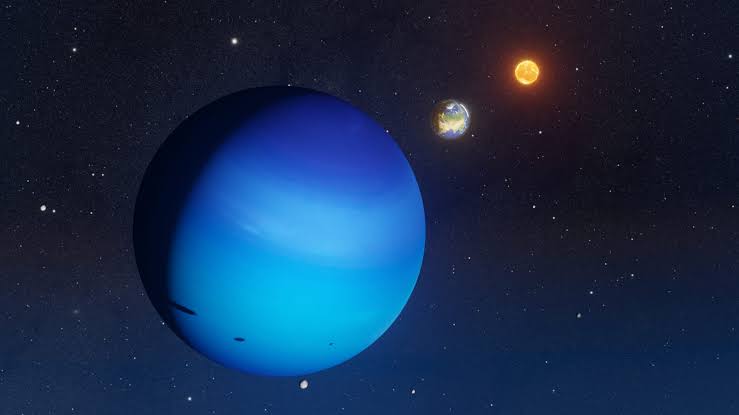
Neptuno Es el octavo planeta principal y el más alejado del Sol, y orbita en las gélidas y sombrías profundidades del Sistema Solar exterior. Situado a una distancia media de aproximadamente 4.500 millones de kilómetros (30,1 unidades astronómicas) de nuestra estrella, Neptuno tarda 165 años terrestres en completar una sola revolución orbital. Descubierto el 23 de septiembre de 1846 por el astrónomo alemán Johann Gottfried Galle a partir de las predicciones matemáticas proporcionadas por el matemático francés Urbain Le Verrier, Neptuno ocupa un lugar único en la historia como el primer planeta localizado mediante cálculos matemáticos en lugar de búsquedas ópticas. El planeta, que debe su nombre al dios romano del mar, resplandece en las fotografías del espacio profundo como una brillante esfera de color azul zafiro.
Al ser el segundo de los dos del Sistema Solar Gigantes de hielo, Neptuno tiene un radio ligeramente menor que el de su vecino, Urano, pero posee una mayor masa y densidad. Más del 80 % de la masa del planeta está compuesta por un océano supercrítico, caliente y denso de materiales “helados” —agua, metano y amoníaco— comprimidos a millones de atmósferas de presión sobre un núcleo rocoso sólido del tamaño de la Tierra. El metano de las capas profundas de la atmósfera, combinado con un absorbente químico aún no identificado, elimina las longitudes de onda de la luz roja, lo que confiere a Neptuno su llamativa e intensa coloración azul.
A pesar de recibir solo el 0,1 % de la energía solar que llega a la Tierra, Neptuno presenta las condiciones meteorológicas más violentas del Sistema Solar. Impulsadas por una potente fuente de calor interna que irradia 2,6 veces más energía de la que el planeta absorbe del Sol, las corrientes en chorro supersónicas aúllan a través de sus capas de nubes a velocidades que superan los 2.100 kilómetros por hora. Rodeado por un tenue sistema de anillos de polvo oscuro con misteriosos arcos grumosos, Neptuno preside una familia de 16 lunas conocidas, entre las que destacan Tritón—un mundo gigante y helado que se mueve en una órbita retrógrada y que arroja continuamente al espacio géiseres activos de nitrógeno. Neptuno, que solo ha sido observado de cerca una vez por la sonda Voyager 2 de la NASA en agosto de 1989, sigue siendo la última frontera azul de la ciencia planetaria.
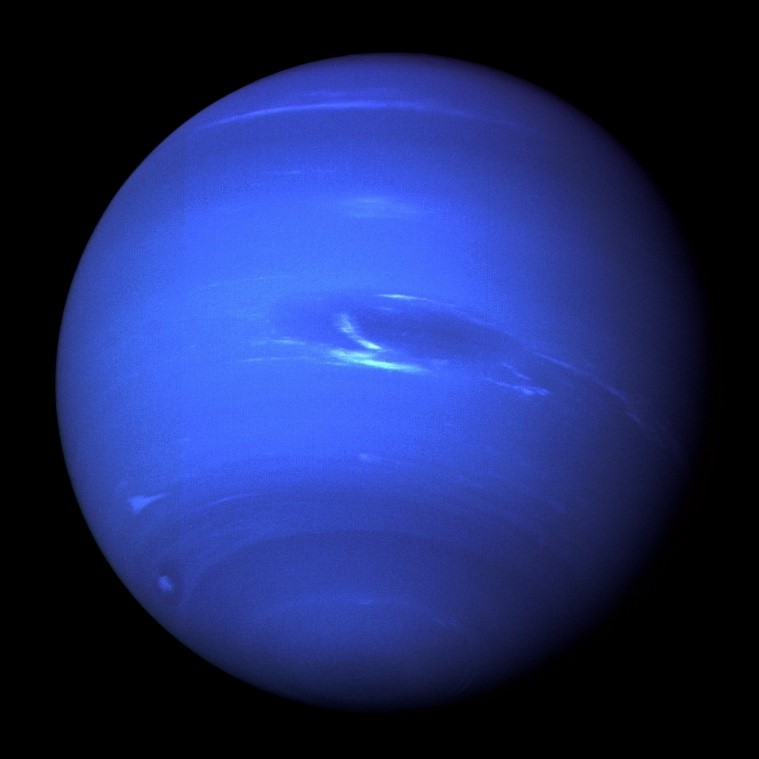
I. UBICACIÓN CÓSMICA Y PARÁMETROS DEL ÚLTIMO PLANETA
Situado en el umbral exterior helado del sistema planetario principal, Neptuno representa el triunfo de la física gravitatoria clásica. Su enorme distancia del Sol determina un entorno caracterizado por ciclos estacionales prolongados, unas dimensiones orbitales inmensas y una elevada densidad física entre los planetas gigantes.
1. El triunfo de la mecánica celeste: un descubrimiento matemático
Neptuno es único entre todos los planetas del Sistema Solar: es el único planeta cuya existencia se predijo únicamente mediante deducción matemática antes de que se observara a través de un telescopio.
Anomalías orbitales de Urano: Tras el descubrimiento de Urano en 1781, los astrónomos siguieron su movimiento a través del cielo. A principios del siglo XIX, observaciones precisas revelaron que Urano se desviaba constantemente de la trayectoria prevista por las leyes de la gravitación universal de Isaac Newton. Se movía ligeramente más rápido de lo esperado en algunas partes de su órbita y más lento en otras, lo que sugería que la atracción gravitatoria de un planeta exterior aún por descubrir estaba ejerciendo fuerza sobre él.
La carrera matemática: Dos matemáticos asumieron, de forma independiente, el reto de calcular la posición del perturbador invisible:
John Couch Adams: Un matemático británico que realizó los primeros cálculos preliminares entre 1843 y 1845, aunque los observatorios británicos retrasaron la búsqueda de las coordenadas celestes previstas.
Urbain Le Verrier: Un matemático francés que, de forma independiente, calculó la posición y la masa exactas del planeta hipotético en 1846 y envió sus coordenadas al Observatorio de Berlín.
Noche del Descubrimiento (23 de septiembre de 1846): El astrónomo Johann Gottfried Galle, con la ayuda de su alumno Heinrich Louis d’Arrest en el Observatorio de Berlín, recibió la carta de Le Verrier. Utilizando un mapa estelar actualizado, Galle apuntó el telescopio hacia las coordenadas calculadas y localizó a Neptuno en tan solo 1 grado de la ubicación prevista por Le Verrier en menos de una hora de búsqueda.
2. Masa, radio, densidad y gravedad: el gigante helado más denso
Aunque Neptuno tiene un volumen físico ligeramente inferior al de su vecino, Urano, su mayor concentración de compuestos volátiles pesados y su interior comprimido hacen que su masa sea considerablemente mayor.
Misa: Neptuno tiene una masa total de 1,024 por 10 elevado a 26 kilogramos, lo que equivale aproximadamente a 17,15 masas terrestres. Su masa es aproximadamente un 18 % mayor que la de Urano (que pesa 14,5 masas terrestres).
Radio y volumen: El radio volumétrico medio de Neptuno es 24 622 kilómetros—más o menos 3,86 veces el radio de la Tierra. En cuanto a capacidad volumétrica, el Neptuno podría albergar más de 57 Tierras.
Densidad: Neptuno tiene una densidad aparente de 1,638 gramos por centímetro cúbico, lo que lo convierte en el el más denso de los cuatro planetas gigantes en el Sistema Solar (Júpiter tiene una densidad de 1,33 g/cm³, Urano de 1,27 g/cm³ y Saturno de 0,69 g/cm³).
Gravedad en la superficie: Medida a un nivel de presión atmosférica de 1 bar, la gravedad superficial de Neptuno es de 11,15 metros por segundo al cuadrado, que es 1,14 veces la gravedad superficial de la Tierra. De entre los planetas exteriores, solo Júpiter ejerce una fuerza gravitatoria mayor que la de Neptuno.
3. Posición orbital y período de revolución
Neptuno marca el límite exterior convencional del sistema planetario principal, recorriendo una trayectoria amplia y extensa a través del espacio profundo.
Distancia extrema: Neptuno orbita alrededor del Sol a una distancia media del semieje mayor de 4.500 millones de kilómetros (aproximadamente 30,07 unidades astronómicas). En el perihelio (punto de máxima aproximación), se acerca hasta los 4.46 mil millones de kilómetros (29,81 UA), mientras que en el afelio (punto de máxima distancia), se aleja hasta los 4.54 mil millones de kilómetros (30,33 UA).
Velocidad de la luz solar: La luz solar tarda aproximadamente 4 horas y 10 minutos viajar desde el Sol hasta Neptuno.
Período orbital: Con una velocidad orbital media de 5,4 kilómetros por segundo, Neptuno tarda 164,79 años terrestres (o 60 190 días terrestres) para completar una sola revolución alrededor del Sol. Desde su descubrimiento en 1846, Neptuno completó su primera órbita completa tras su descubrimiento en julio de 2011.
4. Las estaciones en los límites del sistema
A pesar de su gran distancia del calor solar, Neptuno experimenta cambios estacionales bien definidos, determinados por la inclinación de su eje.
Inclinación axial: El eje de rotación de Neptuno tiene una inclinación de 28,32 grados respecto a su plano orbital: un ángulo de inclinación muy similar al de la Tierra (23,5 grados) y al de Marte (25,2 grados).
Temporadas de 40 años: Dado que Neptuno tarda casi 165 años en completar una órbita, cada una de sus cuatro estaciones (primavera, verano, otoño e invierno) dura más de 40 años terrestres.
Respuesta atmosférica estacional: Aunque la energía solar que llega a Neptuno solo representa el 0,1 % de la que llega a la Tierra, los cambios en el ángulo de incidencia de la luz solar a lo largo de estaciones que abarcan varias décadas provocan cambios térmicos apreciables en la estratosfera superior, lo que altera las formaciones de nubes polares, la intensidad de las corrientes en chorro atmosféricas y la densidad del smog a gran altitud a lo largo de décadas.
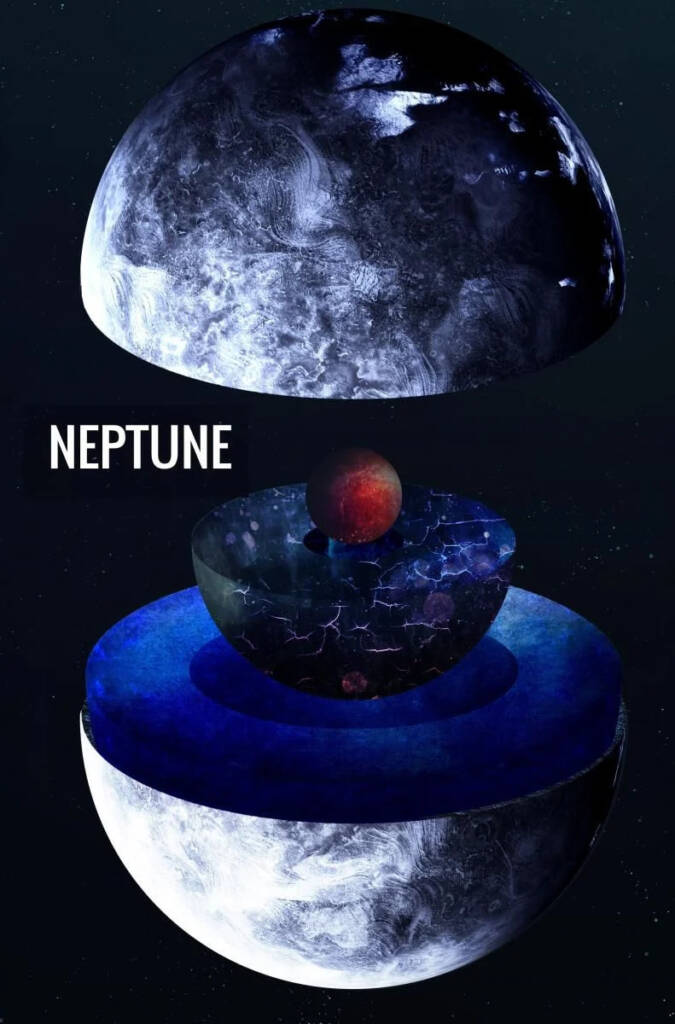
II. LA ARQUITECTURA DE INTERIORES Y EL MISTERIO DEL CALOR INTERNO
Bajo su impresionante manto atmosférico de color azul intenso se esconde un interior planetario exótico. Comprimidas bajo una presión de millones de atmósferas, las capas internas de Neptuno generan un calor intenso y albergan estados exóticos de la materia, lo que da lugar a algunos de los procesos físicos más dinámicos del Sistema Solar.
1. Estructura de tres capas: atmósfera, manto y núcleo
Los modelos geofísicos basados en las mediciones gravitatorias de la Voyager 2 dividen a Neptuno en tres capas internas principales:
Atmósfera exterior: La envoltura gaseosa, que representa aproximadamente entre el 10 y el 20 por ciento del radio total del planeta y entre el 5 y el 10 por ciento de su masa, está compuesta principalmente por hidrógeno molecular (80 %), helio (19 por ciento), y metano (1,5 %), pasando de forma gradual al denso manto fluido que se encuentra debajo.
Manto helado denso: Esta gruesa capa, que constituye la mayor parte del volumen del planeta y equivale aproximadamente a entre 10 y 15 masas terrestres, está compuesta por agua, amoníaco y metano. En astronomía planetaria, estos compuestos se denominan “hielos”, aunque en el interior de Neptuno forman un océano de fluido ultradenso y hirviente que alcanza temperaturas de entre 2.000 y 5.000 grados Celsius.
Núcleo rocoso pesado: En el centro del planeta se encuentra un núcleo sólido compuesto por hierro, níquel y roca silícea. Con un peso aproximado de 1.2 Masas terrestres, en el núcleo se alcanzan presiones superiores a los 7 millones de atmósferas y temperaturas de unos 5.200 grados Celsius.
2. El océano de agua y amoníaco supercríticos y los estados extremos
A profundidades superiores a los 7.000 kilómetros, la combinación extrema de calor intenso y presión aplastante hace que los compuestos volátiles superen sus puntos críticos, lo que elimina la distinción entre líquidos y gases.
Océano de fluidos supercríticos: El manto se presenta como un vasto océano de fluido supercrítico altamente conductor. La materia en este estado fluye con la baja viscosidad de un gas, al tiempo que conserva la alta densidad y la capacidad de disolución de un líquido.
Estado superiónico: En las regiones más profundas del manto, el agua se transforma en hielo superiónico. A presiones superiores a 100 gigapascales, los átomos de oxígeno se fijan en una red cristalina sólida, mientras que los protones de hidrógeno se mueven rápidamente a través de la red. Este estado único convierte al manto profundo en un conductor eléctrico excepcional, lo que desempeña un papel fundamental en la generación del campo magnético de Neptuno.
3. El misterio del calor interno: la anomalía del coeficiente térmico de 2,6
Mientras que Urano, su gemelo casi exacto, apenas irradia energía interna sobrante al espacio, Neptuno cuenta con un intenso motor térmico interno que impulsa una violenta actividad atmosférica.
El índice de equilibrio energético: Neptuno irradia 2,61 veces más energía al espacio que la que recibe del Sol. Este flujo de calor interno es la mayor producción de calor relativa de todos los planetas gigantes del Sistema Solar.
Calor radiogénico y calor primordial: Parte de este balance térmico proviene de la lenta desintegración de los elementos radiactivos presentes en su núcleo rocoso, junto con el calor residual atrapado durante la formación gravitatoria del planeta hace 4.5 mil millones de años.
Separación gravitatoria (lluvia de helio e hidrocarburos): Para explicar la producción total de energía, los geofísicos plantean la hipótesis de que los materiales más pesados —como los complejos de carbono o las gotitas de helio— se separan continuamente de los compuestos más ligeros y se hunden hacia el núcleo por la fuerza de la gravedad, liberando una inmensa energía potencial gravitatoria en forma de calor.
4. Lluvia de diamantes: cristalización del carbono en el manto profundo
En las profundidades del manto, donde las temperaturas superan los 2.000 grados Celsius y las presiones superan los 20 gigapascales, el metano ($CH_4$) las moléculas sufren una descomposición pirolítica extrema.
Disociación molecular: La intensa presión ambiental desintegra las moléculas de metano, liberando átomos de carbono elemental puro de sus enlaces de hidrógeno.
Cristalización en diamante: Los átomos de carbono libres se unen formando tetraedros densos y se cristalizan directamente en estado sólido diamantes. Dado que el diamante es más denso que el manto de fluido de agua y amoníaco que lo rodea, estos diamantes “llueven” lentamente hacia abajo a lo largo de miles de kilómetros en dirección al núcleo.
Prueba de laboratorio experimental: Los experimentos de compresión por choque con láser de alta energía (como los que utilizan láseres de electrones libres de rayos X en el SLAC) han logrado reproducir con éxito estas mismas presiones y temperaturas, lo que demuestra que los compuestos de hidrocarburos se transforman rápidamente en cristales sólidos de nanodiamante en condiciones idénticas a las del manto interior de Neptuno.
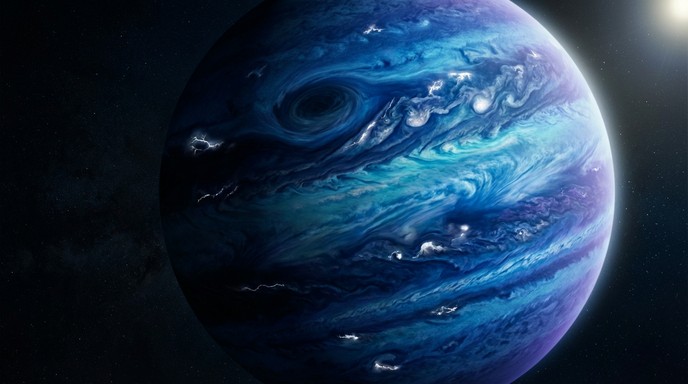
III. DINÁMICA ATMOSFÉRICA EXTREMA Y LOS VIENTOS MÁS RÁPIDOS
A pesar de recibir menos de una milésima parte de la energía solar que calienta la Tierra, Neptuno presenta las condiciones meteorológicas más violentas y los fenómenos meteorológicos más extremos del Sistema Solar. Impulsada por su potente motor térmico interno, la atmósfera azul del planeta es un escenario agitado de corrientes en chorro supersónicas, tormentas oscuras pasajeras y nubes de metano a gran altitud.
1. Composición y tono zafiro intenso: El misterio del metano
En luz visible, Neptuno presenta un tono azul zafiro intenso y vivo que contrasta marcadamente con el tono cian más pálido de Urano.
Composición del gas: La atmósfera superior de Neptuno está compuesta principalmente por hidrógeno molecular (80 %) y helio (19 %), siendo el metano (1,5 %) el principal compuesto volátil, junto con trazas de etano, acetileno y diacetileno.
Absorción del metano rojo: El metano presente en la troposfera superior absorbe la luz roja e infrarroja de la radiación solar entrante, al tiempo que dispersa las longitudes de onda azules, más cortas, de vuelta al espacio.
El agente del color desconocido: Aunque el metano explica el tono azul, los modelos informáticos muestran que el metano por sí solo no puede explicar el tono zafiro claramente más intenso y profundo de Neptuno en comparación con Urano (que tiene una abundancia similar de metano). Los científicos especializados en la atmósfera sospechan que un segundo componente químico, aún sin identificar, o una capa de aerosoles más oscura en la troposfera media de Neptuno absorbe selectivamente la luz roja y amarilla, lo que intensifica el aspecto azul celeste del planeta.
2. Los vientos más rápidos del Sistema Solar: velocidades supersónicas
Neptuno ostenta el récord absoluto de las velocidades más altas de viento planetario jamás registradas en el Sistema Solar.
Corrientes en chorro supersónicas: Mientras que en la Tierra la velocidad máxima del viento ronda los 400 kilómetros por hora en los huracanes más intensos, las corrientes en chorro de Neptuno soplan a velocidades que superan los 2.100 kilómetros por hora (aproximadamente 580 metros por segundo). Estas velocidades superan con holgura la velocidad del sonido en la atmósfera de hidrógeno y helio de Neptuno.
Vientos ecuatoriales retrógrados: Sorprendentemente, estos vientos extremos se desplazan en dirección retrógrada —en sentido contrario a la rotación del planeta, que dura 16 horas— cerca del ecuador. En latitudes más altas, el perfil del viento cambia a corrientes en chorro progradas.
Motor de baja fricción: Dado que Neptuno carece de una superficie sólida que genere fricción mecánica, y dado que el calor interno del planeta provoca fuertes corrientes convectivas ascendentes, las corrientes en chorro atmosféricas prácticamente no encuentran resistencia, lo que permite que los vientos alcancen velocidades hipersónicas.
3. La Gran Mancha Oscura y los anticiclones secundarios
Cuando la Voyager 2 sobrevoló Neptuno en agosto de 1989, sus cámaras revelaron una gigantesca tormenta atmosférica del tamaño de la Tierra en el hemisferio sur, conocida como «La Gran Mancha Oscura».
Estructura de una tormenta anticiclónica: Al igual que la Gran Mancha Roja de Júpiter, la Gran Mancha Oscura de Neptuno es un enorme sistema de tormentas anticiclónicas: un vórtice ovalado de alta presión que mide aproximadamente 13 000 por 6 600 kilómetros.
Migración dinámica y disipación: A diferencia de la antigua tormenta de Júpiter (que ha persistido durante siglos), las manchas oscuras de Neptuno son muy efímeras. Cuando el Telescopio Espacial Hubble se orientó hacia Neptuno en 1994 para fotografiar la mancha original, esta había desaparecido por completo.
Secciones secundarias: Desde entonces, el Hubble ha seguido la evolución de varias tormentas oscuras secundarias (como la Gran Mancha Oscura del Norte, observada entre 2018 y 2020). Estas manchas se forman, migran hacia el ecuador bajo fuertes cizalladuras de la corriente en chorro y se disipan al cabo de unos años, lo que pone de manifiesto un ciclo de vida atmosférico volátil y en rápida evolución.
4. Nubes cirros blancas: Scooter y hielo de metano a gran altitud
Por encima de las oscuras capas de tormenta se alzan formaciones nubosas de un blanco brillante que surcan el planeta a gran altitud.
Composición del cristal de metano: Estas nubes de un blanco brillante se forman cuando intensas columnas convectivas impulsan el metano hacia las capas superiores y frías de la troposfera (donde las temperaturas descienden por debajo de los 200 grados Celsius bajo cero), lo que hace que el gas se congele y se convierta en delicadas estelas de cristales de hielo de metano.
Características de la scooter: Durante el sobrevuelo de 1989, la Voyager 2 detectó una pequeña formación nubosa blanca e irregular a la que se le dio el apodo de «Scooter». Situada más al sur que la Gran Mancha Oscura, «Scooter» orbitaba alrededor de Neptuno cada 16 horas —más rápido que las manchas oscuras que la rodeaban— y parecía desplazarse rápidamente a lo largo de la circunferencia del planeta.
Nubes compañeras: Las manchas oscuras suelen ir acompañadas de nubes brillantes que se forman cuando las masas de aire circundantes se ven empujadas hacia arriba por encima del vórtice de la tormenta, generando densas capas de hielo de metano a gran altitud.
5. Capas de smog y fotoquímica de la atmósfera superior
Por encima de las capas principales de nubes de metano se encuentra una atmósfera compleja y estratificada, moldeada por la radiación ultravioleta solar.
Descomposición fotoquímica: Los rayos ultravioleta solares a gran altitud descomponen las moléculas de metano en la estratosfera, lo que da lugar a reacciones químicas complejas. Estas reacciones dan lugar a moléculas de hidrocarburos más pesadas, como el etano, el acetileno y el etino.
Smog de hidrocarburos a gran altitud: A medida que estos compuestos orgánicos más pesados se condensan, forman finas capas de neblina fotoquímica de hidrocarburos o smog a altitudes superiores a los 100 kilómetros.
Dinámica térmica estratosférica: Este smog orgánico absorbe los rayos ultravioleta solares, lo que provoca una inversión térmica estratosférica en la que la atmósfera superior se calienta ligeramente en comparación con la tropopausa, situada debajo, donde las temperaturas son gélidas.
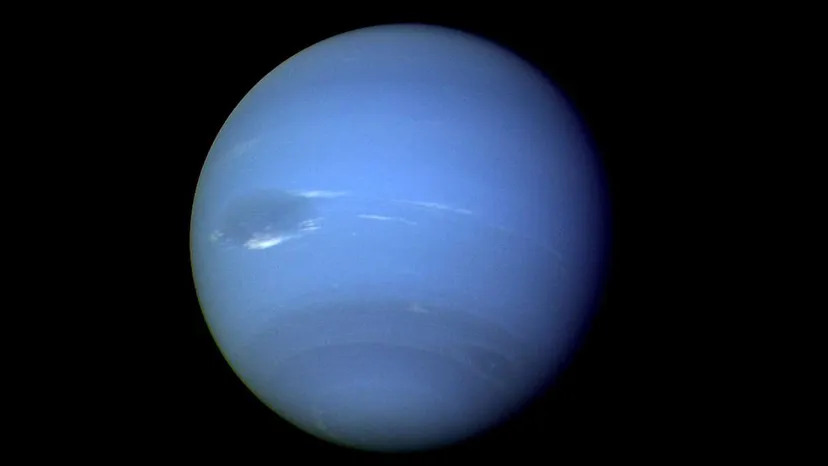
IV. MAGNETOSFERA INCLINADA Y DINÁMICA DE LOS CAMPOS
Al igual que su hermano, el gigante helado Urano, Neptuno presenta un entorno magnético que desafía el modelo clásico de campo magnético planetario que se observa en la Tierra, Júpiter y Saturno. Su escudo electromagnético está muy inclinado, desplazado con respecto al núcleo del planeta, y cambia constantemente de forma a medida que el planeta gira por el espacio.
1. Campo magnético asimétrico y muy inclinado
Antes de que la Voyager 2 llegara a Neptuno en agosto de 1989, los científicos sospechaban que el eje magnético del planeta podría estar alineado con su eje de rotación. Sin embargo, las lecturas revelaron un campo magnético muy distorsionado.
Inclinación extrema del eje magnético: El eje magnético de Neptuno presenta una inclinación extraordinaria de 47 grados respecto a su eje de rotación.
Desplazamiento central masivo: El centro del campo magnético no coincide con el centro geométrico del planeta. La fuente dipolar está desplazada hacia el polo sur en aproximadamente 0,55 radios planetarios—un desplazamiento físico de más de 13 500 kilómetros con respecto al núcleo.
Intensidad de campo variable en la superficie: Dado que el dipolo magnético se encuentra muy descentrado, la intensidad del campo magnético en la superficie de las nubes de Neptuno varía drásticamente según la ubicación, oscilando entre un valor mínimo de 0,1 gauss en un hemisferio y más de 1,0 gauss en otro.
El motor dinamo de carcasa poco profunda: Los geofísicos planetarios atribuyen esta estructura asimétrica al mecanismo que genera el campo. En lugar de tener su origen en un núcleo sólido de hierro o en una capa profunda de hidrógeno metálico, el campo magnético de Neptuno se genera relativamente cerca de la superficie, dentro de una delgada capa exterior turbulenta de material eléctricamente conductor agua superiónica y hielo de amoníaco que fluye por el manto.
2. Estructura magnetosférica compleja y reconfiguración constante
Dado que Neptuno gira sobre su eje cada 16,1 horas y presenta un dipolo magnético inclinado 47 grados, su magnetosfera sufre violentas transformaciones físicas a diario.
Movimiento del eje de giro: A medida que Neptuno gira, sus polos magnéticos describen enormes círculos en el espacio. La interacción entre el campo magnético inclinado y el viento solar entrante deforma la magnetosfera hasta convertirla en una estructura compleja, cola en forma de sacacorchos que se extiende millones de kilómetros más allá del planeta.
Apertura y cierre continuos: La inclinación del eje magnético con respecto al viento solar varía constantemente a lo largo de cada ciclo de rotación. Esta rotación provoca que se produzcan repetidamente fenómenos de reconexión magnética, procesos dinámicos en los que las líneas del campo magnético se rompen, se reajustan y se realinean, abriendo rápidamente el interior del planeta al plasma del viento solar antes de volver a cerrarse horas más tarde.
3. Auroras en Neptuno: fenómenos en latitudes medias y ecuatoriales
La combinación de un eje magnético muy inclinado y un centro desplazado da lugar a fenómenos aurorales que se producen en lugares totalmente inesperados.
Zonas aurorales desplazadas: En la Tierra y en Saturno, las auroras se limitan estrictamente a unos anillos ovalados que rodean los polos geográficos norte y sur. En Neptuno, dado que los polos magnéticos se encuentran inclinados casi hasta la mitad del planeta, las auroras se producen principalmente a lo largo de en las latitudes medias y cerca del ecuador.
Geometría multipolar compleja: Dado que el campo magnético presenta fuertes componentes cuadrupolares además de su componente dipolar, las partículas cargadas de alta energía que se precipitan por las líneas de campo hacia la atmósfera crean un complejo mosaico de manchas aurorales débiles y dispersas, en lugar de anillos polares bien definidos.
Emisiones ultravioletas e infrarrojas: Al ser excitados por electrones magnetosféricos de alta energía, los átomos y moléculas de hidrógeno de la atmósfera emiten luz auroral, principalmente en los espectros ultravioleta e infrarrojo, creando un resplandor tenue y localizado que los instrumentos espaciales registran en sus mapas.
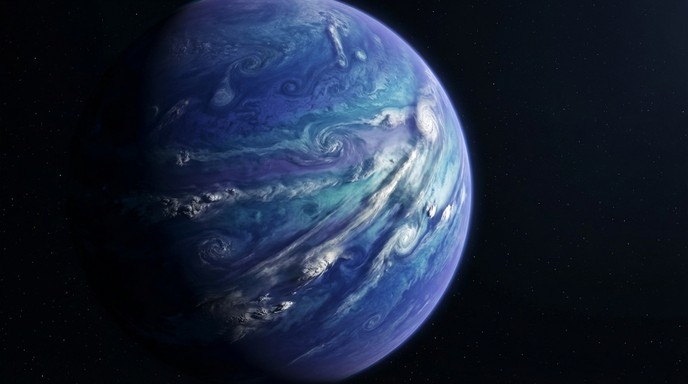
V. EL SISTEMA DE ANILLOS Y LOS ARCOS DE NEPTUNO
Aunque no son tan llamativos ni reflectantes como las brillantes estructuras heladas que rodean a Saturno, Neptuno posee un sistema de anillos tenue y complejo. Compuestos por rocas oscuras recubiertas de polvo y restos helados, los anillos de Neptuno se caracterizan por unas densidades agrupadas inusuales, entre las que destacan una serie de arcos persistentes y misteriosos que desafían la mecánica orbital simple.
1. Anillos oscuros de polvo y hielo
El sistema de anillos de Neptuno está formado por cinco anillos principales, cada uno de los cuales lleva el nombre de un astrónomo destacado que desempeñó un papel fundamental en el descubrimiento del planeta y en el avance de la ciencia planetaria.
Composición «Ultra-Dark»: Los anillos solo reflejan la luz de forma aproximada Entre el 2 y el 7 por ciento de la luz solar que reciben, lo que les confiere un albedo comparable al del carbón. Están compuestos principalmente por hielo de agua mezclado con silicatos y compuestos orgánicos complejos formados por la radiación (tolinas), que dan al material de los anillos una corteza oscura con un tono rojizo.
Alta proporción de polvo: A diferencia de los anillos principales de Saturno (que están formados por trozos de hielo limpios del tamaño de cantos rodados), los anillos de Neptuno contienen una proporción excepcionalmente alta de polvo microscópico, lo que representa del 20 al 70 por ciento del material total en varias bandas anulares.
Los cinco anillos principales
Anillo de Galle: Lleva el nombre de Johann Gottfried Galle (descubridor de Neptuno). Es el anillo más interno y abarca una franja amplia y difusa que se extiende entre los 41 000 y los 43 000 kilómetros desde el centro del planeta.
Anillo de Le Verrier: Lleva el nombre de Urbain Le Verrier (quien predijo matemáticamente la ubicación de Neptuno). Situado a unos 53 200 kilómetros, se trata de un anillo estrecho y denso que mide unos 100 kilómetros de diámetro.
Anillo de Lassell: Lleva el nombre de William Lassell (descubridor de Tritón). Se trata de una amplia y tenue capa de polvo que se extiende desde el anillo de Le Verrier hasta unos 55 400 kilómetros.
Anillo de Arago: Lleva el nombre de François Arago. Se trata de un anillo poco visible situado a 57 200 kilómetros, que delimita el límite exterior de la lámina de Lassell.
Anillo de Adams: Lleva el nombre de John Couch Adams (quien calculó de forma independiente la posición de Neptuno). Situado a 62 930 kilómetros, es el anillo más externo y famoso: una estrecha franja que alberga arcos de material densos y aglomerados.
2. El misterio de los arcos del anillo de Adams
Según la mecánica orbital habitual, las partículas de un anillo planetario estrecho deberían chocar entre sí, dispersarse y distribuirse uniformemente por toda la circunferencia en un breve lapso de tiempo. Sin embargo, el anillo más externo de Neptuno —el Anillo de Adams—presenta aglomeraciones localizadas y densas de material denominadas arcos anulares.
Los cinco arcos con nombre: Las ocultaciones estelares observadas desde tierra y las imágenes de la Voyager 2 permitieron identificar cinco concentraciones de polvo distintas y elevadas dentro del anillo de Adams. Por orden de posición, se denominan:
Valentía: El segmento de arco más pequeño y más tenue.
Libertas: Un segmento de arco denso y persistente.
Aequitas: Un segmento de arco de densidad intermedia.
Fraternitas: El segmento de arco más largo y más brillante.
Igualdad: Un segmento de arco discreto adicional estrechamente relacionado con Fraternitas.
La paradoja de la persistencia del arco: Detectados por primera vez desde la Tierra durante ocultaciones estelares a mediados de la década de 1980 y confirmados por la Voyager 2 en 1989, estos arcos deberían extenderse hasta formar un anillo uniforme en unos pocos años. Sin embargo, las observaciones del telescopio espacial Hubble y del telescopio espacial James Webb confirman que, aunque los arcos evolucionan y fluctúan en brillo, han mantenido sus agrupaciones localizadas durante décadas.
3. Estabilización gravitatoria: el papel de Galatea como «pastora»
Para explicar cómo estos arcos de polvo resisten la dispersión por colisiones, los científicos planetarios se basan en mecanismos de resonancia gravitatoria impulsados por las lunas internas cercanas.
Resonancia con Galatea: El estabilizador principal del anillo de Adams es Galatea, una pequeña luna interior de unos 175 kilómetros de diámetro que orbita a solo 1.000 kilómetros hacia el interior del anillo de Adams, a una distancia de 61.950 kilómetros.
Resonancia de inclinación y corotación: Galatea mantiene un Resonancia orbital 42:43 con el material del anillo de Adams. Dado que Galatea orbita alrededor de Neptuno a una velocidad ligeramente superior a la del material del anillo, su fuerza gravitatoria crea “pozos de potencial” matemáticos o trampas gravitatorias a lo largo de la circunferencia del anillo. Las partículas del anillo quedan atrapadas en estas zonas longitudinales específicas, lo que les impide dispersarse libremente a lo largo de la órbita.
Dinámica del polvo en evolución: Aunque la resonancia de Galatea constituye la principal fuerza de contención, observaciones telescópicas recientes revelan que los arcos están experimentando cambios graduales en su brillo y densidad. Los impactos de micrometeoritos y las colisiones continuas que se producen dentro de los arcos generan constantemente polvo fino, lo que demuestra que los arcos del anillo de Neptuno son estructuras dinámicas y en evolución, moldeadas por un delicado equilibrio entre la gravedad de la luna y las colisiones orbitales.
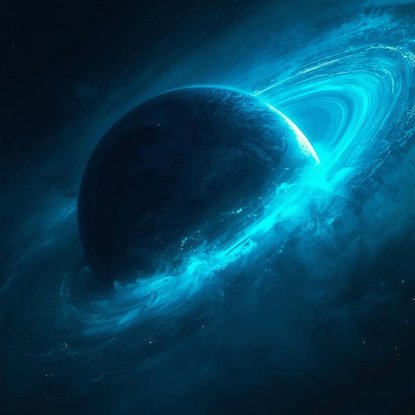
VI. TRITÓN: UN MUNDO HELADO AL REVÉS Y UN OCÉANO SUBTERRÁNEO
Tritón, el satélite más grande de la familia de satélites de Neptuno, es uno de los mundos más enigmáticos del Sistema Solar exterior. Con más del 99,5 % de toda la masa que orbita alrededor de Neptuno, esta gigantesca luna cubierta de hielo es un mundo de condiciones geofísicas extremas, caracterizado por un criovolcanismo activo, una órbita retrógrada y un destino sellado por las fuerzas gravitatorias.
1. Tritón como objeto capturado del cinturón de Kuiper: órbita retrógrada
Con un diámetro de 2.710 kilómetros, Tritón es la séptima luna más grande del Sistema Solar. Sin embargo, sus características orbitales demuestran que no se formó en órbita alrededor de Neptuno.
Órbita retrógrada: Tritón es la única luna grande del Sistema Solar que orbita en una dirección retrógrada—moviéndose en sentido contrario al de la rotación de su planeta principal.
Alta inclinación orbital: Su órbita presenta una inclinación pronunciada de 157 grados respecto al ecuador de Neptuno.
El escenario de la captura: Estas características orbitales son físicamente imposibles para una luna que se formó a partir del disco protoplanetario primigenio de un planeta. En cambio, Tritón era originalmente un sistema binario Objeto del cinturón de Kuiper—un planeta enano similar a Plutón— que se acercó demasiado a Neptuno hace miles de millones de años. La gravedad de Neptuno alteró el sistema binario, expulsando al compañero de Tritón al espacio profundo, al tiempo que capturó a Tritón en una órbita permanente y muy excéntrica que, con el tiempo, se circularizó debido a la fuerza de las mareas.
Destrucción del sistema lunar original: La captura de Tritón alteró violentamente el sistema original de satélites de Neptuno. La fuerza gravitatoria cambiante de Tritón provocó colisiones, expulsiones o la pulverización de la mayoría de las lunas originales de Neptuno, dejando tras de sí una familia de satélites interiores muy mermada.
2. Criovulcanismo activo: géiseres de nitrógeno y polvo
Cuando la Voyager 2 sobrevoló Tritón en 1989, los científicos esperaban encontrar una bola de hielo inerte y llena de cráteres. En cambio, descubrieron uno de los pocos cuerpos geológicamente activos del Sistema Solar.
Géiseres de nitrógeno: La Voyager 2 fotografió un plumas criovolcánicas que brotan de la capa polar sur de Tritón. Estos géiseres lanzan chorros de nitrógeno líquido, metano y polvo carbonoso oscuro hasta 8 kilómetros directamente hacia la atmósfera fina y gélida de Tritón.
Senderos oscuros azotados por el viento: Al alcanzar grandes altitudes, estas columnas oscuras son arrastradas por los vientos predominantes de la atmósfera superior, formando rayas horizontales de hollín que se extienden a lo largo de más de 150 kilómetros a través de los brillantes campos de hielo de nitrógeno.
Calefacción solar y presión del subsuelo: Los géiseres se deben a un efecto invernadero de estado sólido. La luz solar penetra en una capa superior transparente de nitrógeno congelado, calentando los depósitos orgánicos oscuros que se encuentran enterrados debajo. A medida que el hielo de nitrógeno del subsuelo se calienta, se sublima y se convierte en gas a presión, expandiéndose hasta romper de forma explosiva la corteza congelada que lo recubre.
3. “Terreno de melón” y una edad geológica excepcionalmente joven
Tritón ostenta el récord de tener una de las temperaturas superficiales más bajas jamás registradas en el Sistema Solar, que desciende hasta menos 235 grados Celsius (38 kelvin). Sin embargo, su superficie presenta numerosos indicios de una actividad geológica reciente y dinámica.
Terreno del melón cantalupo: Una característica exclusiva de Tritón es que amplias regiones de su hemisferio occidental están cubiertas por una extraña textura conocida como terreno de melón cantalupo. Formado por depresiones circulares entrecruzadas, crestas y montículos bajos, este paisaje se asemeja a la piel de un melón cantalupo. Los científicos atribuyen este relieve al diapirismo: masas de hielo subterráneo más cálido y con mayor flotabilidad que ascienden a través de capas superficiales más densas.
Llanuras y lagos criovolcánicos: Amplias zonas de Tritón presentan cuencas lisas y llanas rodeadas de escarpadas paredes en forma de terrazas. Estas características son antiguas lagos de caldera criovolcánicos, donde se produjeron erupciones de lava compuesta por una mezcla de agua y amoníaco que, al salir a la superficie, se solidificó formando una capa lisa.
Ausencia casi total de cráteres: A pesar de su tamaño, la Voyager 2 cartografió menos de 100 cráteres de impacto en la superficie de Tritón. Esta escasa presencia de cráteres indica que la superficie tiene una edad excepcionalmente joven, inferior a De 10 a 100 millones de años, lo que demuestra que la renovación activa borra constantemente las antiguas marcas de impacto.
Posible océano subterráneo: Es probable que el calentamiento por mareas durante su captura orbital, junto con la desintegración radiactiva y el amoníaco disuelto, que actúa como anticongelante, mantenga una océano global de agua líquida y amoníaco oculta bajo la capa de hielo de Tritón, de 100 kilómetros de espesor.
4. Condenados a la destrucción: el deterioro de la órbita de Tritón
Dado que Tritón orbita alrededor de Neptuno en sentido retrógrado, las interacciones mareales entre la luna y el planeta le están restando constantemente energía orbital.
Desaceleración por las mareas: La gravedad de Tritón provoca un abultamiento de marea en la atmósfera de Neptuno. Dado que Tritón se mueve en sentido contrario al de la rotación del planeta, este abultamiento va detrás de la luna, ejerciendo una resistencia gravitatoria continua que frena a Tritón.
Espiral ascendente: Como consecuencia de esta resistencia, la órbita de Tritón se está acortando gradualmente, lo que hace que la luna se acerque a Neptuno a un ritmo de unos pocos centímetros al año.
Destrucción en un sistema de anillos: En aproximadamente Entre 1.400 y 3.600 millones de años, Tritón cruzará Neptuno’s Límite de Roche—el umbral en el que las fuerzas de marea de Neptuno superan la cohesión gravitatoria interna de Tritón. La luna gigante se desintegrará, creando un colosal y brillante sistema de anillos planetarios mucho más masivo y espectacular que los actuales anillos de Saturno.
5. Pequeñas lunas interiores y satélites irregulares
Más allá de Tritón, Neptuno cuenta con 15 satélites más pequeños, divididos en dos familias distintas:
Lunas internas regulares
Neptuno tiene siete lunas internas pequeñas y oscuras que orbitan en trayectorias circulares y progradas cerca del plano ecuatorial del planeta:
Naiad y Thalassa: Las lunas más cercanas al planeta, que presentan una rara Resonancia orbital 7:3 que los mantiene en una danza orbital que se asemeja a un baile y a una onda.
Despina y Galatea: Pequeños satélites interiores estrechamente vinculados al sistema de anillos de Neptuno (Galatea actúa como luna pastora de los arcos del anillo de Adams).
Larissa e Hippocamp: Cuerpos pequeños e irregulares que orbitan en la zona del anillo interior; Hippocamp fue descubierto por el telescopio espacial Hubble en 2013.
Proteus: Es la mayor de las lunas interiores, con un diámetro de 420 kilómetros. Proteo es un cuerpo con forma de caja y muy craterizado, cuyo tamaño se sitúa justo por debajo del límite necesario para que su gravedad le dé una forma esférica y lisa.
Lunas exteriores irregulares
Situado mucho más allá de Tritón, Neptuno tiene en su órbita un enjambre disperso de ocho lunas exteriores pequeñas e irregulares (como Nereida, Halimede, Sao, Laomedeia y Psamathe). Estos cuerpos siguen trayectorias muy excéntricas, con gran inclinación y predominantemente retrógradas, lo que indica que se trata de antiguos planetesimales capturados del cinturón de Kuiper.
VII. LA EXPLORACIÓN, LA FRONTERA EXTERIOR Y EL FUTURO
El conocimiento directo que tiene la humanidad de Neptuno constituye uno de los capítulos más destacados de la exploración planetaria. Situado en el umbral mismo del espacio interestelar profundo, este mundo azul solo ha sido visitado por una nave espacial en una ocasión, pero sigue siendo fundamental para la astrofísica moderna y la búsqueda de mundos habitables en toda la galaxia.
1. El legado de la Voyager 2 (1989): El encuentro solitario
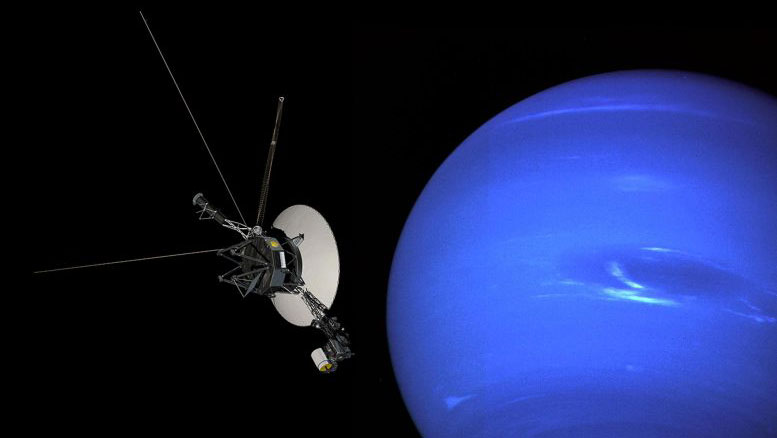
Todo el conjunto de datos directos in situ de que dispone la humanidad sobre el sistema neptuniano procede de un único y histórico sobrevuelo realizado por la NASA Voyager 2 nave espacial en agosto de 1989.
La Gran Vuelta Planetaria: Aprovechando una alineación planetaria excepcional que solo se produce una vez cada 175 años, la Voyager 2 utilizó las asistencias gravitatorias de Júpiter, Saturno y Urano para llegar al último planeta de su viaje.
Momento de máxima aproximación: El 25 de agosto de 1989, la Voyager 2 pasó a solo 4.950 kilómetros por encima del polo norte de Neptuno, lo que supuso su máximo acercamiento a cualquier planeta principal durante toda su misión, que se prolongó durante varias décadas.
Descubrimientos revolucionarios: En cuestión de días, la Voyager 2 transformó nuestra visión de Neptuno. Descubrió seis nuevas lunas interiores (entre ellas, Proteo), confirmó la existencia de cinco anillos planetarios y sus arcos irregulares, midió velocidades de viento superiores a los 2.100 kilómetros por hora, cartografió la Gran Mancha Oscura y descubrió géiseres de nitrógeno activos que entraban en erupción en Tritón.
El mundo final: Tras su sobrevuelo de Tritón, la Voyager 2 se desvió hacia el sur, saliendo del plano de la eclíptica, y emprendió su viaje hacia el espacio interestelar como la única sonda fabricada por el hombre que ha visitado jamás el octavo planeta.
2. Propuestas para misiones de próxima generación: «Neptune Odyssey» y «Trident»
Dado que la Voyager 2 solo proporcionó una breve “instantánea” durante su sobrevuelo, los científicos planetarios llevan mucho tiempo abogando por una misión con un orbitador específico que regrese al sistema de Neptuno.
Neptune Odyssey (concepto de orbitador insignia): Un concepto de misión emblemático estudiado por la NASA, el La odisea de Neptuno prevé un orbitador de larga duración propulsado por generadores termoeléctricos radioisótopos (RTG) de última generación. Diseñada para entrar en órbita alrededor de Neptuno a finales de la década de 2040, pasaría cuatro años cartografiando la atmósfera, la magnetosfera, los arcos de los anillos y las lunas, al tiempo que lanzaría una sonda de entrada atmosférica directamente a las capas de nubes de Neptuno.
Trident (concepto de sobrevuelo de la clase Discovery): Propuesto como una alternativa más económica, el Trident El concepto de la misión tenía como objetivo realizar un sobrevuelo rápido de Neptuno y Tritón. Su objetivo principal era cartografiar el criovolcanismo activo de Tritón, explorar sus hemisferios sur y norte, y medir las señales de inducción magnética para confirmar la presencia de su océano subterráneo.
Lanzamientos en Windows y asistencias gravitatorias: Para llegar a Neptuno en un tiempo de viaje razonable (entre 12 y 16 años) se necesitan vehículos de lanzamiento de gran capacidad, junto con una asistencia gravitatoria fundamental de Júpiter. Los planificadores de la misión están barajando oportunidades de lanzamiento en la década de 2030 para garantizar que Júpiter esté correctamente alineado y pueda impulsar la nave espacial hacia el sistema exterior.
3. Neptuno como análogo clave de los exoplanetas: los mini-Neptunos y las super-Tierras
La exploración de Neptuno es fundamental para comprender el panorama general de los exoplanetas descubiertos por telescopios como el Kepler, el TESS y el James Webb.
Los mundos más comunes de la galaxia: Los estudios sobre exoplanetas revelan que los planetas más abundantes que orbitan alrededor de otras estrellas en la Vía Láctea son cuerpos con masas comprendidas entre la de la Tierra y la de Saturno; concretamente subneptunos (o «mini-Neptunos») y super-Tierras.
El rompecabezas de la diferencia de radios: Los astrónomos observan una brecha clara en los tamaños de los exoplanetas (la “brecha de Fulton”) de entre 1,8 y 2,0 radios terrestres, que separa a las supertierras rocosas de los subneptunos ricos en gas. Comprender cómo Neptuno conservó su densa envoltura, rica en sustancias volátiles como agua, metano e hidrógeno, ayuda a explicar cómo se forman y evolucionan los subneptunos cerca de sus estrellas anfitrionas.
Un laboratorio de verificación sobre el terreno: Dado que los planetas extrasolares de tamaño inferior al de Neptuno se encuentran a años luz de distancia, Neptuno nos sirve de laboratorio local accesible. El estudio de la fotoquímica de su atmósfera, la dinámica térmica interna y los estados supercríticos del manto profundo nos proporciona los modelos de referencia necesarios para descifrar los espectros atmosféricos recopilados en mundos extrasolares lejanos.
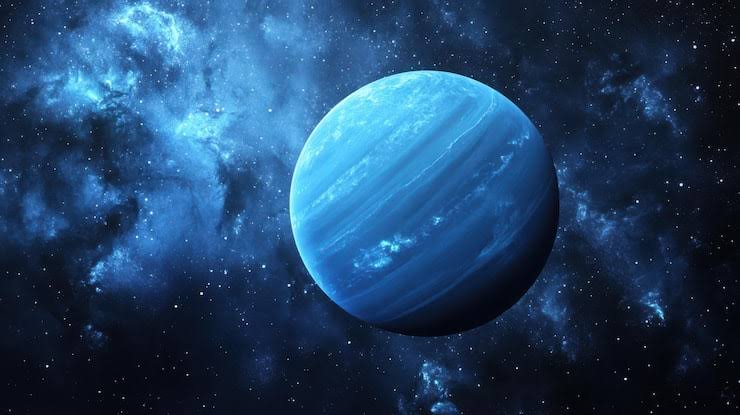
VIII. ANOMALÍAS, HECHOS Y GRANDES CUESTIONES DE LA PLANETOLOGÍA
Neptuno y el sistema de satélites que lo rodea siguen siendo una fuente inagotable de paradojas planetarias. Situado en el límite helado del sistema solar, Neptuno presenta procesos atmosféricos dinámicos, posibles mundos con océanos subterráneos y una mecánica orbital compleja que pone en tela de juicio los modelos clásicos de evolución planetaria.
1. ¿Por qué la dinámica de las nubes de Neptuno es tan extremadamente activa?
Neptuno recibe menos del 0,1 % de la radiación solar que calienta la Tierra. Sin embargo, presenta las condiciones meteorológicas más violentas y energéticas del Sistema Solar, con vientos supersónicos que superan los 2.100 kilómetros por hora.
Motor térmico interno: El principal factor determinante es el potente flujo de calor interno de Neptuno. Neptuno irradia al espacio 2,61 veces más energía térmica de la que recibe del Sol. Esta energía interna genera una intensa convección térmica ascendente, que impulsa los movimientos de los fluidos atmosféricos desde las profundidades del manto hasta las capas superiores de nubes.
Baja fricción atmosférica: En los planetas terrestres como la Tierra, la topografía de la superficie (montañas, cuencas oceánicas) genera una fricción que frena los vientos atmosféricos. Neptuno carece de una superficie sólida, lo que permite que las corrientes en chorro se aceleren con una resistencia mecánica prácticamente nula.
Bajo ruido de fondo solar: En los gigantes gaseosos más cercanos al Sol (como Júpiter), el intenso calentamiento solar calienta la parte superior de las nubes en todas las latitudes, lo que genera interferencias turbulentas que alteran los canales de viento uniformes. En Neptuno, la ausencia de calentamiento solar hace que las corrientes ascendentes térmicas internas se enfrenten a una turbulencia mínima en la atmósfera superior, lo que permite que las corrientes en chorro supersónicas mantengan canales de flujo estables e ininterrumpidos.
2. ¿Podría esconderse bajo Tritón un océano líquido que favoreciera la astrobiología?
Las observaciones de la Voyager 2, junto con los modelos térmicos geofísicos, sugieren que Tritón es uno de los principales candidatos a ser un «mundo oceánico» activo en el sistema solar exterior.
Calentamiento histórico por las mareas: Cuando Neptuno atrajo a Tritón a una órbita retrógrada hace miles de millones de años, la luna sufrió una intensa deformación por fuerzas de marea a medida que su órbita se iba circularizando. Esta fricción por marea generó un enorme calor interno, que derritió gran parte del manto de hielo del interior de Tritón.
Capa anticongelante de amoníaco: El manto de Tritón contiene altas concentraciones de amoníaco mezclado con agua. El amoníaco actúa como un potente anticongelante, reduciendo el punto de congelación del agua líquida hasta aproximadamente menos 90 grados Celsius. Esto permite que una capa líquida se mantenga fluida incluso en las gélidas condiciones del espacio profundo.
Calentamiento del núcleo radiactivo: La desintegración radiactiva de los isótopos en el gran núcleo rocoso de Tritón genera un flujo de calor ascendente continuo. Los modelos sugieren que bajo una capa exterior de hielo de entre 100 y 150 kilómetros de espesor permanece atrapado un océano de agua líquida y amoniaco de entre 100 y 300 kilómetros de profundidad.
Potencial astrobiológico: Si existieran fuentes hidrotermales en el límite donde el océano líquido entra en contacto con el núcleo rocoso de silicatos, estas podrían proporcionar energía térmica y nutrientes químicos (metano, nitrógeno, minerales), creando un entorno capaz de sustentar vida microbiana quimiosintética.
3. Por qué Plutón cruza la órbita de Neptuno y, sin embargo, nunca chocará con él
La órbita altamente excéntrica de Plutón, de 248 años de duración, hace que, durante un periodo de 20 años en cada revolución, se acerque más al Sol que Neptuno (lo último ocurrió entre 1979 y 1999). A pesar de que sus trayectorias orbitales se cruzan en el espacio tridimensional, estos dos mundos nunca entrarán en colisión gracias a dos mecanismos de protección distintos propios de la mecánica celeste:
La resonancia orbital de movimiento medio 3:2: Plutón y Neptuno se encuentran en una resonancia gravitatoria precisa. Por cada tres órbitas que Neptuno completa alrededor del Sol, Plutón completa exactamente dos. Esta sincronización matemática repetitiva garantiza que, cada vez que Plutón alcanza su punto más cercano al Sol (perihelio) —el punto en el que su trayectoria se cruza dentro de la distancia orbital de Neptuno—, Neptuno se encuentre siempre al menos 90 grados por delante o por detrás de Plutón en su órbita.
Separación vertical-orbital-inclinación: La órbita de Plutón presenta una inclinación pronunciada de 17 grados con respecto al plano de la eclíptica, por donde orbitan los planetas principales. En los puntos exactos en los que la trayectoria de Plutón cruza el radio orbital de Neptuno, Plutón se encuentra muy por encima o por debajo del plano de la órbita de Neptuno, lo que garantiza que ambos cuerpos permanezcan separados por cientos de millones de kilómetros en todo momento.
CONCLUSIÓN: LA ÚLTIMA FRONTERA AZUL
Neptuno constituye un extraordinario laboratorio de física situado en el límite exterior de nuestro sistema solar. Desde corrientes en chorro supersónicas y anticiclones oscuros dinámicos hasta las columnas criovolcánicas activas de Tritón y su posible océano subterráneo, el octavo planeta sigue redefiniendo la forma en que evolucionan los planetas gigantes. Como análogo local accesible para los millones de exoplanetas de tamaño inferior al de Neptuno repartidos por toda la galaxia, descifrar la estructura interior de Neptuno, su magnetosfera y la historia de sus satélites sigue siendo una de las fronteras más importantes de la ciencia planetaria moderna.


